Independent Researcher, Washington, DC, UK.
University of Texas, Austin, Texas, USA.
BMJ Glob Health. 2020 Oct;5(10). doi: 10.1136/bmjgh-2020-004222. Epub 2020 Oct 23.
To investigate how health issues affect voting behaviour by considering the COVID-19 pandemic, which offers a unique opportunity to examine this interplay.
We employ a survey experiment in which treatment groups are exposed to key facts about the pandemic, followed by questions intended to elicit attitudes toward the incumbent party and government responsibility for the pandemic.
The survey was conducted amid the lockdown period of 15-26 April 2020 in three large democratic countries with the common governing language of English: India, the United Kingdom and the United States. Due to limitations on travel and recruitment, subjects were recruited through the M-Turk internet platform and the survey was administered entirely online. Respondents numbered 3648.
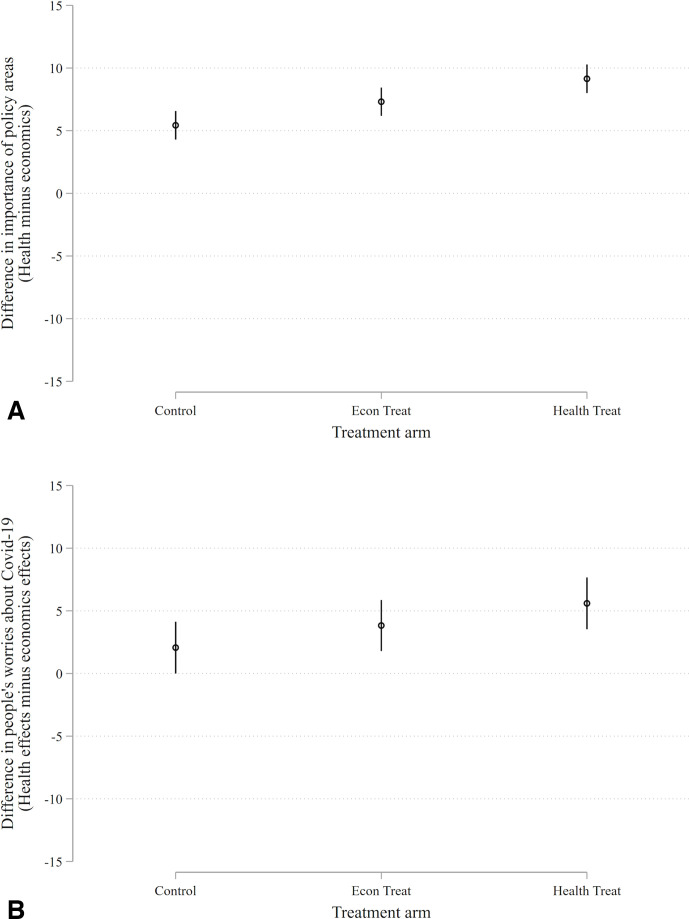
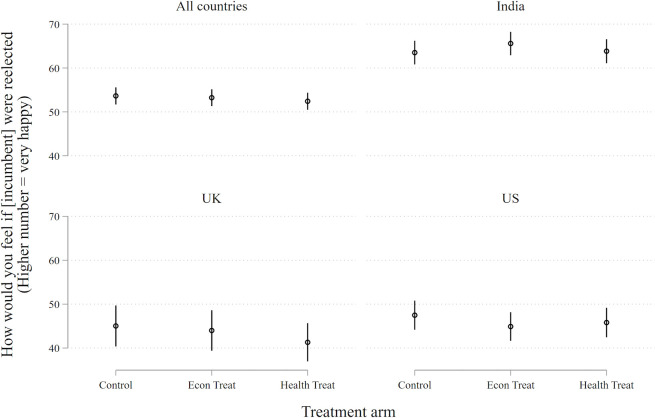
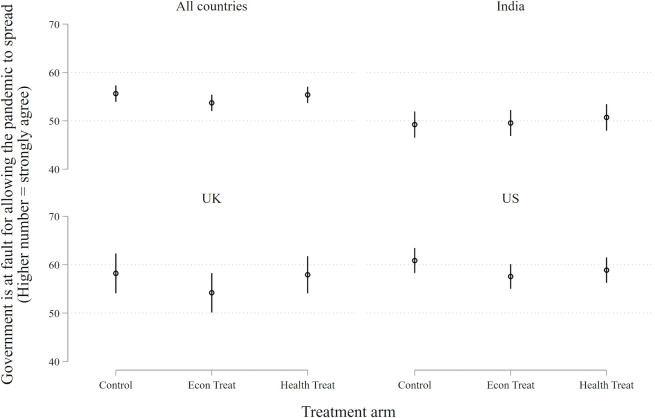
Our expectation was that respondents in the treatment groups would favour, or disfavour, the incumbent and assign blame to government for the pandemic compared with the control group. We observe no such results. Several reasons may be adduced for this null finding. One reason could be that public health is not viewed as a political issue. However, people do think health is an important policy area (>85% agree) and that government has some responsibility for health (>90% agree). Another reason could be that people view public health policies through partisan lenses, which means that health is largely endogenous, and yet we find little evidence of polarisation in our data. Alternatively, it could be that the global nature of the pandemic inoculated politicians from blame and yet a majority of people do think the government is to blame for the spread of the pandemic (~50% agree).
While we cannot precisely determine the mechanisms at work, the null findings contained in this study suggest that politicians are unlikely to be punished or rewarded for their failures or successes in managing COVID-19 in the next election.
Initial research hypotheses centred on expected variation between two treatments, as set forth in a detailed pre-analysis plan, registered at E-Gap: http://egap.org/registration/6645. Finding no difference between the treatments, we decided to focus this paper on the treatment/control comparison. Importantly, results that follow the pre-analysis plan strictly are entirely consistent with results presented here: null findings obtained throughout.
通过考虑 COVID-19 大流行来研究健康问题如何影响投票行为,这为研究这种相互作用提供了一个独特的机会。
我们采用调查实验,其中实验组接触有关大流行的关键事实,然后提出问题,旨在引出对现任政党和政府对大流行责任的态度。
该调查于 2020 年 4 月 15 日至 26 日在三个以英语为共同官方语言的大型民主国家中进行:印度、英国和美国。由于旅行和招募的限制,通过 M-Turk 互联网平台招募了研究对象,并且完全在线进行了调查。受访者人数为 3648 人。
我们预计实验组的受访者会对现任政府表示支持或反对,并将大流行归咎于政府,而对照组则不会。我们没有观察到这样的结果。可能有几个原因导致这一无效结果。一个原因可能是公共卫生不被视为政治问题。然而,人们确实认为健康是一个重要的政策领域(超过 85%的人同意),政府对健康负有一定的责任(超过 90%的人同意)。另一个原因可能是人们通过党派视角来看待公共卫生政策,这意味着健康在很大程度上是内在的,但我们在数据中几乎没有发现两极分化的证据。或者,可能是大流行的全球性使政客免受指责,但大多数人确实认为政府应对大流行的传播负责(约 50%的人同意)。
虽然我们不能准确确定起作用的机制,但本研究中的无效结果表明,政客们不太可能因其在管理 COVID-19 方面的失败或成功而在下一次选举中受到惩罚或奖励。
最初的研究假设集中在两个治疗组之间的预期差异上,这是在详细的预分析计划中提出的,在 E-Gap 上注册:http://egap.org/registration/6645.在治疗组之间没有发现差异后,我们决定将本文的重点放在治疗/对照组比较上。重要的是,严格遵循预分析计划的结果与本文提出的结果完全一致:得到的都是无效结果。