Oehmke James Francis, Moss Charles B, Singh Lauren Nadya, Oehmke Theresa Bristol, Post Lori Ann
Buehler Center for Health Policy and Economics, Feinberg School of Medicine, Northwestern University, Chicago, IL, United States.
Food and Resource Economics Department, University of Florida, Gainesville, FL, United States.
J Med Internet Res. 2020 Oct 5;22(10):e21955. doi: 10.2196/21955.
The Great COVID-19 Shutdown aimed to eliminate or slow the spread of SARS-CoV-2, the virus that causes COVID-19. The United States has no national policy, leaving states to independently implement public health guidelines that are predicated on a sustained decline in COVID-19 cases. Operationalization of "sustained decline" varies by state and county. Existing models of COVID-19 transmission rely on parameters such as case estimates or R and are dependent on intensive data collection efforts. Static statistical models do not capture all of the relevant dynamics required to measure sustained declines. Moreover, existing COVID-19 models use data that are subject to significant measurement error and contamination.
This study will generate novel metrics of speed, acceleration, jerk, and 7-day lag in the speed of COVID-19 transmission using state government tallies of SARS-CoV-2 infections, including state-level dynamics of SARS-CoV-2 infections. This study provides the prototype for a global surveillance system to inform public health practice, including novel standardized metrics of COVID-19 transmission, for use in combination with traditional surveillance tools.
Dynamic panel data models were estimated with the Arellano-Bond estimator using the generalized method of moments. This statistical technique allows for the control of a variety of deficiencies in the existing data. Tests of the validity of the model and statistical techniques were applied.
The statistical approach was validated based on the regression results, which determined recent changes in the pattern of infection. During the weeks of August 17-23 and August 24-30, 2020, there were substantial regional differences in the evolution of the US pandemic. Census regions 1 and 2 were relatively quiet with a small but significant persistence effect that remained relatively unchanged from the prior 2 weeks. Census region 3 was sensitive to the number of tests administered, with a high constant rate of cases. A weekly special analysis showed that these results were driven by states with a high number of positive test reports from universities. Census region 4 had a high constant number of cases and a significantly increased persistence effect during the week of August 24-30. This change represents an increase in the transmission model R value for that week and is consistent with a re-emergence of the pandemic.
Reopening the United States comes with three certainties: (1) the "social" end of the pandemic and reopening are going to occur before the "medical" end even while the pandemic is growing. We need improved standardized surveillance techniques to inform leaders when it is safe to open sections of the country; (2) varying public health policies and guidelines unnecessarily result in varying degrees of transmission and outbreaks; and (3) even those states most successful in containing the pandemic continue to see a small but constant stream of new cases daily.
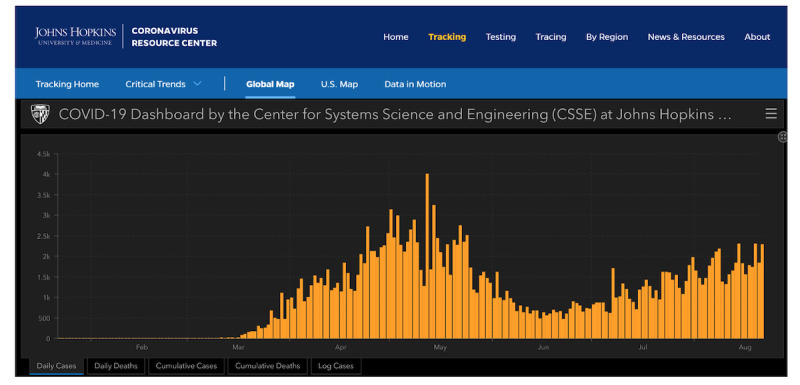
“新冠大封锁”旨在消除或减缓严重急性呼吸综合征冠状病毒2(SARS-CoV-2,即导致新冠疫情的病毒)的传播。美国没有全国性政策,各州只能自行实施基于新冠病例持续下降的公共卫生指南。“持续下降”的实施方式因州和县而异。现有的新冠病毒传播模型依赖于病例估计或R值等参数,且依赖大量的数据收集工作。静态统计模型无法捕捉衡量持续下降所需的所有相关动态。此外,现有的新冠模型使用的数据存在重大测量误差和干扰。
本研究将利用州政府统计的SARS-CoV-2感染数据,生成新冠病毒传播速度、加速度、急动度和速度的7天滞后的新指标,包括SARS-CoV-2感染的州级动态。本研究为全球监测系统提供了原型,以指导公共卫生实践,包括新冠病毒传播的新标准化指标,以便与传统监测工具结合使用。
使用广义矩估计法的阿雷利亚诺-邦德估计器对动态面板数据模型进行估计。这种统计技术可以控制现有数据中的各种缺陷。对模型和统计技术的有效性进行了检验。
基于回归结果验证了统计方法,该结果确定了感染模式的近期变化。在2020年8月17日至23日以及8月24日至30日这几周,美国疫情的演变存在显著的地区差异。人口普查区1和2相对平静,存在较小但显著的持续效应,与前两周相比相对不变。人口普查区3对检测数量敏感,病例持续率较高。每周的专项分析表明,这些结果是由大学阳性检测报告数量较多的州推动的。人口普查区4的病例数持续较高,在8月24日至30日当周持续效应显著增加。这一变化代表该周传播模型R值的增加,与疫情再次出现一致。
美国重新开放带来三个必然结果:(1)即使疫情仍在蔓延,疫情的“社会”终结和重新开放也将在“医学”终结之前发生。我们需要改进标准化监测技术,以便在国家部分地区安全开放时为领导人提供信息;(2)不同的公共卫生政策和指南不必要地导致了不同程度的传播和疫情爆发;(3)即使是那些在控制疫情方面最成功的州,每天仍会出现少量但持续的新病例。
