Wahby Sarah, Jarczyk Jonas, Fierek Alexander, Heinkele Jakob, Weis Cleo-Aron, Eckstein Markus, Martini Thomas, Porubsky Stefan, Hafner Mathias, Erben Philipp
Department of Urology and Urosurgery, Medical Faculty Mannheim, University of Heidelberg, Theodor-Kutzer-Ufer 1-3, 68167 Mannheim, Germany.
Department of Urology and Urosurgery, Medical Faculty Mannheim, University of Heidelberg, Theodor-Kutzer-Ufer 1-3, 68167 Mannheim, Germany.
Transl Oncol. 2021 Jan;14(1):100900. doi: 10.1016/j.tranon.2020.100900. Epub 2020 Oct 21.
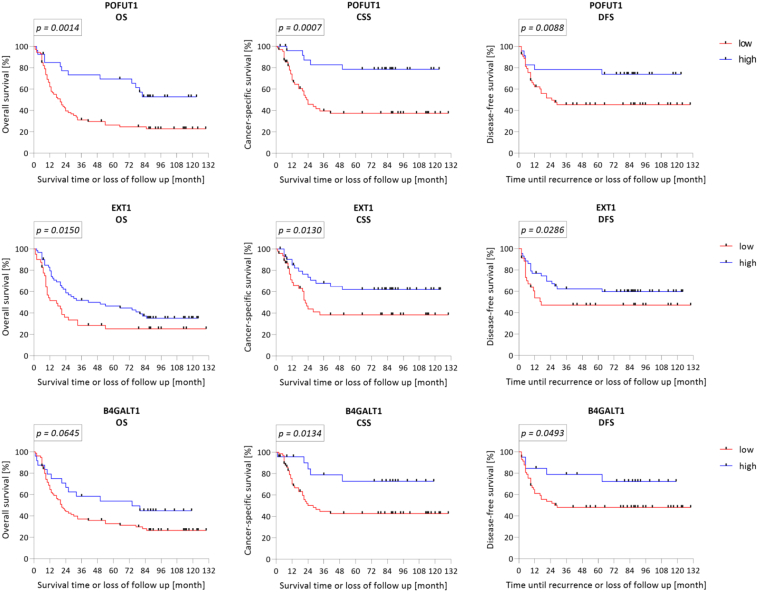
Muscle-invasive bladder cancer (MIBC) is characterized by high recurrence and rapid progression. Progression is linked to changes in glycan structures and altered levels of glycosyltransferases. The relationship of mRNA expression by glycosyltransferase genes B4GALT1, EXT1, MGAT5B, and POFUT1 to the probability of surviving MIBC after radical cystectomy has not yet been investigated. mRNA expression was analyzed using qRT-PCR in formalin-fixed and paraffin-embedded tumor samples (n = 105; 74% male patients and 26% female patients; median age = 72 years), correlated with histopathological variables, and evaluated by means of multivariable Cox regression analysis regarding to overall survival (OS), cancer-specific survival (CSS), and disease-free survival (DFS). Multivariable Cox regression analysis identified POFUT1 mRNA expression as superior prognostic marker, compared with currently used histological tumor stage methods, for CSS by MIBC patients following radical cystectomy. Thus, the patients with low POFUT1 mRNA were at a 4.9-fold greater risk for cancer-specific death according to the multivariable analysis (p = 0.0001). Low mRNA levels predicted poor survival according to the Kaplan-Meier analysis ((POFUT1:OS p = 0.0014; CSS p = 0.0007; DFS p = 0.0088); (EXT1:OS p = 0.0150; CSS p = 0.0130; DFS p = 0.0286); (B4GALT1:CSS p = 0.0134; DFS p = 0.0493)). A subgroup analysis of patients without lymph node metastasis (pN-; n = 73) indicated that low expression of POFUT1 predicted reduced OS (p = 0.0073), CSS (p = 0.0058,) and DSS (p = 0.0079). Low levels of POFUT1 mRNA are an independent prognostic indicator for OS and CSS in MIBC patients following radical cystectomy. This finding demonstrates the importance of altered glycosylation for the progress of MIBC.
肌层浸润性膀胱癌(MIBC)的特点是高复发率和快速进展。进展与聚糖结构的变化和糖基转移酶水平的改变有关。糖基转移酶基因B4GALT1、EXT1、MGAT5B和POFUT1的mRNA表达与根治性膀胱切除术后MIBC患者的生存概率之间的关系尚未得到研究。使用qRT-PCR分析福尔马林固定石蜡包埋肿瘤样本(n = 105;74%为男性患者,26%为女性患者;中位年龄 = 72岁)中的mRNA表达,将其与组织病理学变量相关联,并通过多变量Cox回归分析评估总生存期(OS)、癌症特异性生存期(CSS)和无病生存期(DFS)。多变量Cox回归分析确定,与目前使用的组织学肿瘤分期方法相比,POFUT1 mRNA表达是根治性膀胱切除术后MIBC患者CSS的更好的预后标志物。因此,根据多变量分析,POFUT1 mRNA水平低的患者癌症特异性死亡风险高4.9倍(p = 0.0001)。根据Kaplan-Meier分析,低mRNA水平预示着生存不良((POFUT1:OS p = 0.0014;CSS p = 0.0007;DFS p = 0.0088);(EXT1:OS p = 0.0150;CSS p = 0.0130;DFS p = 0.0286);(B4GALT1:CSS p = 0.0134;DFS p = 0.0493))。对无淋巴结转移患者(pN-;n = 73)的亚组分析表明,POFUT1低表达预示着OS(p = 0.0073)、CSS(p = 0.0058)和DSS(p = 0.0079)降低。POFUT1 mRNA低水平是根治性膀胱切除术后MIBC患者OS和CSS的独立预后指标。这一发现证明了糖基化改变对MIBC进展的重要性。