Faculty of Psychology, Department of Cognition, Emotion, and Methods in Psychology, University of Vienna, Vienna, Austria.
Department of Psychology, McGill University, Montreal, Quebec, Canada.
Br J Health Psychol. 2021 May;26(2):553-569. doi: 10.1111/bjhp.12485. Epub 2020 Oct 25.
Social connections are crucial for our health and well-being. This is especially true during times of high uncertainty and distress, such as during the COVID-19 lockdown. This period was characterized by unprecedented physical distancing (often communicated as social distancing) measures resulting in significant changes to people's usual social lives. Given the potential effects of this disruption on people's well-being, it is crucial to identify factors which are associated with negative health outcomes, and conversely, those that promote resilience during times of adversity.
We examined the relationship between individuals' levels of social connectedness during lockdown and self-reported stress, worry, and fatigue.
Survey data were collected from 981 individuals in a representative sample of Austrian citizens. Data collection occurred during the last week of a six-week nationwide lockdown due to the COVID-19 pandemic. The final sample consisted of 902 participants. Participants were asked to complete validated questionnaires to assess levels of social connectedness as well as measures of perceived stress, worry-both general and COVID-19 specific-and symptoms of fatigue during the previous two weeks.
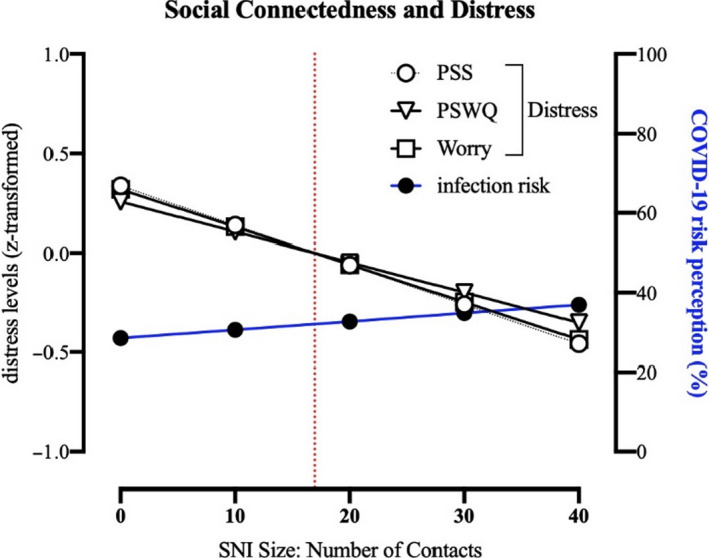
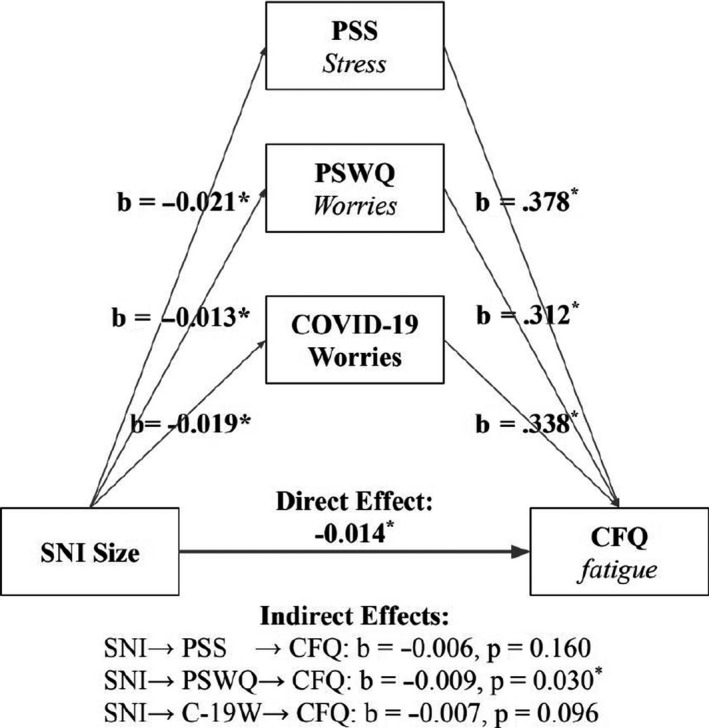
Our results demonstrate that greater social connectedness during the lockdown period was associated with lower levels of perceived stress, as well as general and COVID-19-specific worries. Furthermore, we found a negative relationship between fatigue and social connectedness, which was mediated by feelings of stress, general worries, and COVID-19-specific worries-respectively, indicating that individuals with smaller network sizes, who were highly distressed during the pandemic, were also likely to report feeling more fatigued.
Our findings highlight the important role that social connections play in promoting resilience by buffering against negative physical and mental health outcomes, particularly in times of adversity in times of adversity.
社会联系对我们的健康和幸福至关重要。在高不确定性和压力时期尤其如此,例如在 COVID-19 封锁期间。这一时期的特点是前所未有的身体距离(通常传达为社交距离)措施,导致人们的日常生活发生重大变化。鉴于这种干扰对人们幸福感的潜在影响,确定与负面健康结果相关的因素,以及相反,在逆境中促进韧性的因素至关重要。
我们研究了封锁期间个人社会联系水平与自我报告的压力、担忧和疲劳之间的关系。
从奥地利公民的代表性样本中收集了 981 个人的调查数据。数据收集是在 COVID-19 大流行期间为期六周的全国封锁的最后一周进行的。最终样本包括 902 名参与者。要求参与者完成经过验证的问卷,以评估封锁期间的社会联系水平以及感知压力、一般和 COVID-19 特定的担忧以及前两周的疲劳症状。
我们的结果表明,封锁期间更大的社会联系与较低的感知压力水平以及一般和 COVID-19 特定的担忧有关。此外,我们发现疲劳与社会联系之间存在负相关关系,这种关系分别通过压力、一般担忧和 COVID-19 特定担忧来介导,这表明网络规模较小的个体在大流行期间感到高度困扰,也可能报告感到更加疲劳。
我们的发现强调了社会联系通过缓冲负面身心健康结果,特别是在逆境中促进韧性的重要作用。