Department of Sport Science and Physical Education, Faculty of Health and Sport Science, University of Agder, Kristiansand, Norway.
Department of Medicine, Endocrinology, Herlev University Hospital, Copenhagen, Denmark.
Front Endocrinol (Lausanne). 2020 Sep 25;11:512365. doi: 10.3389/fendo.2020.512365. eCollection 2020.
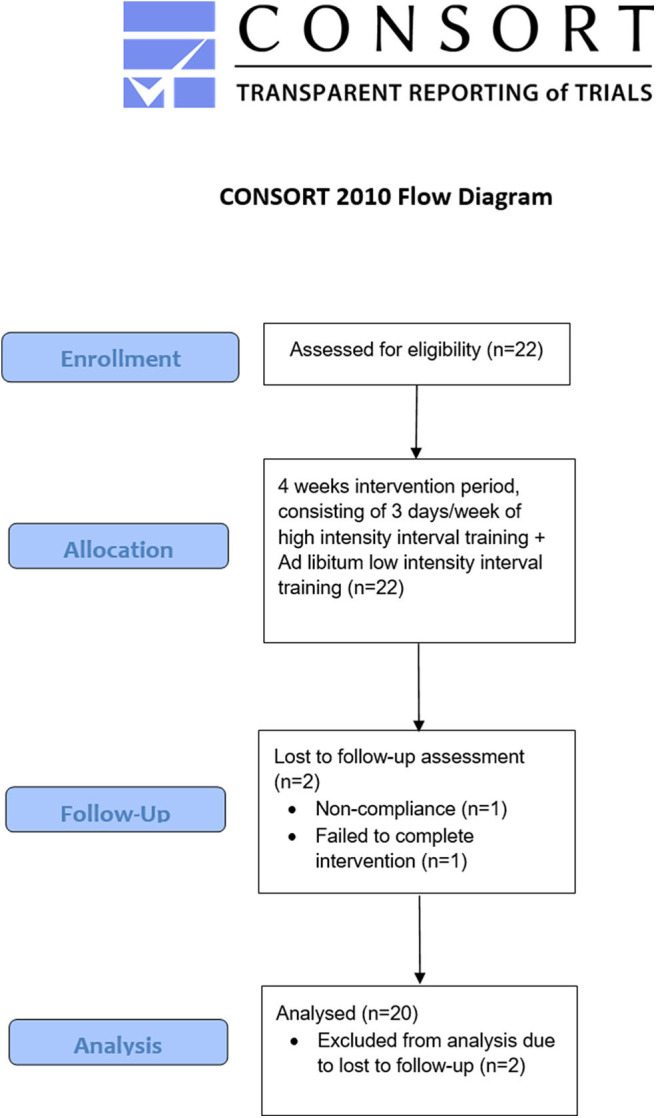
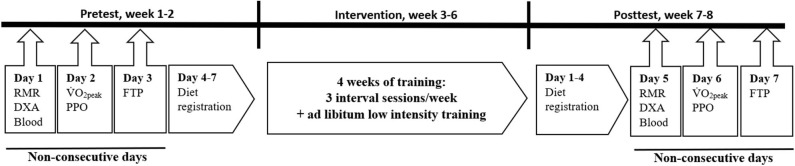
Cyclists often apply block periodization to high training volumes in meso- and macrocycles to optimize training adaptation and to prepare for competition. Body mass influences performance in many sports, including endurance disciplines, and conditions related to the syndrome Relative Energy Deficiency in Sports (RED-S) such as metabolic adaptations and premature osteoporosis have also been reported in male cyclists. This study aimed to determine how a 4-week mesocycle of intensified endurance training designed to increase performance, would affect markers of RED-S in well-trained male cyclists. Twenty-two participants (age: 33.5 ± 6.6 years, height: 181.4 ± 5.2 cm, weight: 76.5 ± 7.4 kg, peak oxygen uptake (VO): 63.5 ± 6.6 mL·kg·min) were recruited and instructed to maintain their background training load and to follow a supervised training protocol consisting of three high-intensity interval training sessions per week with a work duration of 32 min per session. Protocols included pre- and postintervention assessment of resting metabolic rate (RMR) using a ventilated hood, body composition and bone health by dual-energy X-ray absorptiometry (DXA), blood samples, energy intake, and aerobic performance. The interval training increased participants' aerobic performance-peak power output [4.8%, < 0.001], VO [2.4%, = 0.005], and functional threshold power [6.5%, < 0.001] as well as total testosterone levels [8.1%, = 0.011]-while no changes were observed in free testosterone [4.1%, = 0.326]. Bodyweight, body composition, and energy intake were unchanged from pre- to post-test. Triiodothyronine (T) [4.8%, = 0.008], absolute RMR [3.0%, = 0.010], relative RMR [2.6%, = 0.013], and RMR [3.3%, = 0.011] decreased, and cortisol levels increased [12.9%, = 0.021], while no change were observed in the total testosterone:cortisol ratio [1.6%, = 0.789] or the free testosterone:cortisol (fT:cor) ratio [3.2%, = 0.556]. A subgroup analysis of the five participants with the largest increase in fT:cor ratio, revealed a greater improvement in functional threshold power (9.5 vs. 2.5%, = 0.037), and higher relative RMR (0.6 vs. -4.2% = 0.039, respectively). In conclusion, 4 weeks of intensified endurance interval training increased the athletes' aerobic performance and testosterone levels. However, negative changes in markers related to RED-S, such as a reduction in RMR and T, and an increase in cortisol were observed. These results indicate the complexity involved, and that male athletes are at risk of developing clinical indications of RED-S even during a short 4-week endurance training mesocycle.
自行车运动员通常在中周期和大周期内采用块状周期化来增加高训练量,以优化训练适应并为比赛做准备。体重会影响许多运动项目的表现,包括耐力项目,而且与运动相关的能量不足综合征(RED-S)相关的条件,如代谢适应和过早骨质疏松,也在男性自行车运动员中报道过。本研究旨在确定 4 周的强化耐力训练中周期如何提高表现,会如何影响训练有素的男性自行车运动员的 RED-S 标志物。招募了 22 名参与者(年龄:33.5 ± 6.6 岁,身高:181.4 ± 5.2 厘米,体重:76.5 ± 7.4 公斤,峰值摄氧量(VO):63.5 ± 6.6 毫升·公斤·分钟),并指导他们保持背景训练负荷,并遵循监督训练方案,每周进行三次高强度间歇训练,每次训练持续 32 分钟。方案包括干预前后使用通风罩评估静息代谢率(RMR)、双能 X 射线吸收法(DXA)评估身体成分和骨骼健康、血液样本、能量摄入和有氧表现。间歇训练提高了参与者的有氧表现-峰值功率输出[4.8%, < 0.001]、VO[2.4%, = 0.005]和功能阈值功率[6.5%, < 0.001]以及总睾酮水平[8.1%, = 0.011],而游离睾酮没有变化[4.1%, = 0.326]。体重、身体成分和能量摄入在测试前后没有变化。三碘甲状腺原氨酸(T)[4.8%, = 0.008]、绝对 RMR[3.0%, = 0.010]、相对 RMR[2.6%, = 0.013]和 RMR[3.3%, = 0.011]下降,皮质醇水平升高[12.9%, = 0.021],而总睾酮:皮质醇比值[1.6%, = 0.789]或游离睾酮:皮质醇(fT:cor)比值[3.2%, = 0.556]没有变化。对 fT:cor 比值增加最大的 5 名参与者进行亚组分析,发现功能阈值功率有更大的改善(9.5% vs. 2.5%, = 0.037),相对 RMR 更高(0.6% vs. -4.2%, = 0.039)。总之,4 周的强化耐力间歇训练提高了运动员的有氧表现和睾酮水平。然而,观察到与 RED-S 相关的标志物出现了负面变化,例如 RMR 和 T 降低,皮质醇升高。这些结果表明涉及到的复杂性,男性运动员即使在短时间的 4 周耐力训练中周期也有发展 RED-S 临床指征的风险。