Miralles-Amorós Laura, Asencio-Mas Nuria, Martínez-Olcina María, Vicente-Martínez Manuel, Frutos José Manuel García-De, Peñaranda-Moraga Marcelo, Gonzálvez-Alvarado Lucía, Yáñez-Sepúlveda Rodrigo, Cortés-Roco Guillermo, Martínez-Rodríguez Alejandro
Department of Analytical Chemistry, Nutrition and Food Science, University of Alicante, 03690 Alicante, Spain.
Faculty of Health Science, Miguel de Cervantes European University, 47012 Valladolid, Spain.
Metabolites. 2023 Jan 23;13(2):168. doi: 10.3390/metabo13020168.
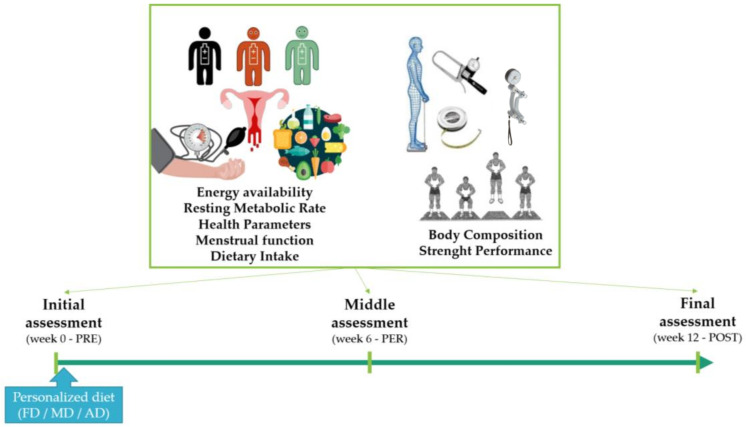
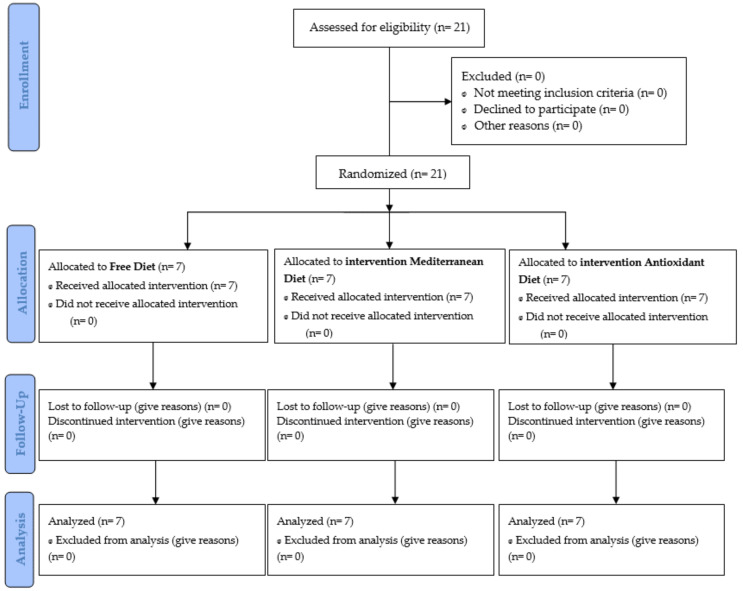
Energy deficits are often observed in athletes, especially in female athletes, due to the high expenditure of sport and strict diets. Low energy availability can cause serious health problems and affect sport performance. The aim of this study was to evaluate the effects of different personalized dietary plans on physiological and physical factors related to energy deficit syndrome in female professional handball players. Twenty-one professional female handball players, aged 22 ± 4 years, 172.0 ± 5.4 cm and 68.4 ± 6.7 kg, divided into three groups (FD: free diet; MD: Mediterranean diet; and AD: high antioxidant diet), participated in this 12-week randomized controlled trial. Energy expenditure through indirect calorimetry, energy availability, 7 day dietary intake analysis, blood pressure, cholesterol, menstrual function, body composition by both anthropometry and bioelectrical impedance, and strength performance were assessed. All participants showed low energy availability (<30 kcal/lean mass per day); despite this, all had eumenorrhea. Significant improvements were found after the intervention in all components of body composition ( < 0.05). In the remaining variables, despite slight improvements, none were significant neither over time nor between the different groups. Low energy availability has been observed in all professional female handball players, which may lead to serious consequences. A longer period of intervention is required to assess the differences between diets and improvements in other parameters.
由于运动消耗大且饮食严格,运动员尤其是女性运动员常出现能量不足的情况。能量摄入不足会引发严重的健康问题并影响运动表现。本研究旨在评估不同个性化饮食计划对职业女子手球运动员与能量缺乏综合征相关的生理和身体因素的影响。21名年龄在22±4岁、身高172.0±5.4厘米、体重68.4±6.7千克的职业女子手球运动员被分为三组(FD:自由饮食组;MD:地中海饮食组;AD:高抗氧化剂饮食组),参与了这项为期12周的随机对照试验。通过间接测热法评估能量消耗、能量摄入、7天饮食摄入量分析、血压、胆固醇、月经功能、通过人体测量学和生物电阻抗法评估身体成分以及力量表现。所有参与者均表现出能量摄入不足(每天每瘦体重<30千卡);尽管如此,所有人月经周期正常。干预后身体成分的所有组成部分均有显著改善(<0.05)。在其余变量中,尽管有轻微改善,但无论是随时间变化还是在不同组之间,均无显著差异。所有职业女子手球运动员均存在能量摄入不足的情况,这可能会导致严重后果。需要更长时间的干预来评估不同饮食之间的差异以及其他参数的改善情况。