Fondazione Policlinico Universitario "A. Gemelli" -Istituti di Ricovero e Cura a Carattere Scientifico, Rome, Italy.
Istituto di Patologia Generale, Università Cattolica del Sacro Cuore Rome, Rome, Italy.
Front Immunol. 2020 Sep 30;11:565631. doi: 10.3389/fimmu.2020.565631. eCollection 2020.
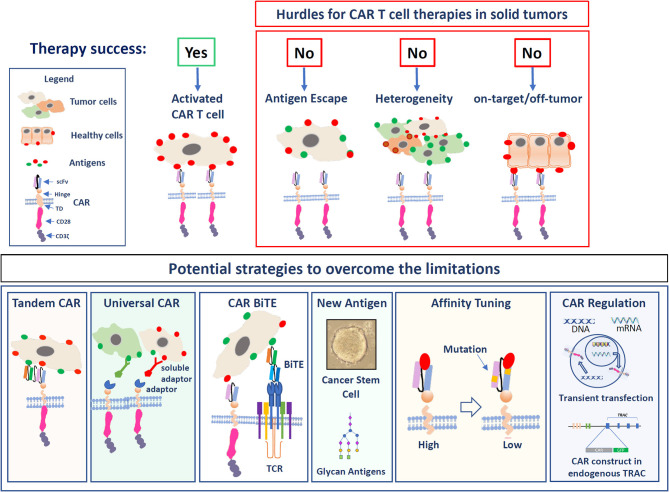
The chimeric antigen receptor (CAR) is an artificial molecule engineered to induce cytolytic T cell reactions in tumors. Generally, this molecule combines an extracellular single-chain variable fragment (scFv) able to recognize tumor-associated epitopes together with the intracellular signaling domains that are required for T cell activation. When expressed by T cells, the CAR enables the recognition and subsequent destruction of cancer cells expressing the complementary antigen on their surface. Although the clinical application for CAR T cells is currently limited to some hematological malignancies, researchers are trying to develop CAR T cell-based therapies for the treatment of solid tumors. However, while in the case of CD19, or other targets restricted to the hematopoietic compartment, the toxicity is limited and manageable, the scarcity of specific antigens expressed by solid tumors and not by healthy cells from vital organs makes the clinical development of CAR T cells in this context particularly challenging. Here we summarize relevant research and clinical trials conducted to redirect CAR T cells to surface antigens in solid tumors and cancer stem cells with a focus on colorectal cancer and glioblastoma. Finally, we will discuss current knowledge of altered glycosylation of CSCs and cancer cells and how these novel epitopes may help to target CAR T cell-based immunotherapy in the future.
嵌合抗原受体(CAR)是一种人工分子,经过设计可在肿瘤中诱导细胞毒性 T 细胞反应。通常,这种分子将能够识别肿瘤相关表位的胞外单链可变片段(scFv)与 T 细胞激活所需的细胞内信号结构域结合在一起。当 T 细胞表达 CAR 时,它能够识别并随后破坏表面表达互补抗原的癌细胞。尽管 CAR T 细胞的临床应用目前仅限于某些血液恶性肿瘤,但研究人员正在尝试开发基于 CAR T 细胞的疗法来治疗实体瘤。然而,在针对 CD19 或其他仅限于造血部位的靶点的情况下,毒性是有限且可控制的,而实体瘤表达的特异性抗原稀缺,且与来自重要器官的健康细胞不同,这使得 CAR T 细胞在这种情况下的临床开发特别具有挑战性。在这里,我们总结了针对实体瘤表面抗原和癌症干细胞的 CAR T 细胞重定向的相关研究和临床试验,重点介绍结直肠癌和胶质母细胞瘤。最后,我们将讨论 CSCs 和癌细胞中糖基化改变的当前知识,以及这些新表位如何帮助未来针对 CAR T 细胞的免疫治疗。