Ahmed Md Shakil, Yesmin Mahbuba, Jeba Farah, Hoque Md Sirajul, Jamee Ahsan Rahman, Salam Abdus
Department of Chemistry, Faculty of Science, University of Dhaka, Dhaka 1000, Bangladesh.
Department of Medicine, Enam Medical College & Hospital, Savar Dhaka, Bangladesh.
Toxicol Rep. 2020 Oct 9;7:1373-1380. doi: 10.1016/j.toxrep.2020.10.003. eCollection 2020.
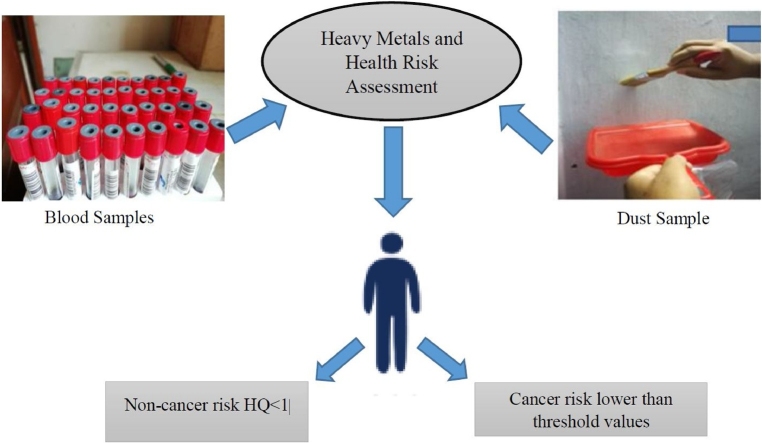
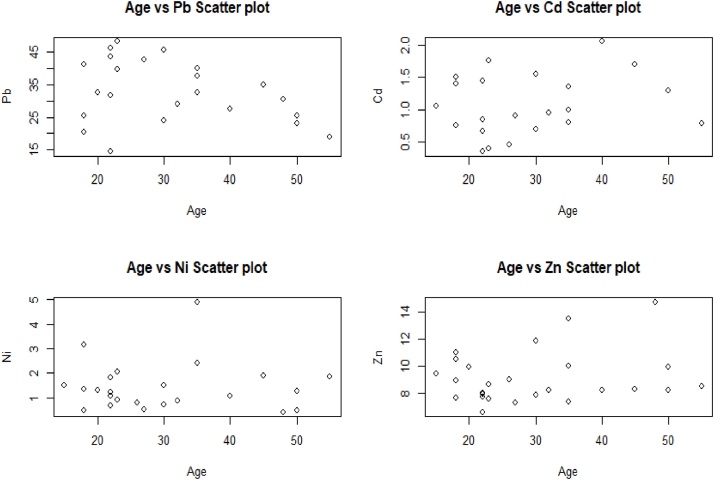
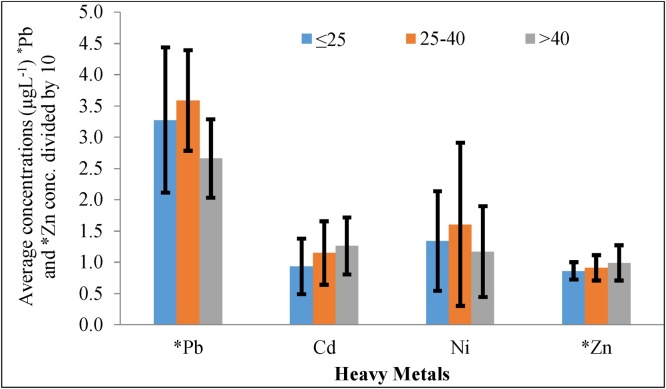
To assess the potential health risk caused by heavy metals twenty-six blood samples were collected from plastic industry workers based on ages and smoking status in Dhaka, Bangladesh. Heavy metals were analyzed with an atomic absorption spectrometer. The mean concentrations of Lead (Pb), Cadmium (Cd), Nickel (Ni), and Zinc (Zn) found in blood samples of the exposed workers were 32.78 ± 9.47, 1.08 ± 0.47, 1.42 ± 1.01, and 9.08 ± 1.95 μgL, respectively. The average heavy metal concentrations in blood samples of smoking workers show a narrow range of fluctuation than that of non-smoking workers. A review of different age groups of industry workers shows the workers between the ages of 26 and 40 are more likely to contaminated with Pb (35.90 ± 8.06 μgL) and Ni (1.61 ± 1.31 μgL). The higher level of Cd (1.26 ± 0.46 μgL) and Zn (9.91 ± 2.80 μgL) was found in >40 years old workers. The mean concentration in indoor dust samples of different industrial subsections reported as 40.27 ± 10.33, 3.24 ± 0.83, 18.08 ± 3.61, and 103.64 ± 8.16 mg kg for Pb, Cd, Ni, and Zn, respectively. Exposed workers have relatively less critical health implications concluded from the average daily intake (ADI), hazard quotient (HQs), and hazard index (HI) values. The HI values of Pb, Cd, Ni, and Zn were reported as 2.0 × 10, 4.64 × 10, 1.62 × 10, and 5.49 × 10, respectively, which have imparted minimal risks (as HI < 1) to the health of the workers. The cancer risks of Pb, Cd, and Ni were reported as 1.46 × 10, 1.77 × 10, and 1.31 × 10, respectively lower than the threshold values. Therefore, the result divulged a potentially lower cancer risk compared to EPA limit value of 1 × 10 to 1 × 10 for exposed industrial workers.
为评估重金属造成的潜在健康风险,从孟加拉国达卡的塑料行业工人中,根据年龄和吸烟状况采集了26份血样。使用原子吸收光谱仪对重金属进行分析。在接触工人的血样中发现的铅(Pb)、镉(Cd)、镍(Ni)和锌(Zn)的平均浓度分别为32.78±9.47、1.08±0.47、1.42±1.01和9.08±1.95μg/L。吸烟工人血样中的重金属平均浓度波动范围比不吸烟工人的窄。对不同年龄组的行业工人进行的一项调查显示,年龄在26至40岁之间的工人更容易受到铅(35.90±8.06μg/L)和镍(1.61±1.31μg/L)的污染。在40岁以上的工人中发现了较高水平的镉(1.26±0.46μg/L)和锌(9.91±2.80μg/L)。不同工业部门室内灰尘样本中铅、镉、镍和锌的平均浓度分别报告为40.27±10.33、3.24±0.83、18.08±3.61和103.64±8.16mg/kg。从平均每日摄入量(ADI)、危险商数(HQs)和危险指数(HI)值来看,接触工人的健康影响相对较小。铅、镉、镍和锌的HI值分别报告为2.0×10、4.64×10、1.62×10和5.49×10,对工人健康造成的风险极小(因为HI<1)。铅、镉和镍的癌症风险分别报告为1.46×10、1.77×10和1.31×10,均低于阈值。因此,与美国环境保护局(EPA)对接触工业工人规定的1×10至1×10的限值相比,结果显示潜在的癌症风险较低。