Institute of Pharmaceutical Sciences, Federal University of Alagoas, Maceió, Brazil.
Department of Clinical and Toxicological Analyses, Faculty of Pharmaceutical Sciences, University of São Paulo, São Paulo, Brazil.
Front Public Health. 2020 Sep 24;8:518. doi: 10.3389/fpubh.2020.00518. eCollection 2020.
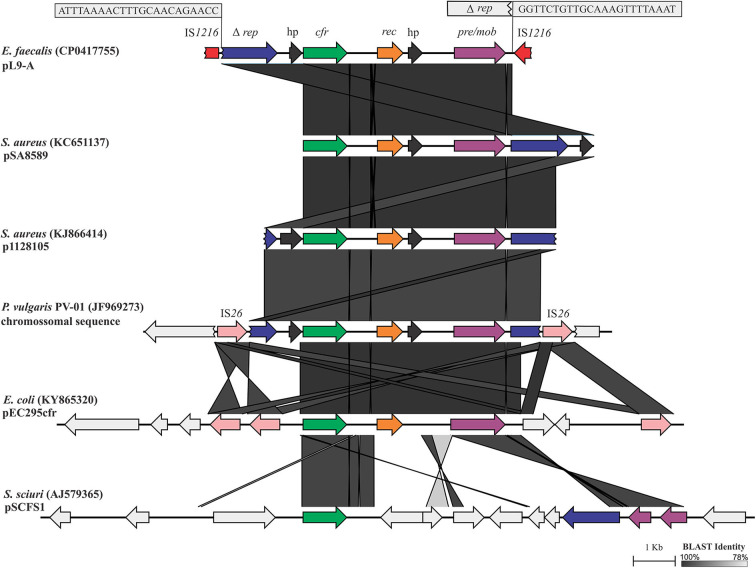
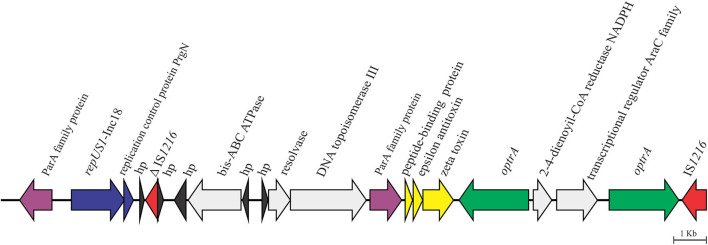
Oxazolidinones are one of the most important antimicrobials potentially active against glycopeptide- and β-lactam-resistant Gram-positive pathogens. Linezolid-the first oxazolidinone to be approved for clinical use in 2000 by the US Food and Drug Administration-and the newer molecule in the class, tedizolid, inhibit protein synthesis by suppressing the formation of the 70S ribosomal complex in bacteria. Over the past two decades, transferable oxazolidinone resistance genes, in particular and , have been identified in Firmicutes isolated from healthcare-related infections, livestock, and the environment. Our goals in this study were to investigate the genetic contexts and the transferability of the and genes and examine genomic features, such as antimicrobial resistance genes, plasmid incompatibility types, and CRISPR-Cas defenses of a linezolid-resistant isolated in feces from a healthy pig during an antimicrobial surveillance program for animal production in Brazil. The gene was found to be integrated into a transposon-like structure of 7,759 nt flanked by IS and capable of excising and circularizing, distinguishing it from known genetic contexts for in spp., while was inserted into an Inc18 broad host-range plasmid of >58 kb. Conjugal transfer of and was shown by filter mating. The coexistence of and in an isolated from a healthy nursery pig highlights the need for monitoring the use of antibiotics in the Brazilian swine production system for controlling spread and proliferation of antibiotic resistance.
恶唑烷酮类是最重要的抗菌药物之一,具有抗糖肽类和β-内酰胺类耐药革兰阳性病原体的潜在活性。利奈唑胺——美国食品和药物管理局 (FDA) 于 2000 年批准的第一个用于临床的恶唑烷酮类药物——和该类别的新型分子替加环素,通过抑制细菌 70S 核糖体复合物的形成来抑制蛋白质合成。在过去的二十年中,已在与医疗保健相关的感染、牲畜和环境中分离出的Firmicutes 中发现了可转移的恶唑烷酮类耐药基因,特别是 和 。我们在这项研究中的目标是研究 和 基因的遗传背景和可转移性,并研究基因组特征,如抗微生物耐药基因、质粒不相容类型和 CRISPR-Cas 防御,这是在巴西进行动物生产抗微生物监测计划期间从健康猪粪便中分离出的利奈唑胺耐药 的。发现 基因整合到一个 7759 个核苷酸的转座子样结构中,该结构由 IS 侧翼,能够切除和环化,使其与 spp.中的 已知遗传背景区分开来,而 则插入到一个 >58 kb 的 Inc18 广泛宿主范围的质粒中。通过过滤交配显示了 和 的共转移。在来自健康保育猪的 中同时存在 和 ,突出了需要监测巴西养猪生产系统中抗生素的使用,以控制抗生素耐药性的传播和扩散。