Gill Madeleine, Blacketer Charlotte, Chitti Franco, Telfer Karmen, Papanicolas Lito, Dann Lisa M, Tucker Emily C, Bryant Robert V, Costello Samuel P
Department of Gastroenterology The Queen Elizabeth Hospital Adelaide South Australia Australia.
School of Medicine University of Adelaide Adelaide South Australia Australia.
JGH Open. 2020 Aug 6;4(5):950-957. doi: 10.1002/jgh3.12396. eCollection 2020 Oct.
Fecal microbiota transplantation (FMT) is a highly effective therapy for recurrent or refractory infection (rCDI). Despite inclusion in society guidelines, the uptake of FMT therapy has been variable. Physician and patient attitudes may be a barrier to evidence-based uptake of therapies; however, data assessing attitudes regarding FMT for rCDI are limited.
The South Australian FMT for CDI database prospectively recorded patient outcomes of FMT for CDI from August 2013 to January 2019. A total of 93 consecutive patients who underwent FMT for rCDI in South Australia were invited to participate in a 20-question survey regarding the patient experience of FMT. All gastroenterologists and infectious disease physicians practicing in South Australia were invited to participate in an online survey comprised of 22 questions that addressed referral experience, indications for referral, perceived risks, and regulation and funding.
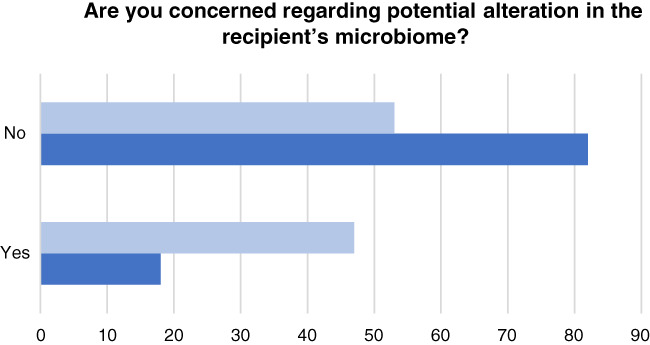
Fifty-four patients (54/93, 58%) returned the survey, of whom 52 (96%) would recommend FMT to others, and 51 (94%) were satisfied with treatment outcome. Fifty physicians returned the online survey (50/100, 50%), of whom 23 (46%) were concerned about disease transmission risk, and 15 (30%) believed that the risk of FMT would outweigh the benefit. Infectious diseases physicians and advanced trainees had significantly greater concern regarding the potential alteration of the microbiome than gastroenterology physicians and advanced trainees (8/17 (47%) 6/33 (18%); = 0.047).
Despite high levels of patient-reported satisfaction following FMT, physician-reported reservations exist and may present a barrier to uptake of this therapy.
粪菌移植(FMT)是治疗复发性或难治性艰难梭菌感染(rCDI)的一种高效疗法。尽管已被纳入社会指南,但FMT疗法的应用情况却不尽相同。医生和患者的态度可能是循证应用疗法的一个障碍;然而,评估对rCDI进行FMT的态度的数据有限。
南澳大利亚CDI的FMT数据库前瞻性记录了2013年8月至2019年1月期间CDI的FMT患者结局。邀请了南澳大利亚连续93例接受rCDI的FMT患者参与一项关于FMT患者体验的20个问题的调查。邀请了在南澳大利亚执业的所有胃肠病学家和传染病医生参与一项由22个问题组成的在线调查,这些问题涉及转诊经历、转诊指征、感知风险以及监管和资金。
54例患者(54/93,58%)回复了调查,其中52例(96%)会向他人推荐FMT,51例(94%)对治疗结果满意。50名医生回复了在线调查(50/100,50%),其中23例(46%)担心疾病传播风险,15例(30%)认为FMT的风险将超过益处。与胃肠病学医生和高级受训人员相比,传染病医生和高级受训人员对微生物组潜在改变的担忧明显更大(8/17(47%)对6/33(18%);P = 0.047)。
尽管患者报告FMT后的满意度较高,但医生报告存在保留意见,这可能是该疗法应用的一个障碍。