Castillo-Leon Eduardo, Cioffi Catherine E, Vos Miriam B
Department of Pediatrics Emory University School of Medicine Atlanta GA USA.
Nutrition & Health Sciences Doctoral Program Laney Graduate School Emory University Atlanta GA USA.
Endocrinol Diabetes Metab. 2020 Sep 17;3(4):e00184. doi: 10.1002/edm2.184. eCollection 2020 Oct.
The prevalence and incidence of youth-onset nonalcoholic fatty liver disease (NAFLD) far exceeds other paediatric chronic liver diseases and represents a considerable public health issue globally.
Here, we performed a narrative review of current knowledge regarding the epidemiology of paediatric NAFLD, selected concepts in pathogenesis, comorbidities, diagnosis, and management, and issues related to the transition to adulthood.
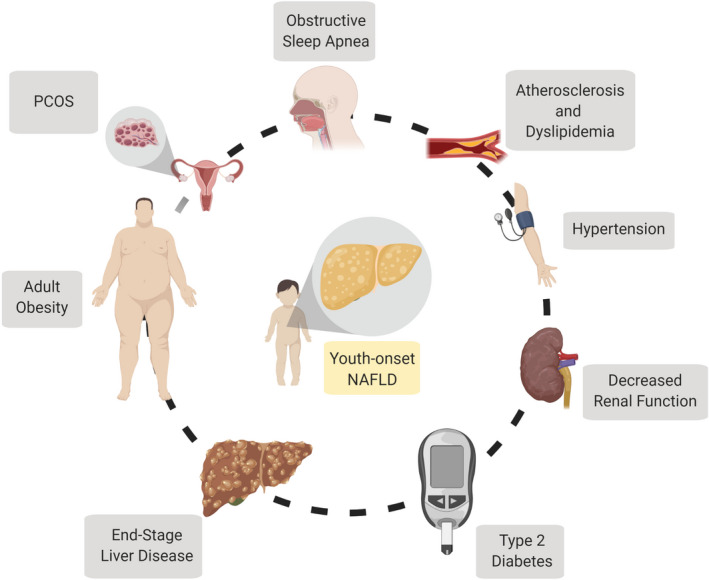
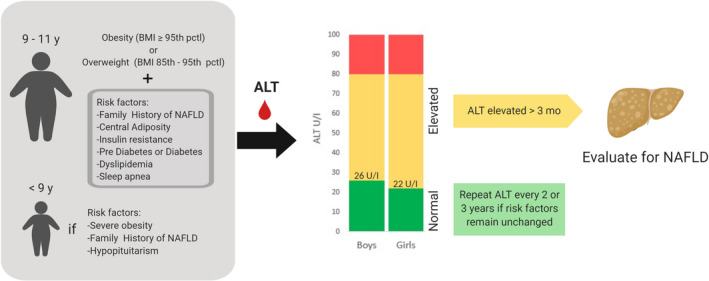
Paediatric NAFLD has become increasingly more prevalent, especially in certain subgroups, such as children with obesity and certain races/ethnicities. The pathophysiology of paediatric NAFLD is complex and multifactorial, driven by an interaction of environmental and genetic factors. Once developed, NAFLD in childhood is associated with type 2 diabetes, hypertension, increased cardiovascular disease risk, and end-stage liver disease. This predicts an increased burden of morbidity and mortality in adolescents and young adults. Early screening and diagnosis are therefore crucial, and the development of noninvasive biomarkers remains an active area of investigation. Currently, treatment strategies are focused on lifestyle changes, but there is also research interest in pharmacological and surgical options. In the transition from paediatric to adult care, there are several potential challenges/barriers to treatment and research is needed to understand how best to support patients during this time.
Our understanding of the epidemiology and pathophysiology of paediatric NAFLD has increased considerably over recent decades, but several critical knowledge gaps remain and must be addressed in order to better mitigate the short-term and long-term risks of youth-onset NAFLD.
青少年非酒精性脂肪性肝病(NAFLD)的患病率和发病率远远超过其他儿科慢性肝病,是全球一个相当严重的公共卫生问题。
在此,我们对有关儿科NAFLD流行病学的现有知识、发病机制、合并症、诊断和管理方面的选定概念以及与向成年期过渡相关的问题进行了叙述性综述。
儿科NAFLD越来越普遍,尤其是在某些亚组中,如肥胖儿童和某些种族/族裔群体。儿科NAFLD的病理生理学复杂且多因素,由环境和遗传因素的相互作用驱动。一旦发生,儿童期的NAFLD与2型糖尿病、高血压、心血管疾病风险增加和终末期肝病相关。这预示着青少年和年轻成年人发病和死亡负担的增加。因此,早期筛查和诊断至关重要,非侵入性生物标志物的开发仍然是一个活跃的研究领域。目前,治疗策略侧重于生活方式的改变,但对药物和手术选择也有研究兴趣。在从儿科护理向成人护理的过渡中,存在几个潜在的治疗挑战/障碍,需要开展研究以了解在此期间如何最好地支持患者。
近几十年来,我们对儿科NAFLD的流行病学和病理生理学的理解有了很大提高,但仍存在几个关键的知识空白,必须加以解决,以便更好地降低青少年期NAFLD的短期和长期风险。