Centre for Global Public Health, Institute for Population Health Studies, Queen Mary University of London, London, United Kingdom.
Center for Engineering, Modelling and Applied Social Sciences, Federal University of ABC, Santo André, São Paulo, Brazil.
PLoS One. 2020 Oct 26;15(10):e0241017. doi: 10.1371/journal.pone.0241017. eCollection 2020.
Economic recessions carry an impact on population health and access to care; less is known on how health systems adapt to the conditions brought by a downturn. This particularly matters now that the COVID-19 epidemic is putting health systems under stress. Brazil is one of the world's most affected countries, and its health system was already experiencing the aftermath of the 2015 recession.
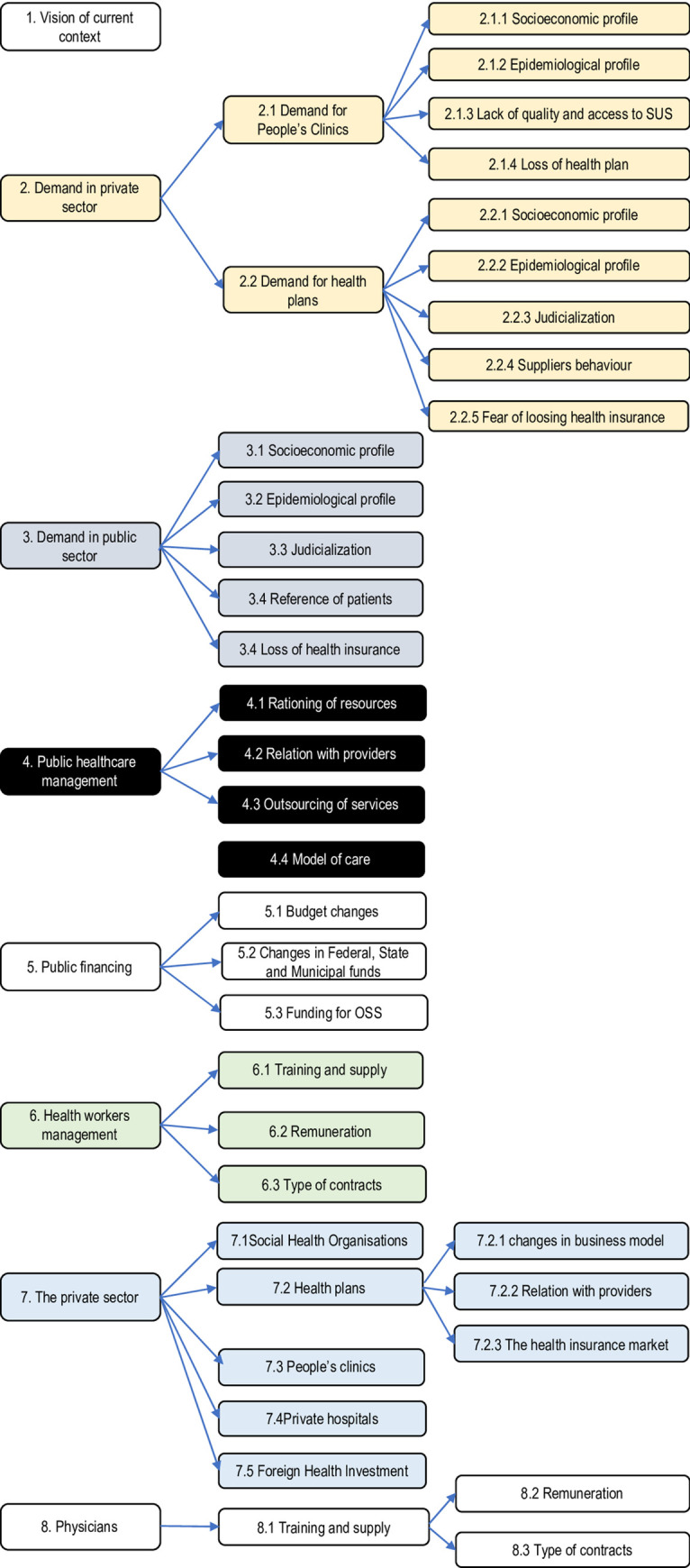
Between 2018 and 2019 we conducted 46 semi-structured interviews with health practitioners, managers and policy-makers to explore the impact of the 2015 recession on public and private providers in prosperous (São Paulo) and impoverished (Maranhão) states in Brazil. Thematic analysis was employed to identify drivers and consequences of system adaptation and coping strategies. Nvivo software was used to aid data collection and analysis. We followed the Standards for Reporting Qualitative Research to provide an account of the findings.
We found the concept of 'health sector crisis' to be politically charged among healthcare providers in São Paulo and Maranhão. Contrary to expectations, the public sector was reported to have found ways to compensate for diminishing federal funding, having outsourced services and adopted flexible-if insecure-working arrangements. Following a drop in employment and health plans, private health insurance companies have streamlined their offer, at times at the expenses of coverage. Low-cost walk-in clinics were hit hard by the recession, but were also credited for having moved to cater for higher-income customers in Maranhão.
The 'plates' of a health system may shift and adjust in unexpected ways in response to recessions, and some of these changes might outlast the crisis. As low-income countries enter post-COVID economic recessions, it will be important to monitor the adjustments taking place in health systems, to ensure that past gains in access to care and job security are not eroded.
经济衰退对人口健康和获得医疗保健的机会产生影响,但人们对卫生系统如何适应经济衰退带来的条件知之甚少。鉴于 COVID-19 疫情正在给卫生系统带来压力,这一点尤为重要。巴西是受疫情影响最严重的国家之一,其卫生系统已经在经受 2015 年经济衰退的余波。
在 2018 年至 2019 年间,我们对巴西繁荣州(圣保罗州)和贫困州(马拉尼昂州)的卫生从业人员、管理人员和政策制定者进行了 46 次半结构化访谈,以探讨 2015 年经济衰退对公共和私人医疗服务提供者的影响。采用主题分析来确定系统适应和应对策略的驱动因素和后果。我们使用 Nvivo 软件辅助数据收集和分析。我们遵循定性研究报告标准,以提供发现的说明。
我们发现,卫生保健提供者在圣保罗州和马拉尼昂州将“卫生部门危机”这一概念视为政治问题。与预期相反,据报道,公共部门找到了弥补联邦资金减少的方法,将服务外包,并采用了灵活的(但不稳定的)工作安排。在就业和健康计划下降之后,私人医疗保险公司精简了他们的服务,有时是以牺牲覆盖范围为代价的。在经济衰退期间,低费用的即到即诊诊所受到了严重打击,但也因在马拉尼昂州转向为高收入客户提供服务而受到赞誉。
卫生系统的“板块”可能会以意想不到的方式转移和调整,以应对经济衰退,其中一些变化可能会持续到危机之后。随着低收入国家进入 COVID-19 后经济衰退,重要的是要监测卫生系统中正在进行的调整,以确保过去在获得医疗保健和工作保障方面取得的进展不会被侵蚀。