Departamento de Medicina Preventiva, Faculdade de Medicina, Universidade de Sao Paulo, Sao Paulo, São Paulo, Brazil.
Centro de Engenharia, Modelagem e Ciências Sociais Aplicadas, Universidade Federal do ABC, Santo Andre, São Paulo, Brazil.
BMJ Glob Health. 2020 Feb 28;5(2):e002122. doi: 10.1136/bmjgh-2019-002122. eCollection 2020.
Although economic crises are common in low/middle-income countries (LMICs), the evidence of their impact on health systems is still scant. We conducted a comparative case study of Maranhão and São Paulo, two unevenly developed states in Brazil, to explore the health financing and system performance changes brought in by its 2014-2015 economic recession.
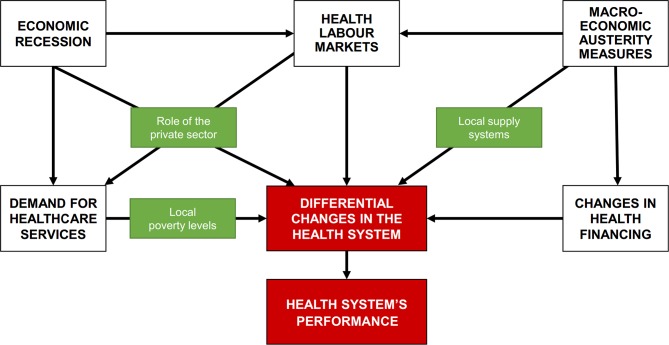
Drawing from economic and health system research literature, we designed a conceptual framework exploring the links between macroeconomic factors, labour markets, demand and supply of health services and system performance. We used data from the National Health Accounts and National Household Sample Survey to examine changes in Brazil's health spending over the 2010-2018 period. Data from the National Agency of Supplementary Health database and the public health budget information system were employed to compare and contrast health financing and system performance of São Paulo and Maranhão.
Our analysis shows that Brazil's macroeconomic conditions deteriorated across the board after 2015-2016, with São Paulo's economy experiencing a wider setback than Maranhão's. We showed how public health expenditures flattened, while private health insurance expenditures increased due to the recession. Public financing patterns differed across the two states, as health funding in Maranhão continued to grow after the crisis years, as it was propped up by transfers to local governments. While public sector staff and beds per capita in Maranhão were not affected by the crisis, a decrease in public physicians was observed in São Paulo.
Our case study suggests that in a complex heterogeneous system, economic recessions reverberate unequally across its parts, as the effects are mediated by private spending, structure of the market and adjustments in public financing. Policies aimed at mitigating the effects of recessions in LMICs will need to take such differences into account.
尽管经济危机在中低收入国家(LMICs)很常见,但它们对卫生系统的影响证据仍然很少。我们对巴西两个发展不平衡的州——马拉尼昂州和圣保罗州进行了比较案例研究,以探讨其 2014-2015 年经济衰退带来的卫生融资和系统绩效变化。
我们借鉴经济和卫生系统研究文献,设计了一个概念框架,探讨宏观经济因素、劳动力市场、卫生服务需求和供应与系统绩效之间的联系。我们使用国家卫生账户和国家住户抽样调查的数据来考察 2010-2018 年期间巴西卫生支出的变化。我们还利用补充卫生数据库和公共卫生预算信息系统的数据,比较和对比了圣保罗州和马拉尼昂州的卫生融资和系统绩效。
我们的分析表明,2015-2016 年后,巴西的宏观经济状况全面恶化,圣保罗州的经济衰退比马拉尼昂州更为严重。我们展示了公共卫生支出如何趋于平稳,而私人医疗保险支出因经济衰退而增加。两个州的公共融资模式不同,因为危机年后,马拉尼昂州的卫生资金继续增长,因为它得到了向地方政府的转移资金的支持。虽然马拉尼昂州的公共部门员工和人均床位未受危机影响,但圣保罗州的公共医生数量有所减少。
我们的案例研究表明,在一个复杂的异质系统中,经济衰退在其各个部分的影响并不均衡,因为这些影响受到私人支出、市场结构和公共融资调整的影响。旨在减轻 LMICs 经济衰退影响的政策需要考虑到这些差异。