Suresh Sinduja, Becker Alexander, Glasmacher Birgit
Institute for Multiphase Processes (IMP), Leibniz University Hannover, 30823 Garbsen, Hannover, Germany.
Lower Saxony Centre for Biomedical Engineering, Implant Research and Development (NIFE), 30625 Hannover, Germany.
Polymers (Basel). 2020 Oct 22;12(11):2448. doi: 10.3390/polym12112448.
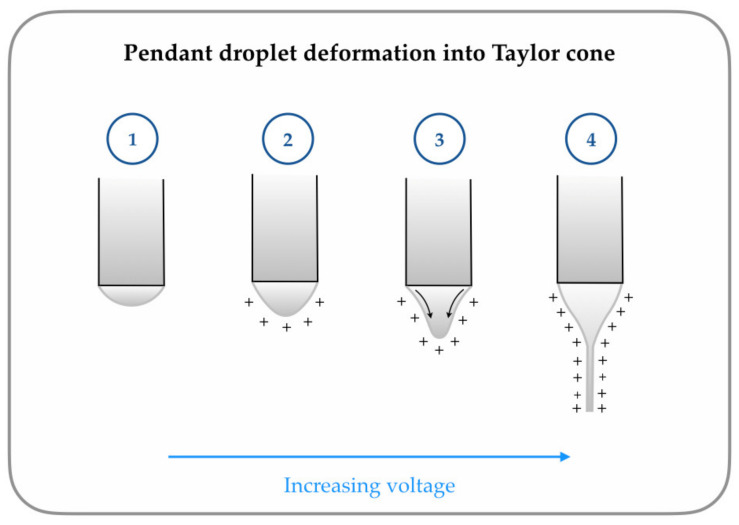
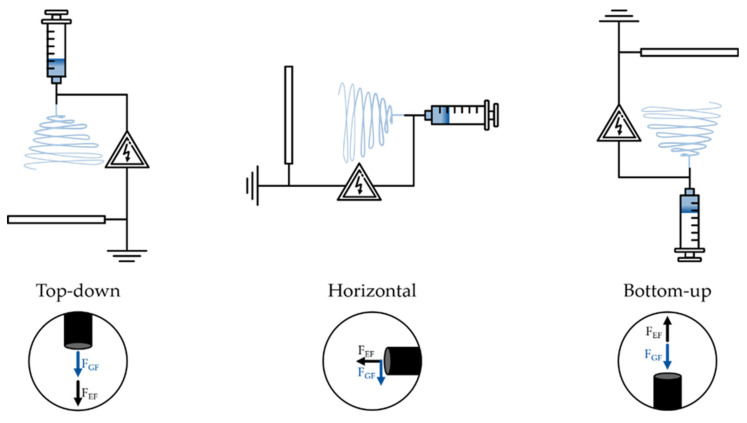
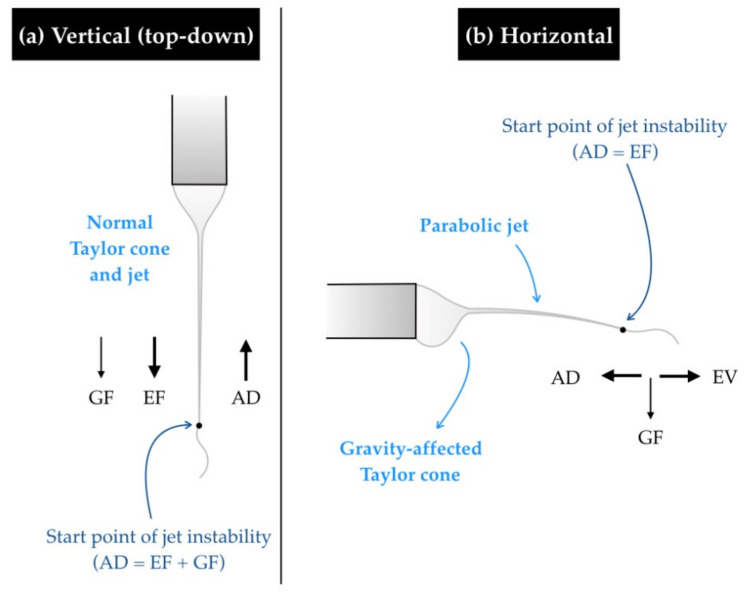
Electrospinning is a versatile fibre fabrication method with applications from textile to tissue engineering. Despite the appearance that the influencing parameters of electrospinning are fully understood, the effect of setup orientation has not been thoroughly investigated. With current burgeoning interest in modified and specialised electrospinning apparatus, it is timely to review the impact of this seldom-considered parameter. Apparatus configuration plays a major role in the morphology of the final product. The primary difference between spinning setups is the degree to which the electrical force and gravitational force contribute. Since gravity is much lower in magnitude when compared with the electrostatic force, it is thought to have no significant effect on the spinning process. But the shape of the Taylor cone, jet trajectory, fibre diameter, fibre diameter distribution, and overall spinning efficiency are all influenced by it. In this review paper, we discuss all these developments and more. Furthermore, because many research groups build their own electrospinning apparatus, it would be prudent to consider this aspect as particular orientations are more suitable for certain applications.
静电纺丝是一种用途广泛的纤维制造方法,其应用涵盖从纺织到组织工程等多个领域。尽管表面上人们已经完全了解静电纺丝的影响参数,但装置方向的影响尚未得到充分研究。随着当前对改进型和专用静电纺丝设备的兴趣日益增长,及时回顾这一很少被考虑的参数的影响是很有必要的。装置配置在最终产品的形态中起着主要作用。纺丝装置之间的主要区别在于电力和重力的作用程度。由于与静电力相比,重力的大小要小得多,因此人们认为它对纺丝过程没有显著影响。但泰勒锥的形状、射流轨迹、纤维直径、纤维直径分布以及整体纺丝效率都会受到它的影响。在这篇综述论文中,我们将讨论所有这些进展以及更多内容。此外,由于许多研究小组都自行制造静电纺丝设备,考虑到特定方向更适合某些应用,谨慎对待这一方面是明智的。