Martínez-Hortelano Jose Alberto, Cavero-Redondo Iván, Álvarez-Bueno Celia, Garrido-Miguel Miriam, Soriano-Cano Alba, Martínez-Vizcaíno Vicente
Universidad de Castilla-La Mancha, Social and Health Care Research Center, Santa Teresa Jornet s/n, 16071, Cuenca, Spain.
Universidad Politécnica y Artística del Paraguay, Asunción, Paraguay.
BMC Pregnancy Childbirth. 2020 Oct 27;20(1):649. doi: 10.1186/s12884-020-03335-7.
Previous studies have reported a high prevalence of excessive gestational weight gain (GWG) in women with prepregnancy BMI classified as overweight and obese. However, the joint evidence regarding GWG and prepregnancy BMI in the worldwide population has not been synthesized. Thus, this systematic review and meta-analysis aimed to estimate global and regional mean GWG and the prevalence of GWG above, within and below 2009 Institute of Medicine (IOM) guidelines. Second, we aimed to estimate global and regional prepregnancy BMI and the prevalence of BMI categories according to World Health Organization (WHO) classification.
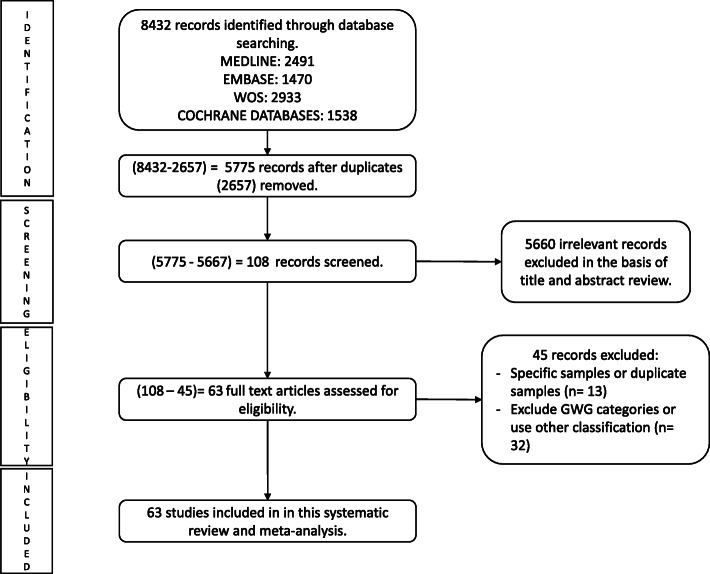
We searched Medline, Embase, the Cochrane Library and Web of Science to identify observational studies until 9 May 2018. We included studies published from 2009 that used 2009 IOM guidelines, reporting data from women in general population with singleton pregnancies. The 2009 IOM categories for GWG and the WHO categories for prepregnancy BMI were used. DerSimonian and Laird random effects methods were used to estimate the pooled and their respective 95% confidence intervals (95% CIs) of the mean and by category rates of GWG and prepregnancy BMI, calculated by global and regions.
Sixty-three published studies from 29 countries with a total sample size of 1,416,915 women were included. The global prevalence of GWG above and below the 2009 IOM guidelines, was 27.8% (95% CI; 26.5, 29.1) and 39.4% (95% CI; 37.1, 41.7), respectively. Furthermore, meta-regression analyses showed that the mean GWG and the prevalence of GWG above guidelines have increased. The global prevalence of overweight and obesity, was 23.0% (95% CI; 22.3, 23.7) and 16.3% (95% CI; 15.4, 17.4), respectively. The highest mean GWG and prepregnancy BMI were in North America and the lowest were in Asia.
Considering the high prevalence of GWG above the 2009 IOM guidelines and women with overweight/obesity and their continuously increasing trend in most regions, clinicians should recommend lifestyle interventions to improve women's weight during reproductive age. Due to regional variability, these interventions should be adapted to each cultural context.
Prospectively registered with PROSPERO ( CRD42018093562 ).
先前的研究报告称,孕前体重指数(BMI)分类为超重和肥胖的女性中,孕期体重过度增加(GWG)的患病率很高。然而,尚未综合全球人群中关于GWG和孕前BMI的联合证据。因此,本系统评价和荟萃分析旨在估计全球和区域的平均GWG以及高于、符合和低于2009年医学研究所(IOM)指南的GWG患病率。其次,我们旨在估计全球和区域的孕前BMI以及根据世界卫生组织(WHO)分类的BMI类别患病率。
我们检索了Medline、Embase、Cochrane图书馆和科学网,以识别截至2018年5月9日的观察性研究。我们纳入了2009年以后发表的使用2009年IOM指南的研究,报告了一般人群中单胎妊娠女性的数据。使用了2009年IOM的GWG类别和WHO的孕前BMI类别。采用DerSimonian和Laird随机效应方法估计汇总的以及按全球和区域计算的GWG和孕前BMI均值及其各自95%置信区间(95%CI)的类别率。
纳入了来自29个国家的63项已发表研究,总样本量为1416915名女性。高于和低于2009年IOM指南的GWG全球患病率分别为27.8%(95%CI:26.5,29.1)和39.4%(95%CI:37.1,41.7)。此外,荟萃回归分析表明,平均GWG和高于指南的GWG患病率有所增加。超重和肥胖的全球患病率分别为23.0%(95%CI:22.3,23.7)和16.3%(95%CI:15.4,17.4)。平均GWG和孕前BMI最高的是北美,最低的是亚洲。
考虑到高于2009年IOM指南的GWG患病率较高,以及超重/肥胖女性在大多数地区呈持续上升趋势,临床医生应建议采取生活方式干预措施,以改善育龄期女性的体重。由于区域差异,这些干预措施应适用于每种文化背景。
前瞻性注册于PROSPERO(CRD42018093562)。