Department of Sanitation Economy Administration, Nanfang Hospital, Southern Medical University, Guangzhou, China.
Guangdong Provincial People's Hospital,Guangdong Academy of Medical Sciences, Guangzhou, China.
BMJ Open. 2020 Oct 26;10(10):e039701. doi: 10.1136/bmjopen-2020-039701.
Suboptimal health status (SHS), a third state between good health and disease, can easily develop into chronic diseases, and can be influenced by lifestyle and health consciousness. No study has surveyed the intermediation of health consciousness on the relationship between lifestyle and SHS. This study aimed to analyse the association of lifestyle and SHS, and intermediation of health consciousness in Chinese urban residents.
A cross-sectional face-to-face survey using a four-stage stratified sampling method.
We investigated 5803 Chinese urban residents aged 18 years and over. We measured SHS using the Sub-Health Measurement Scale V1.0. We adopted a structural equation model to analyse relationships among lifestyle, health consciousness and SHS. We applied a bootstrapping method to estimate the mediation effect of health consciousness.
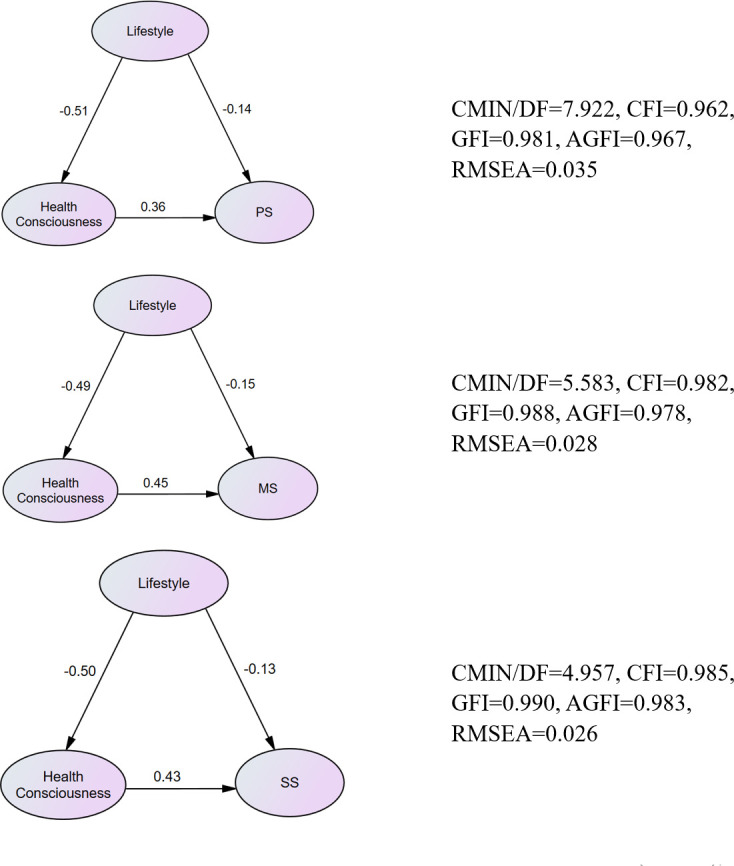
Lifestyle had stronger indirect associations with physical ( -0.185, 95% CI -0.228 to -0.149), mental ( -0.224, 95% CI -0.265 to -0.186) and social SHS ( -0.216, 95% CI -0.257 to -0.179) via health consciousness than direct associations of physical ( -0.144, 95% CI -0.209 to -0.081), mental ( -0.146, 95% CI -0.201 to -0.094) and social SHS ( -0.130, 95% CI -0.181 to -0.077). Health consciousness has a strong direct association with physical ( 0.360, 95% CI 0.295 to 0.427), mental ( 0.452, 95% CI 0.392 to 0.510) and social SHS ( 0.434, 95% CI 0.376 to 0.490). Ratio of mediating effect of health consciousness to direct effect of lifestyle with physical, mental and social SHS was 1.28, 1.53 and 1.66, respectively.
Health consciousness was more important in preventing physical, mental and social SHS than lifestyle. Therefore, it might be useful in changing unhealthy lifestyle and reducing the influence of poor lifestyle on physical, mental and social SHS.
介于良好健康状态和疾病之间的第三状态——亚健康状态,很容易发展成慢性病,且可受到生活方式和健康意识的影响。目前尚无研究调查健康意识对生活方式和亚健康状态之间关系的中介作用。本研究旨在分析中国城市居民的生活方式与亚健康状态的关系,以及健康意识在其中的中介作用。
采用四阶段分层整群抽样方法的横断面面对面调查。
我们调查了 5803 名年龄在 18 岁及以上的中国城市居民。我们使用亚健康量表 V1.0 来衡量亚健康状态。我们采用结构方程模型来分析生活方式、健康意识与亚健康状态之间的关系。我们采用 bootstrap 方法来估计健康意识的中介效应。
与生活方式对身体亚健康状态(-0.185,95%CI-0.228 至-0.149)、心理亚健康状态(-0.224,95%CI-0.265 至-0.186)和社会亚健康状态(-0.216,95%CI-0.257 至-0.179)的直接关联相比,生活方式通过健康意识对身体亚健康状态(-0.144,95%CI-0.209 至-0.081)、心理亚健康状态(-0.146,95%CI-0.201 至-0.094)和社会亚健康状态(-0.130,95%CI-0.181 至-0.077)的间接关联更强。健康意识与身体亚健康状态(0.360,95%CI0.295 至 0.427)、心理亚健康状态(0.452,95%CI0.392 至 0.510)和社会亚健康状态(0.434,95%CI0.376 至 0.490)均具有很强的直接关联。健康意识对生活方式与身体、心理和社会亚健康状态的直接效应的中介效应占比分别为 1.28、1.53 和 1.66。
与生活方式相比,健康意识在预防身体、心理和社会亚健康状态方面更为重要。因此,改变不健康的生活方式,降低不良生活方式对身体、心理和社会亚健康状态的影响,可能会有所帮助。