
通过体内选择使登革病毒 1 适应白纹伊蚊。
Experimental adaptation of dengue virus 1 to Aedes albopictus mosquitoes by in vivo selection.
机构信息
Arboviruses and Insect Vectors Unit, Institut Pasteur, Paris, France.
Sorbonne Université, Collège doctoral, 75005, Paris, France.
出版信息
Sci Rep. 2020 Oct 27;10(1):18404. doi: 10.1038/s41598-020-75042-4.
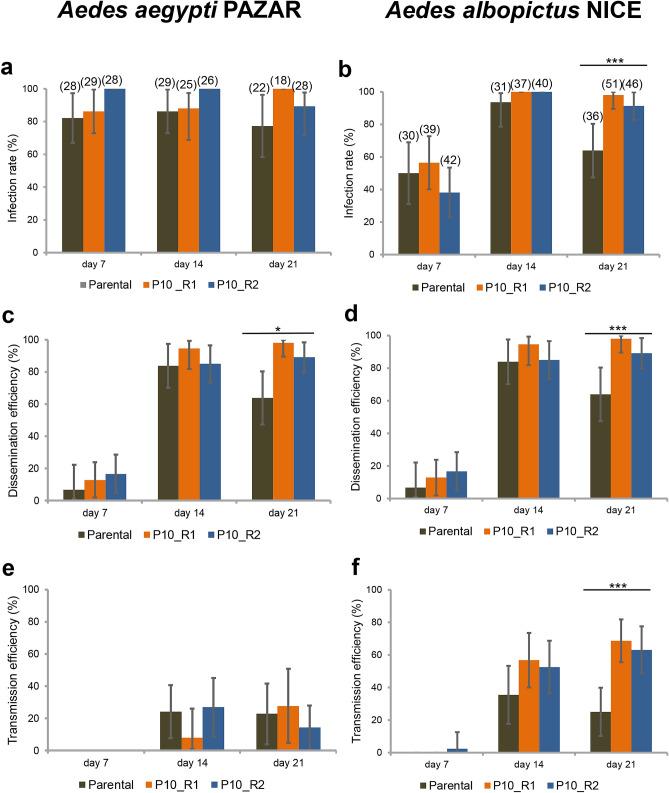
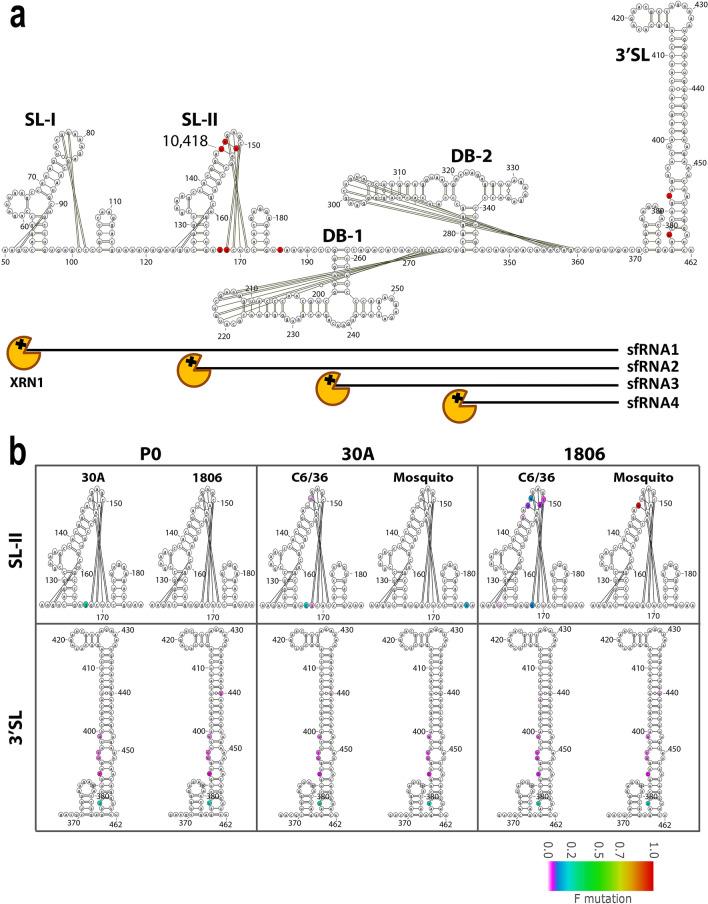
In most of the world, Dengue virus (DENV) is mainly transmitted by the mosquito Aedes aegypti while in Europe, Aedes albopictus is responsible for human DENV cases since 2010. Identifying mutations that make DENV more competent for transmission by Ae. albopictus will help to predict emergence of epidemic strains. Ten serial passages in vivo in Ae. albopictus led to select DENV-1 strains with greater infectivity for this vector in vivo and in cultured mosquito cells. These changes were mediated by multiple adaptive mutations in the virus genome, including a mutation at position 10,418 in the DENV 3'UTR within an RNA stem-loop structure involved in subgenomic flavivirus RNA production. Using reverse genetics, we showed that the 10,418 mutation alone does not confer a detectable increase in transmission efficiency in vivo. These results reveal the complex adaptive landscape of DENV transmission by mosquitoes and emphasize the role of epistasis in shaping evolutionary trajectories of DENV variants.
在世界上大多数地区,登革热病毒(DENV)主要由埃及伊蚊传播,而在欧洲,白纹伊蚊自 2010 年以来负责人类 DENV 病例。确定使 DENV 更适合通过 Ae. albopictus 传播的突变将有助于预测流行株的出现。在白纹伊蚊体内进行的 10 次连续传代导致选择出 DENV-1 株,这些株在体内和培养的蚊子细胞中对该载体具有更高的感染力。这些变化是由病毒基因组中的多个适应性突变介导的,包括 DENV 3'UTR 中位置 10418 的突变,该突变位于参与亚基因组黄病毒 RNA 产生的 RNA 茎环结构内。使用反向遗传学,我们表明,10418 点突变本身不会导致体内传播效率的可检测增加。这些结果揭示了蚊子传播 DENV 的复杂适应性景观,并强调了上位性在塑造 DENV 变体进化轨迹中的作用。




 Zotero 插件