Jacob Blaustein Center for Scientific Cooperation, The Jacob Blaustein Institutes for Desert Research, Ben-Gurion University of the Negev, Midreshet Ben-Gurion, Israel.
Mitrani Department of Desert Ecology, Swiss Institute for Dryland Environmental and Energy Research, The Jacob Blaustein Institutes for Desert Research, Ben-Gurion University of the Negev, Midreshet Ben-Gurion, Israel.
Mol Ecol Resour. 2022 Nov;22(8):2843-2859. doi: 10.1111/1755-0998.13649. Epub 2022 Jun 6.
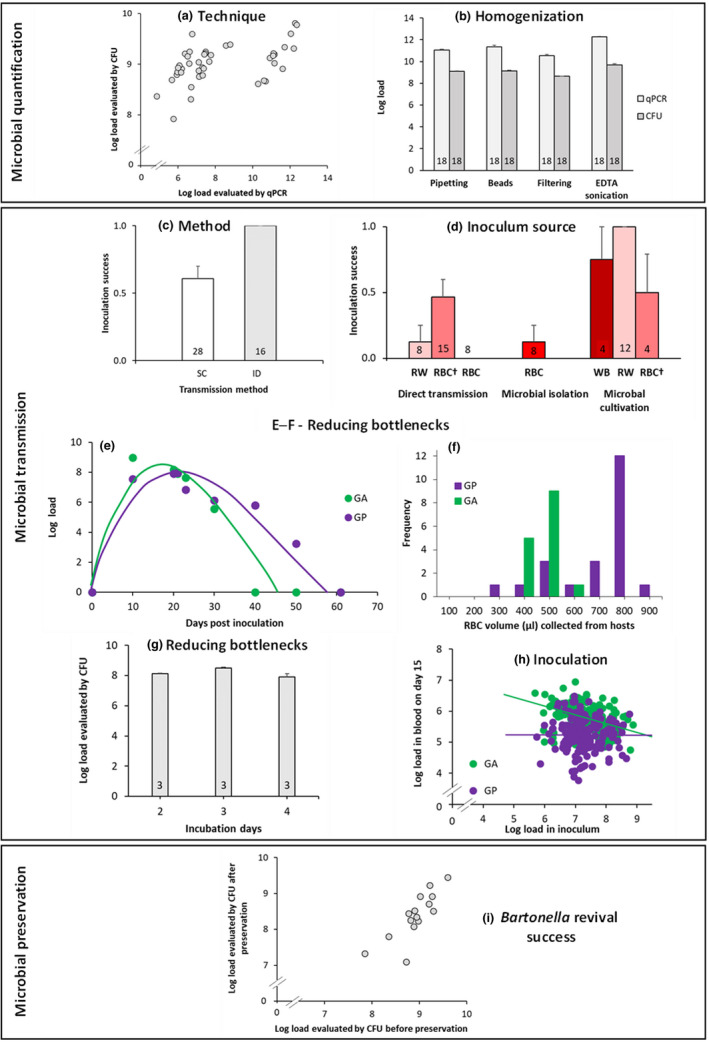
Laboratory experiments in which blood-borne parasitic microbes evolve in their animal hosts offer an opportunity to study parasite evolution and adaptation in real time and under natural settings. The main challenge of these experiments is to establish a protocol that is both practical over multiple passages and accurately reflects natural transmission scenarios and mechanisms. We provide a guide to the steps that should be considered when designing such a protocol, and we demonstrate its use via a case study. We highlight the importance of choosing suitable ancestral genotypes, treatments, number of replicates per treatment, types of negative controls, dependent variables, covariates, and the timing of checkpoints for the experimental design. We also recommend specific preliminary experiments to determine effective methods for parasite quantification, transmission, and preservation. Although these methodological considerations are technical, they also often have conceptual implications. To this end, we encourage other researchers to design and conduct in vivo evolution experiments with blood-borne parasitic microbes, despite the challenges that the work entails.
实验室实验中,血液传播的寄生微生物在其动物宿主中进化,为实时研究寄生虫进化和适应提供了机会,并在自然环境下进行。这些实验的主要挑战是建立一个既可以在多次传代中实际应用,又能准确反映自然传播场景和机制的方案。我们提供了一份指南,介绍了在设计此类方案时应考虑的步骤,并通过案例研究展示了其用途。我们强调了选择合适的祖先基因型、处理方法、每种处理的重复次数、阴性对照的类型、因变量、协变量以及实验设计的检查点时间的重要性。我们还建议进行特定的初步实验,以确定寄生虫定量、传播和保存的有效方法。虽然这些方法学上的考虑因素是技术性的,但它们也常常具有概念性的影响。为此,我们鼓励其他研究人员设计和进行血液传播的寄生微生物的体内进化实验,尽管这项工作存在挑战。