Khatri Monika, Mantri Sneha S, Deogade Suryakant C, Bhasin Abhilasha, Mantri Shivkumar, Khatri Neetu, Jain Priyanka, Chauhan Deepak
Department of Prosthodontics and Crown & Bridge, Hitkarini Dental College and Hospital, Hitkarini Hills, Dumna Airport Road, Jabalpur, India.
Department of Prosthodontics and Crown & Bridge, Government Dental College and Hospital, Medical Campus, Medical Square, Nagpur, India.
Contemp Clin Dent. 2020 Jan-Mar;11(1):10-14. doi: 10.4103/ccd.ccd_9_19. Epub 2020 Jul 13.
Surface detail reproduction (SDR) and dimensional stability of elastomeric impression material play a crucial role in fixed prosthodontics.
The aim of this study was to compare the effect of chemical disinfection on SDR and dimensional stability of polyvinyl siloxane (PVS) and polyether (PE) with a new vinyl polyether silicone (VPES) elastomeric impression material.
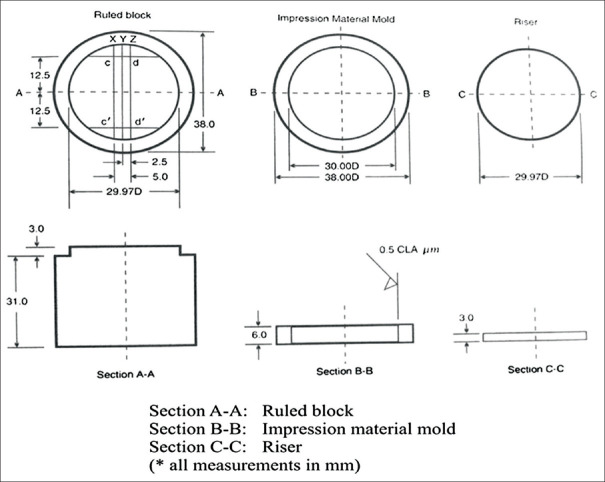
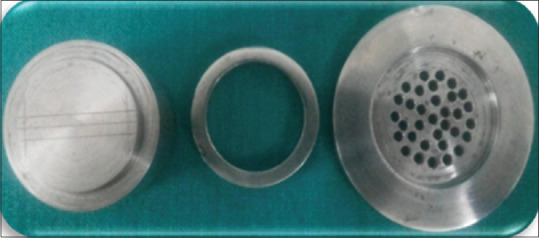
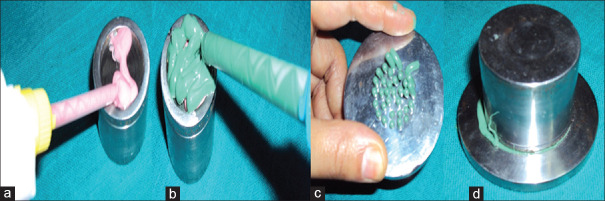
A stainless steel mold was made to fabricate the study specimens for nonaqueous PVS, PE, and VPES elastic dental impression materials. Single mix impression techniques with light- and heavy-body consistency of all three materials were used to prepare the test specimens. The specimens were immersed in glutaraldehyde (Cidex) 2.45% and sodium hypochlorite (Hypo) 3.0% disinfection for 15 min (T1) and 12 h (T2) immersion after which dimensional stability and SDR were recorded using stereomicroscope and digital Vernier caliper.
The data were analyzed using the one-way ANOVA, paired -test, Kruskal-Wallis test, and Wilcoxon signed-rank test.
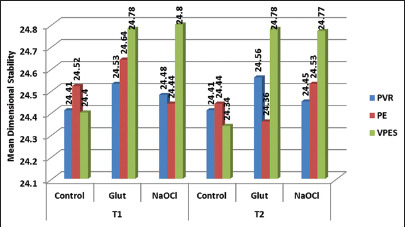
Dimensional stability at the T2 time interval showed a highly significant difference for control and glutaraldehyde groups ( < 0.001), whereas a statistically significant difference for Hypo group ( < 0.05). SDR of the three materials when compared at T1 time interval showed a statistically significant difference ( = 0.015). A comparison between two disinfectants at T1 time interval revealed a highly significant difference ( < 0.001), while at T2 interval significant difference was obtained ( = 0.009).
VPES impressions display acceptable dimensional stability and SDR for clinical use with immersion disinfection. Although some statistically significant differences in linear dimensional stability and semidefinite programming were observed among VPES, PE, and PVS, but the clinical impact of these differences is minor considering the overall accuracy of casts which was high.
弹性印模材料的表面细节再现(SDR)和尺寸稳定性在固定修复学中起着至关重要的作用。
本研究的目的是比较化学消毒对新型乙烯基聚醚硅氧烷(VPES)弹性印模材料与聚乙烯基硅氧烷(PVS)和聚醚(PE)的SDR和尺寸稳定性的影响。
制作不锈钢模具以制备用于非水性PVS、PE和VPES弹性牙科印模材料的研究标本。使用三种材料的轻体和重体稠度的单组分印模技术制备测试标本。将标本浸入2.45%的戊二醛(Cidex)和3.0%的次氯酸钠(Hypo)中进行消毒15分钟(T1)和浸泡12小时(T2),之后使用体视显微镜和数字游标卡尺记录尺寸稳定性和SDR。
使用单因素方差分析、配对检验、Kruskal-Wallis检验和Wilcoxon符号秩检验对数据进行分析。
在T2时间间隔,对照组和戊二醛组的尺寸稳定性显示出高度显著差异(<0.001),而次氯酸钠组有统计学显著差异(<0.05)。在T1时间间隔比较三种材料的SDR显示有统计学显著差异(=0.015)。在T1时间间隔比较两种消毒剂显示出高度显著差异(<0.001),而在T2时间间隔获得显著差异(=0.009)。
VPES印模在浸泡消毒后用于临床时显示出可接受的尺寸稳定性和SDR。尽管在VPES、PE和PVS之间观察到线性尺寸稳定性和半定规划存在一些统计学显著差异,但考虑到铸型的整体精度较高,这些差异的临床影响较小。