Schwebel Frank J, Larimer Mary E
Department of Psychology, Center for the Study of Health and Risk Behaviors, University of Washington, Seattle, USA.
Department of Psychology, Center on Alcoholism, Substance Abuse, and Addictions, University of New Mexico, Albuquerque, USA.
Digit Health. 2020 Oct 12;6:2055207620965052. doi: 10.1177/2055207620965052. eCollection 2020 Jan-Dec.
Text messaging has been proposed as a method for increasing the reach of interventions for harmful alcohol and other drug use. This paper describes the design of an automated text messaging adjunct to a substance use intervention intended to support adolescents and young adults attempting to change their alcohol and other drug use behavior. Feasibility and acceptability testing was conducted as part of this pilot study.
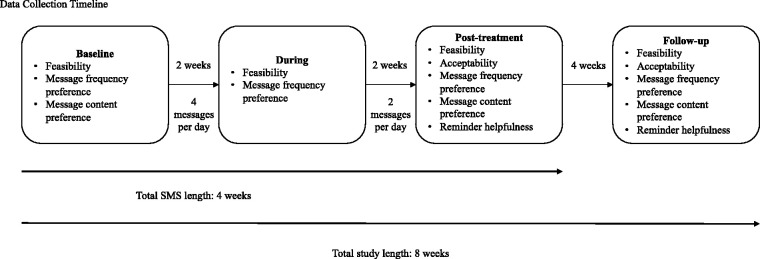
Five focus groups were conducted to refine text message content and finalize pilot intervention design. Automated, daily, substance use-related reminder text messages were sent to pilot intervention participants ( 39), who were recruited from outpatient treatment.
Of those who were invited, 63% enrolled in the study and 89.7% remained enrolled in the study as measured by completing at least one assessment after baseline. Participants reported a positive experience with the messages, particularly supportive/empowering messages and commitment reminder messages.
These findings suggest that text messaging is a feasible and acceptable method for delivery of substance use-related reminder content as an adjunct to substance use intervention.
短信已被提议作为一种增加对有害酒精和其他药物使用干预覆盖面的方法。本文描述了一种自动短信辅助物质使用干预的设计,旨在支持试图改变其酒精和其他药物使用行为的青少年和年轻人。作为这项试点研究的一部分,进行了可行性和可接受性测试。
开展了五个焦点小组以完善短信内容并确定试点干预设计。与物质使用相关的自动每日提醒短信被发送给从门诊治疗中招募的试点干预参与者(39人)。
在被邀请者中,63%登记参加了研究,以基线后完成至少一次评估来衡量,89.7%仍参与研究。参与者报告对这些短信有积极体验,特别是支持性/赋能性短信和承诺提醒短信。
这些发现表明,短信作为物质使用干预的辅助手段,是传递与物质使用相关提醒内容的一种可行且可接受的方法。