Department of Epidemiology & Population Health, Albert Einstein College of Medicine, Bronx, NY, USA.
Department of Oncology, Montefiore Medical Center, Bronx, NY, USA.
Leuk Lymphoma. 2021 Mar;62(3):581-589. doi: 10.1080/10428194.2020.1839656. Epub 2020 Oct 28.
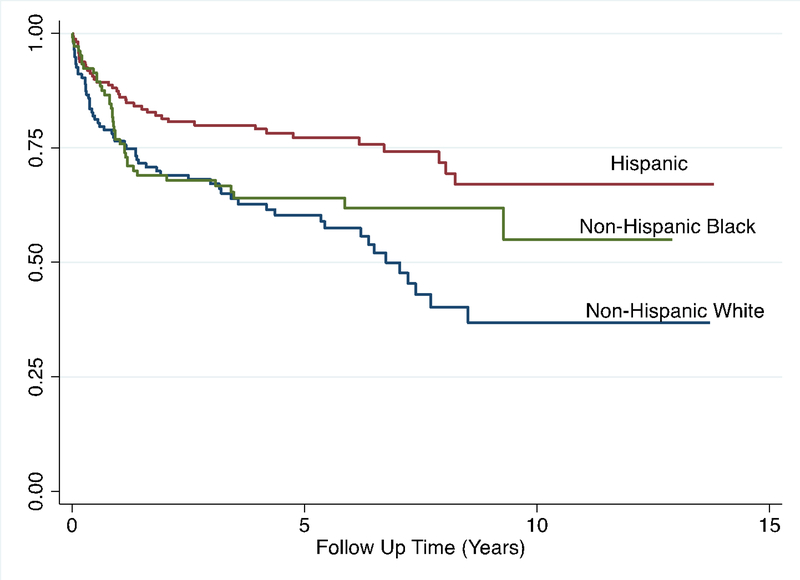
Racial/ethnic differences in diffuse large B-cell lymphoma (DLBCL) survival have focused on non-Hispanic Whites (NHW) and non-Hispanic Blacks (NHB), often excluding Hispanics/Latinos. To further assess these racial/ethnic survival differences, we identified incident DLBCL cases diagnosed between 2005 and 2016 ( = 404; NHW = 136, NHB = 106, Hispanic/Latino = 162) at Montefiore Medical Center (Bronx, NY). All-cause mortality survival curves were assessed by the Kaplan-Meier method and log-rank test. Cox proportional hazards regression assessed the association between demographic/clinical factors and all-cause mortality. Hispanic/Latino patients experienced 52% lower risk of mortality compared to NHWs (HR = 0.48, 95%CI = 0.28-0.83), after adjusting for clinical prognostic factors. This reduced risk experienced by Hispanics/Latinos was similarly observed by age at diagnosis (≤60 years, >60 years), stage (I/II, III/IV), and receipt of chemotherapy. NHBs and NHWs experienced similar risk of mortality (HR = 0.85, 95%CI = 0.52-1.40). Overall, among DLBCL patients, Hispanics/Latinos had improved survival compared to NHWs. Additional research should seek to identify the drivers of this survival benefit.
非西班牙裔白人和非西班牙裔黑种人(NHB)在弥漫性大 B 细胞淋巴瘤(DLBCL)生存方面的种族差异一直是研究重点,研究通常排除了西班牙裔/拉丁裔。为了进一步评估这些种族间的生存差异,我们确定了 2005 年至 2016 年间( = 404;NHW = 136,NHB = 106,西班牙裔/拉丁裔 = 162)在 Montefiore 医疗中心(纽约州布朗克斯)诊断出的 DLBCL 病例。使用 Kaplan-Meier 方法和对数秩检验评估全因死亡率生存曲线。Cox 比例风险回归评估了人口统计学/临床因素与全因死亡率之间的关系。与 NHW 相比,西班牙裔/拉丁裔患者的死亡率风险降低了 52%(HR = 0.48,95%CI = 0.28-0.83),调整了临床预后因素后仍有该结果。在考虑了诊断时的年龄(≤60 岁,>60 岁)、分期(I/II 期、III/IV 期)和化疗的接受情况后,西班牙裔/拉丁裔的这种风险降低仍然存在。NHB 和 NHW 的死亡率风险相似(HR = 0.85,95%CI = 0.52-1.40)。总体而言,在 DLBCL 患者中,与 NHW 相比,西班牙裔/拉丁裔患者的生存率得到了改善。应开展更多研究,以确定这种生存获益的驱动因素。