Maryland Population Research Center, University of Maryland, College Park, Maryland, United States of America.
Department of Family Science, University of Maryland School of Public Health, College Park, Maryland, United States of America.
PLoS One. 2020 Oct 28;15(10):e0240701. doi: 10.1371/journal.pone.0240701. eCollection 2020.
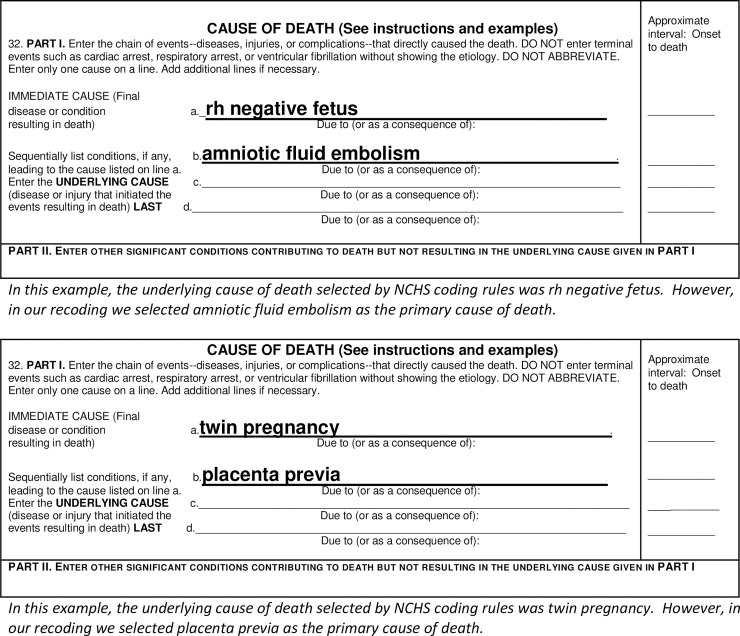
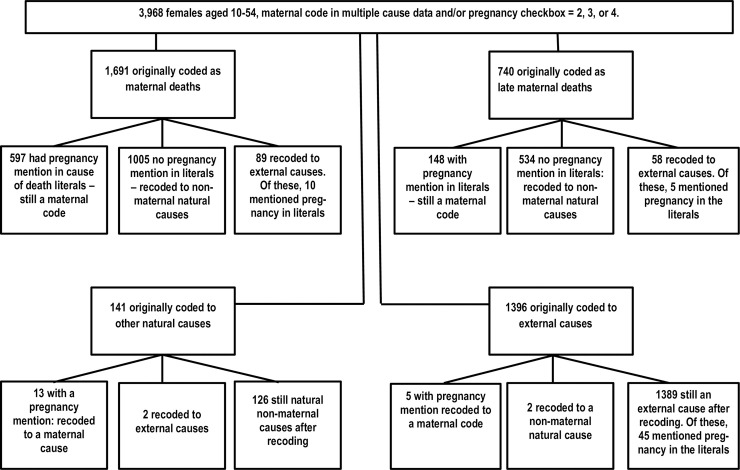
Changes in data collection and processing of US maternal mortality data across states over time have led to inconsistencies in maternal death reporting. Our purpose was to identify possible misclassification of maternal deaths and to apply alternative coding methods to improve specificity of maternal causes. We analyzed 2016-2017 US vital statistics mortality data with cause-of-death literals (actual words written on the death certificate) added. We developed an alternative coding strategy to code the "primary cause of death" defined as the most likely cause that led to death. We recoded deaths with or without literal pregnancy mentions to maternal and non-maternal causes, respectively. Originally coded and recoded data were compared for overall maternal deaths and for a subset of deaths originally coded to ill-defined causes. Among 1691 originally coded maternal deaths, 597 (35.3%) remained a maternal death upon recoding and 1094 (64.7%) were recoded to non-maternal causes. The most common maternal causes were eclampsia and preeclampsia, obstetric embolism, postpartum cardiomyopathy, and obstetric hemorrhage. The most common non-maternal causes were diseases of the circulatory system and cancer, similar to the leading causes of death among all reproductive-age women (excluding injuries). Among 735 records originally coded to ill-defined causes, 94% were recoded to more specific, informative causes from literal text. Eighteen deaths originally coded as non-maternal mentioned pregnancy in the literals and were recoded as maternal deaths. Literal text provides more detailed information on cause of death which is often lost during coding. We found evidence of both underreporting and overreporting of maternal deaths, with possible overreporting predominant. Accurate data is essential for measuring the effectiveness of maternal mortality reduction programs.
美国各州的孕产妇死亡率数据在收集和处理方面的变化,导致了孕产妇死亡报告的不一致。我们的目的是确定孕产妇死亡是否可能被错误分类,并应用替代编码方法来提高孕产妇死因的特异性。我们分析了 2016-2017 年美国生命统计死亡率数据,并添加了死因文字描述(死亡证明上实际书写的文字)。我们开发了一种替代编码策略,对“主要死因”进行编码,定义为最有可能导致死亡的原因。我们将有或没有妊娠文字描述的死亡分别重新编码为孕产妇和非孕产妇原因。我们比较了原始编码和重新编码数据的总体孕产妇死亡人数,以及原始编码为不明确原因的死亡人数的一个子集。在最初编码的 1691 例孕产妇死亡中,597 例(35.3%)在重新编码后仍为孕产妇死亡,1094 例(64.7%)被重新编码为非孕产妇死亡。最常见的孕产妇死因是子痫和先兆子痫、产科栓塞、产后心肌病和产科出血。最常见的非孕产妇死因是循环系统疾病和癌症,与所有育龄妇女(不包括伤害)的主要死因相似。在最初编码为不明确原因的 735 例记录中,94%的记录根据文字描述被重新编码为更具体、更有信息的原因。18 例最初编码为非孕产妇的死亡在文字描述中提到了妊娠,并被重新编码为孕产妇死亡。文字描述提供了关于死因的更详细信息,而这些信息在编码过程中经常丢失。我们发现了孕产妇死亡报告的漏报和多报的证据,可能以多报为主。准确的数据对于衡量减少孕产妇死亡率计划的有效性至关重要。