Cavallari Ilaria, Grassi Angela, Del Bianco Paola, Aceti Alberto, Zaborra Carlotta, Sharova Evgeniya, Bertazzolo Irene, D'Agostino Donna M, Iafrate Massimo, Ciminale Vincenzo
Veneto Institute of Oncology IOV-IRCCS, 35128, Padua, Italy.
Department of Surgery, Oncology and Gastroenterology, University of Padua, 35128 Padua, Italy.
Cancers (Basel). 2020 Oct 26;12(11):3133. doi: 10.3390/cancers12113133.
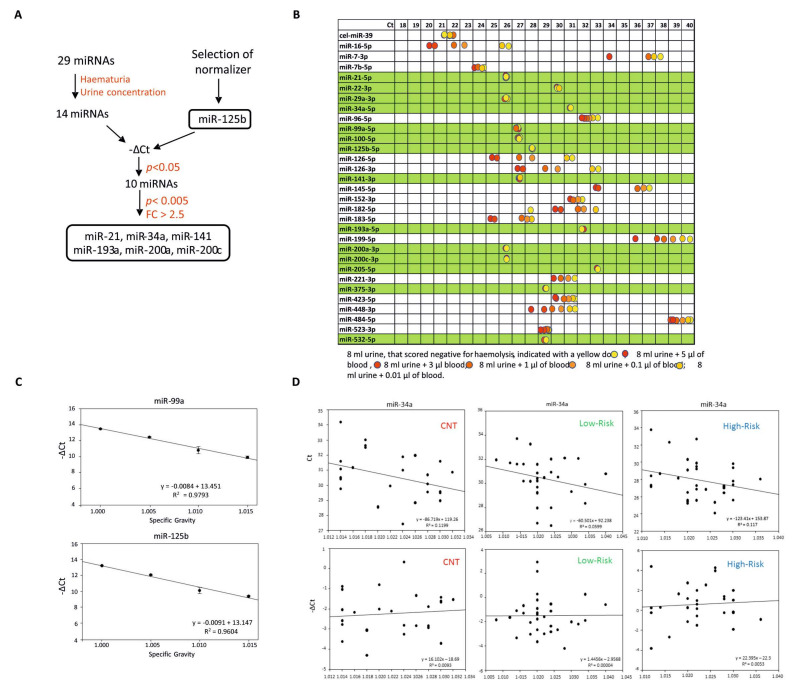
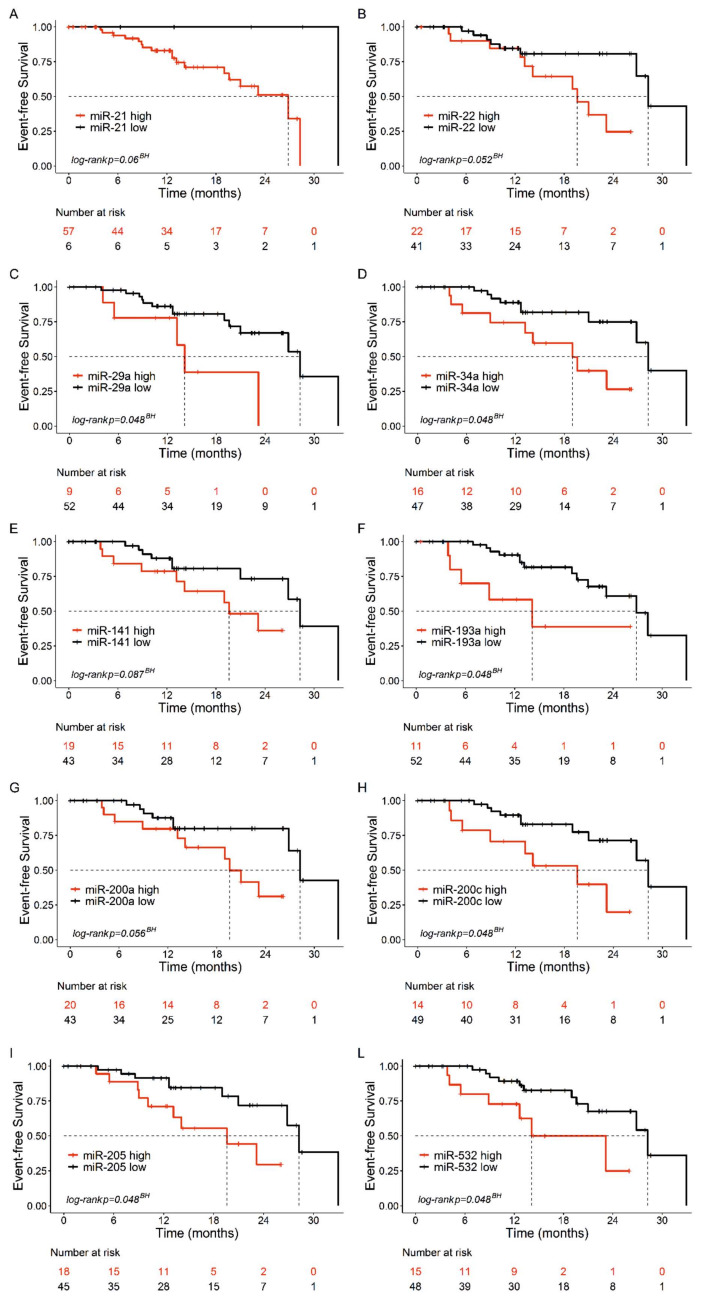
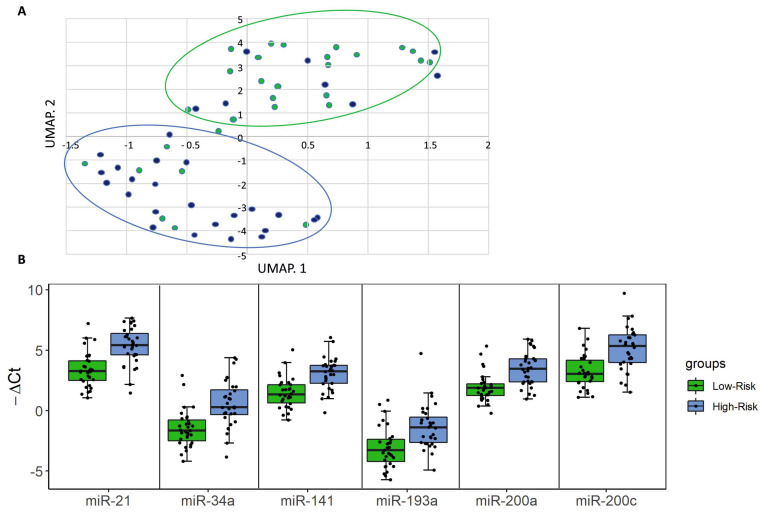
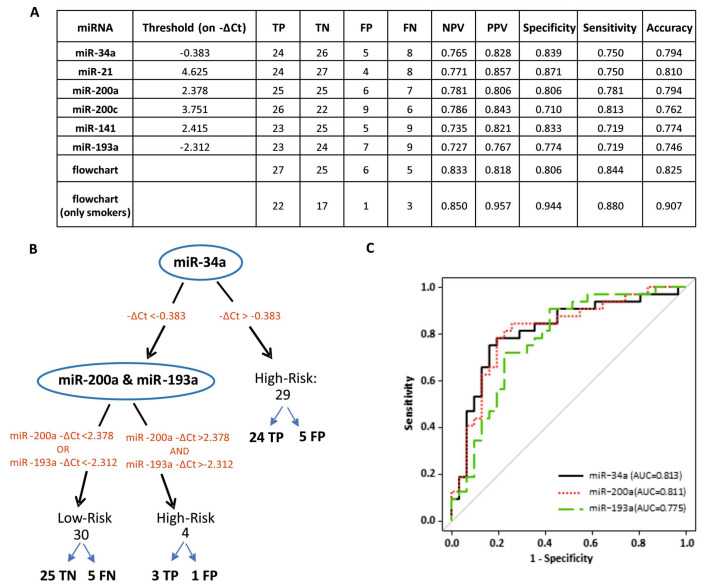
Robust non-invasive tests for prognostic stratification of bladder cancer (BCa) patients are in high demand. Following a comprehensive analysis of studies on BCa, we selected a panel of 29 microRNAs (miRNAs) and analyzed their levels in urine and plasma samples in a prospective cohort of 63 BCa patients (32 at high risk of recurrence and 31 low-risk cases) and 37 healthy controls using RT-qPCR. To design an assay suitable for large-scale testing, we applied a hierarchical pipeline to select the miRNAs that were not affected by confounding factors such as haematuria and urine specific gravity, and exceeded stringent cut-off criteria (fold change >2.5 and value < 0.005). Using a two-step decision tree based on the urine levels of miR-34a-5p, miR-200a-3p and miR-193a-5p, normalized against miR-125b-5p, patients could be classified as high- or low-risk with a sensitivity of 0.844, specificity of 0.806 and accuracy of 0.825. Furthermore, univariate Cox proportional hazards regression analyses indicated that increased urine levels of miR-29a-3p, miR-34a-5p, miR-193a-5p, miR-200c-3p, miR-205-5p and miR-532-5p were associated with a shorter event-free survival (hazard ratios > 3.1, value < 0.05). Taken together, our findings suggest that measuring the urine levels of these miRNAs could provide a novel cost-effective, noninvasive test for risk assessment of BCa patients.
对于膀胱癌(BCa)患者进行预后分层的可靠非侵入性检测方法需求迫切。在对BCa相关研究进行全面分析之后,我们挑选了一组29种微小RNA(miRNA),并使用逆转录定量聚合酶链反应(RT-qPCR)分析了63例BCa患者(32例高复发风险和31例低风险病例)以及37例健康对照者尿液和血浆样本中这些miRNA的水平。为设计适用于大规模检测的分析方法,我们采用了分层流程来选择不受血尿和尿比重等混杂因素影响且超过严格截断标准(倍数变化>2.5且值<0.005)的miRNA。基于以miR-125b-5p标准化后的miR-34a-5p、miR-200a-3p和miR-193a-5p的尿液水平构建两步决策树,可将患者分为高风险或低风险,灵敏度为0.844,特异性为0.806,准确率为0.825。此外,单变量Cox比例风险回归分析表明,尿液中miR-29a-3p、miR-34a-5p、miR-193a-5p、miR-200c-3p、miR-205-5p和miR-532-5p水平升高与无事件生存期缩短相关(风险比>3.1,值<0.05)。综上所述,我们的研究结果表明,检测这些miRNA的尿液水平可为BCa患者的风险评估提供一种新型的经济高效的非侵入性检测方法。