Plastic and Reconstructive Surgery Research, Centre for Dermatology Research, NIHR Manchester Biomedical Research Centre, University of Manchester, Manchester, United Kingdom.
Department of Pathology, Wexner Medical Center, The Ohio State University, Columbus, OH, United States.
Front Immunol. 2020 Sep 30;11:552205. doi: 10.3389/fimmu.2020.552205. eCollection 2020.
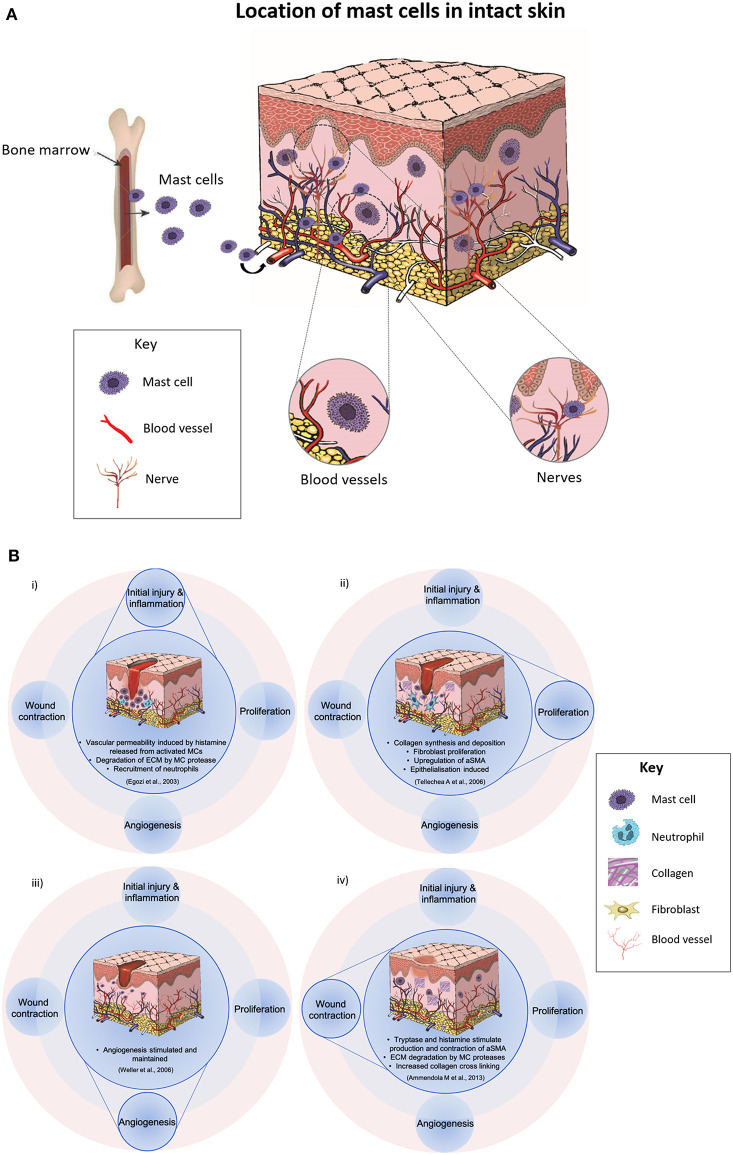
Mast cells (MCs) are an important immune cell type in the skin and play an active role during wound healing. MCs produce mediators that can enhance acute inflammation, stimulate re-epithelialisation as well as angiogenesis, and promote skin scarring. There is also a link between MCs and abnormal pathological cutaneous scarring, with increased numbers of MCs found in hypertrophic scars and keloid disease. However, there has been conflicting data regarding the specific role of MCs in scar formation in both animal and human studies. Whilst animal studies have proved to be valuable in studying the MC phenomenon in wound healing, the appropriate translation of these findings to cutaneous wound healing and scar formation in human subjects remains crucial to elucidate the role of these cells and target treatment effectively. Therefore, this perspective paper will focus on evaluation of the current evidence for the role of MCs in skin scarring in both animals and humans in order to identify common themes and future areas for translational research.
肥大细胞(MCs)是皮肤中一种重要的免疫细胞类型,在伤口愈合过程中发挥着积极的作用。MCs 产生的介质可以增强急性炎症,刺激再上皮化以及血管生成,并促进皮肤瘢痕形成。MCs 与异常病理性皮肤瘢痕之间也存在联系,在增生性瘢痕和瘢痕疙瘩疾病中发现 MCs 的数量增加。然而,关于 MCs 在动物和人类研究中对瘢痕形成的具体作用,一直存在相互矛盾的数据。虽然动物研究已被证明在研究伤口愈合中的 MC 现象方面具有价值,但将这些发现适当地转化为人类皮肤伤口愈合和瘢痕形成,对于阐明这些细胞的作用并有效地靶向治疗仍然至关重要。因此,本观点文章将重点评估 MCs 在动物和人类皮肤瘢痕形成中的作用的现有证据,以确定共同的主题和未来的转化研究领域。