Division of Nephrology, Department of Medicine, Icahn School of Medicine at Mount Sinai, New York, NY, United States.
UO Nefrologia, Azienda Ospedaliera-Universitaria di Parma, Parma, Italy.
Front Immunol. 2020 Sep 29;11:583702. doi: 10.3389/fimmu.2020.583702. eCollection 2020.
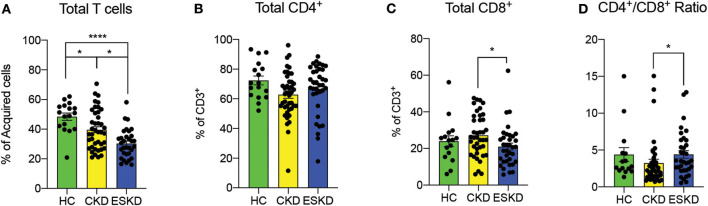
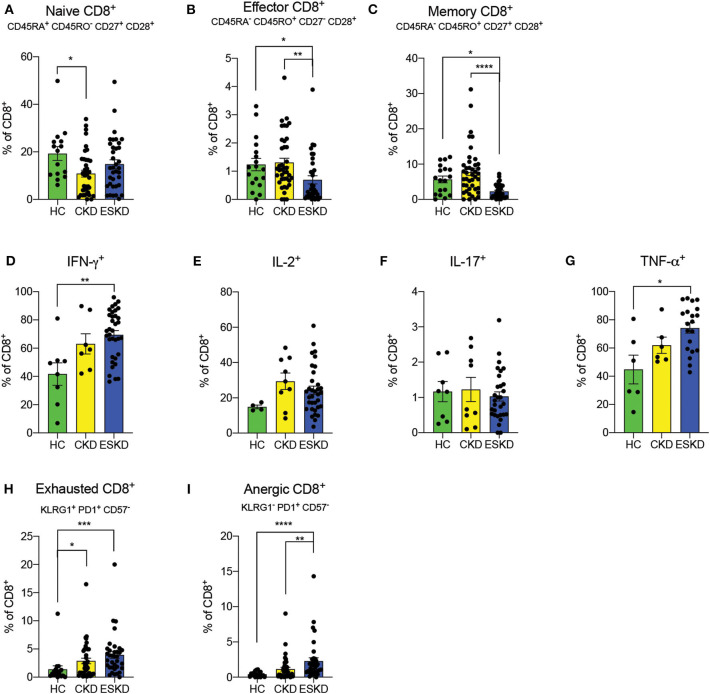
Individuals with kidney failure are at increased risk of cardiovascular events, as well as infections and malignancies, but the associated immunological abnormalities are unclear. We hypothesized that the uremic milieu triggers a chronic inflammatory state that, while accelerating atherosclerosis, promotes T cell exhaustion, impairing effective clearance of pathogens and tumor cells. Clinical and demographic data were collected from 78 patients with chronic kidney disease (CKD) ( = 42) or end-stage kidney disease (ESKD) ( = 36) and from 18 healthy controls (HC). Serum cytokines were analyzed by Luminex. Immunophenotype of T cells was performed by flow cytometry on peripheral blood mononuclear cells. ESKD patients had significantly higher serum levels of IFN-γ, TNF-α, sCD40L, GM-CSF, IL-4, IL-8, MCP-1, and MIP-1β than CKD and HC. After mitogen stimulation, both CD4 and CD8 T cells in ESKD group demonstrated a pro-inflammatory phenotype with increased IFN-γ and TNF-α, whereas both CKD and ESKD patients had higher IL-2 levels. CKD and ESKD were associated with increased frequency of exhausted CD4 T cells (CD4KLRG1PD1CD57) and CD8 T cells (CD8KLRG1PD1CD57), as well as anergic CD4 T cells (CD4KLRG1PD1CD57) and CD8 T cells (CD8KLRG1PD1CD57). Although total percentage of follicular helper T cell (T) was similar amongst groups, ESKD had reduced frequency of T (CCR6CXCR3CXCR5PD1CD4CD8), but increased T (CCR6CXCR3CXCR5PD1CD4CD8), and plasmablasts (CD3CD56CD19CD27CD38CD138). In conclusion, kidney failure is associated with pro-inflammatory markers, exhausted T cell phenotype, and upregulated T, especially in ESKD. These immunological changes may account, at least in part, for the increased cardiovascular risk in these patients and their susceptibility to infections and malignancies.
肾衰竭患者发生心血管事件、感染和恶性肿瘤的风险增加,但相关免疫异常尚不清楚。我们假设尿毒症环境引发慢性炎症状态,在加速动脉粥样硬化的同时促进 T 细胞耗竭,从而影响对病原体和肿瘤细胞的有效清除。收集了 78 例慢性肾脏病(CKD)患者(=42 例)和终末期肾脏病(ESKD)患者(=36 例)和 18 例健康对照者(HC)的临床和人口统计学数据。通过 Luminex 分析血清细胞因子。通过流式细胞术分析外周血单个核细胞的 T 细胞免疫表型。ESKD 患者的血清 IFN-γ、TNF-α、sCD40L、GM-CSF、IL-4、IL-8、MCP-1 和 MIP-1β水平明显高于 CKD 和 HC。ESKD 组经有丝分裂原刺激后,CD4 和 CD8 T 细胞均表现出促炎表型,IFN-γ和 TNF-α增加,而 CKD 和 ESKD 患者的 IL-2 水平均升高。CKD 和 ESKD 患者均与耗竭的 CD4 T 细胞(CD4KLRG1PD1CD57)和 CD8 T 细胞(CD8KLRG1PD1CD57)以及无反应性 CD4 T 细胞(CD4KLRG1PD1CD57)和 CD8 T 细胞(CD8KLRG1PD1CD57)频率增加有关。尽管各组滤泡辅助性 T 细胞(Tfh)的总百分比相似,但 ESKD 患者的 Tfh(CCR6CXCR3CXCR5PD1CD4CD8)频率降低,但 Tfh(CCR6CXCR3CXCR5PD1CD4CD8)和浆母细胞(CD3CD56CD19CD27CD38CD138)频率增加。总之,肾衰竭与促炎标志物、衰竭的 T 细胞表型以及上调的 T 细胞有关,尤其是在 ESKD 中。这些免疫学变化至少部分解释了这些患者心血管风险增加以及他们对感染和恶性肿瘤的易感性。