Cahill Niamh, Weinberger Michelle, Alkema Leontine
Department of Mathematics and Statistics, Maynooth University, Maynooth, Ireland.
Avenir Health, Washington D.C., USA.
Gates Open Res. 2020 Jul 21;4:113. doi: 10.12688/gatesopenres.13125.1. eCollection 2020.
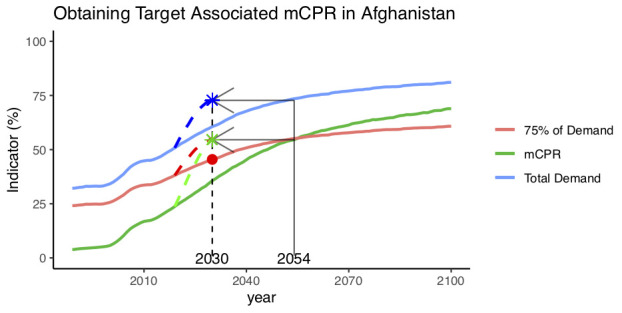
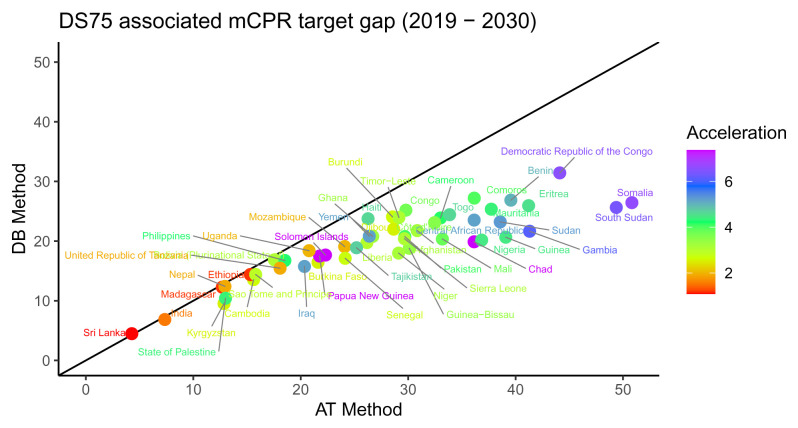
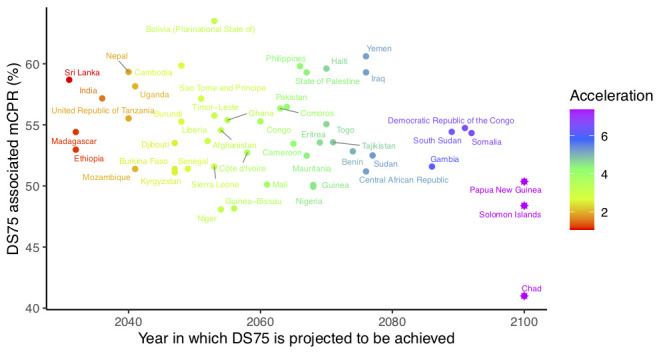
Sustainable Development Goal 3.7 aims to ensure universal access to sexual and reproductive health services. One suggested benchmark is to have at least 75% of the demand for contraception satisfied with modern methods (DS) in all countries by 2030. The translation of DS-based targets into targets for the modern contraceptive prevalence rate (mCPR) is needed to make targets actionable. We propose the Accelerated Transition (AT) method for determining the mCPR needed to reach demand-satisfied targets by 2030. The starting point for this method is the projection of DS under "business as usual" using the one-country implementation of the Family Planning Estimation Model (FPEMcountry). For countries in which the DS target is projected to be later than 2030, the AT method assumes that meeting the DS target by 2030 requires an acceleration of the contraceptive use transition such that the DS target, and its associated mCPR, will be reached in 2030 as opposed to the later year. The DS-target-associated mCPR becomes the mCPR target for the year 2030. We apply the AT method to assess progress needed for attaining the 75% DS target for married or in-union women in the world's poorest countries. For 50 out of 68 countries, we estimate that accelerations are needed, with required mCPR increases ranging from 4.3 to 50.8 percentage points. The AT method quantifies the acceleration needed - as compared to business as usual projections - for a country to meet a family planning target. The method can be used to determine the mCPR needed to reach demand-satisfied targets.
可持续发展目标3.7旨在确保普遍获得性健康和生殖健康服务。一个建议的基准是到2030年在所有国家使至少75%的避孕需求通过现代方法得到满足(需求满足率)。需要将基于需求满足率的目标转化为现代避孕普及率(mCPR)目标,以使目标具有可操作性。我们提出加速转变(AT)方法来确定到2030年实现需求满足目标所需的mCPR。该方法的起点是使用计划生育估计模型的单国实施版本(FPEMcountry)对“照常营业”情况下的需求满足率进行预测。对于预测需求满足率目标晚于2030年的国家,AT方法假定到2030年实现需求满足率目标需要加速避孕使用转变,以便在2030年而非更晚的年份实现需求满足率目标及其相关的mCPR。与需求满足率目标相关的mCPR成为2030年的mCPR目标。我们应用AT方法来评估世界最贫穷国家已婚或同居妇女实现75%需求满足率目标所需的进展。在68个国家中的50个国家,我们估计需要加速,所需的mCPR增幅从4.3个百分点到50.8个百分点不等。AT方法量化了一个国家为实现计划生育目标相对于照常营业预测所需的加速程度。该方法可用于确定实现需求满足目标所需的mCPR。