Clark Joseph, Crowther Lucia, Johnson Miriam J, Ramsenthaler Christina, Currow David C
Wolfson Palliative Care Research Centre, University of Hull, Hull, United Kingdom.
Faculty of Health Sciences, Zurich University of Applied Sciences, Winterthur, Switzerland.
PLOS Glob Public Health. 2022 Jul 8;2(7):e0000533. doi: 10.1371/journal.pgph.0000533. eCollection 2022.
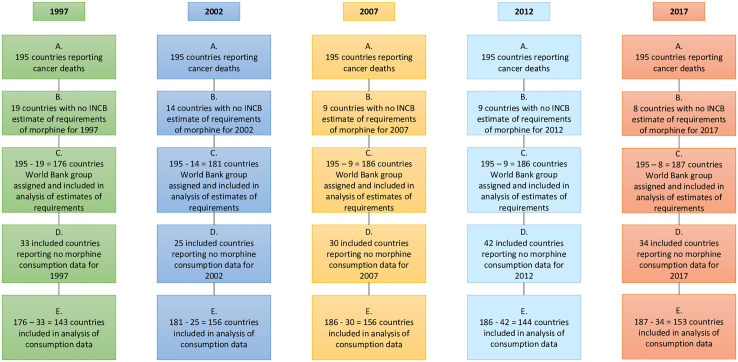
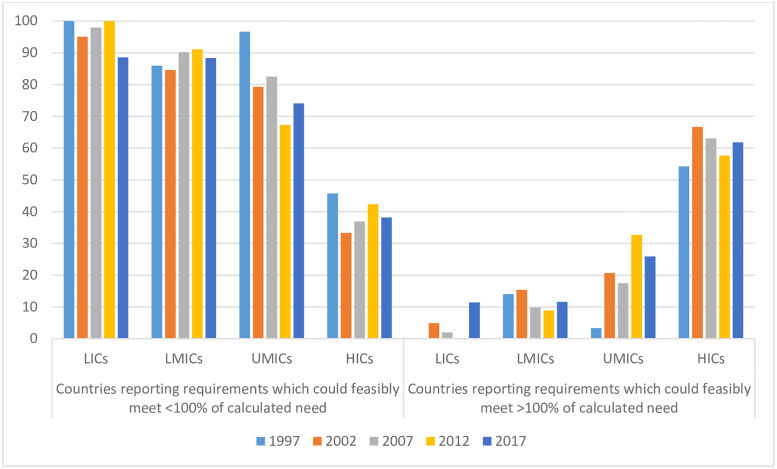
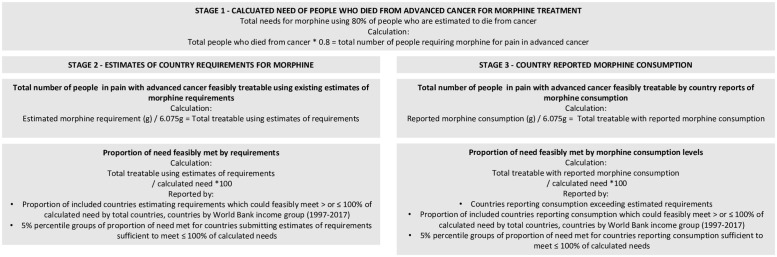
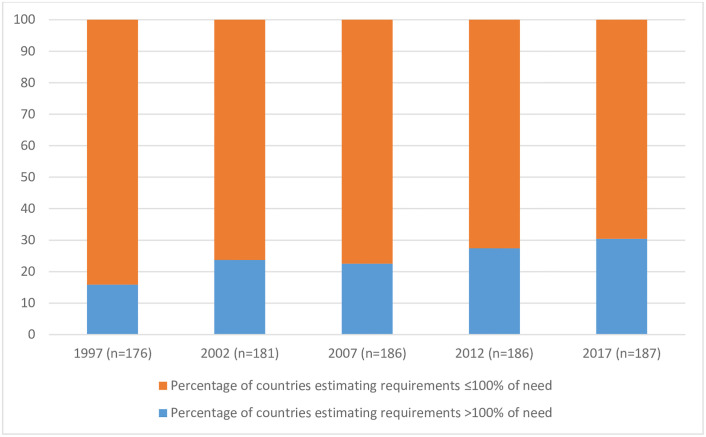
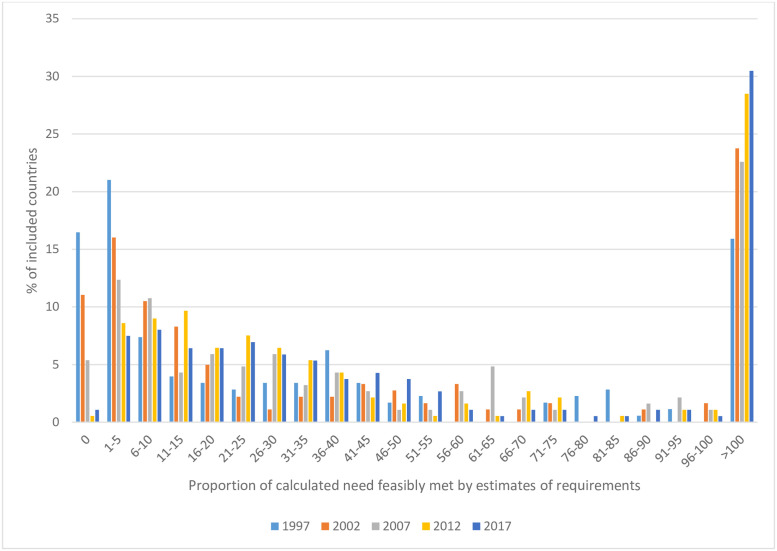
Lack of access to therapeutic opioids continuing causes global health inequalities. Access to morphine for symptom control is regulated under the terms of the Single Convention on Narcotics, countries must submit annual morphine requirement estimates and report consumption to the International Narcotics Control Board (INCB). INCB indicates access to morphine is increasing, however, estimated needs are unreported so changing proportions of needs feasibly met by requirements and consumption are unknown. Retrospective time series-analysis taking cross-sections every five years of gaps between calculated needs for morphine for people who die from cancer and total treatable using estimates of requirements and consumption (1997, 2002, 2007, 2012, 2017). We calculated need using INCB-recommended methods (80% of people who die from cancer require 67.5mg of morphine daily for 90 days (6.075g)) for countries reporting estimates and consumption using Global Burden of Disease cancer deaths by country. Gaps between calculated need and total treatable population using estimates and consumption were calculated. We report proportions of need feasibly met by estimates and consumption for included countries, by World Bank Income group. Global availability of morphine increased, from estimates sufficient to treat 86% of calculated needs in 1997, to 701% in 2017. However, proportion of countries estimating requirements feasibly meeting >100% of calculated needs rose only from 16% to 30%. Almost all Low-and-Middle-Income Countries submitted inadequate estimates with little change in 20 years. Consumption was lower than calculated needs at all time-points. Very few countries reported consumption greater than their estimate of requirement. Most countries submitted morphine estimates insufficient to meet analgesic needs of people who died from cancer. Estimates of requirements contextualise future Consumption, and increases in adequacy of estimates and consumption were minimal over 20 years. Annual publication of calculated morphine needs alongside estimates and consumption may be a key step to drive countries' accountabilities.
无法获取治疗性阿片类药物持续导致全球健康不平等。根据《麻醉品单一公约》的条款,用于症状控制的吗啡获取受到管制,各国必须提交吗啡年度需求估计数,并向国际麻醉品管制局(INCB)报告消费量。INCB表示吗啡的可及性正在增加,然而,估计需求未被报告,因此通过需求和消费量实际满足的需求比例变化情况不明。采用回顾性时间序列分析,每隔五年对因癌症死亡者的吗啡计算需求量与使用需求估计数和消费量计算的可治疗总数之间的差距进行横断面分析(1997年、2002年、2007年、2012年、2017年)。我们使用INCB推荐的方法计算需求(80%因癌症死亡者在90天内每天需要67.5毫克吗啡(6.075克)),针对使用各国疾病负担癌症死亡数据报告估计数和消费量的国家。计算了计算需求量与使用估计数和消费量得出的可治疗总人口之间的差距。我们按世界银行收入组报告了纳入国家通过估计数和消费量实际满足的需求比例。吗啡的全球可及性有所增加,从1997年足以满足86%计算需求量的估计数,增至2017年的701%。然而,估计需求量能实际满足超过100%计算需求量的国家比例仅从16%升至30%。几乎所有低收入和中等收入国家提交的估计数不足,且20年来几乎没有变化。在所有时间点,消费量均低于计算需求量。很少有国家报告的消费量高于其需求估计数。大多数国家提交的吗啡估计数不足以满足因癌症死亡者的镇痛需求。需求估计数体现了未来的消费量,在20年期间,估计数和消费量的充足性增幅极小。每年公布计算得出的吗啡需求量以及估计数和消费量可能是推动各国承担责任的关键一步。