Graduate Entry Medical School, Health Research Institute, University of Limerick, Limerick, Ireland.
Physical Activity for Health Research Cluster, Health Research Institute, Department of Physical Education & Sport Sciences, University of Limerick, Limerick, Ireland.
PLoS One. 2020 Oct 29;15(10):e0240974. doi: 10.1371/journal.pone.0240974. eCollection 2020.
Physical inactivity among adults aged 50 years and over is a worldwide health concern. The objectives of the study were to investigate the perspectives of those involved with existing physical activity programmes on optimising recruitment, sustainability and scalability of physical activity programmes for adults aged 50 years and over.
The study was conducted in Ireland's Midwest region, where community-based physical activity programmes are delivered to groups by state-funded Local Sports Partnerships. Programme attendees, physical activity professionals and community advocates were recruited. One-to-one interviews and focus groups were conducted in 2018, recorded, transcribed and analysed by an interdisciplinary team experienced in qualitative research. Over a series of meetings, a thematic approach was used to code and analyse the transcripts, categorising data into higher order codes, themes and overarching themes with the purpose of making meaning of the data. Twenty-nine people participated in four focus groups and 18 participated in one-to-one interviews.
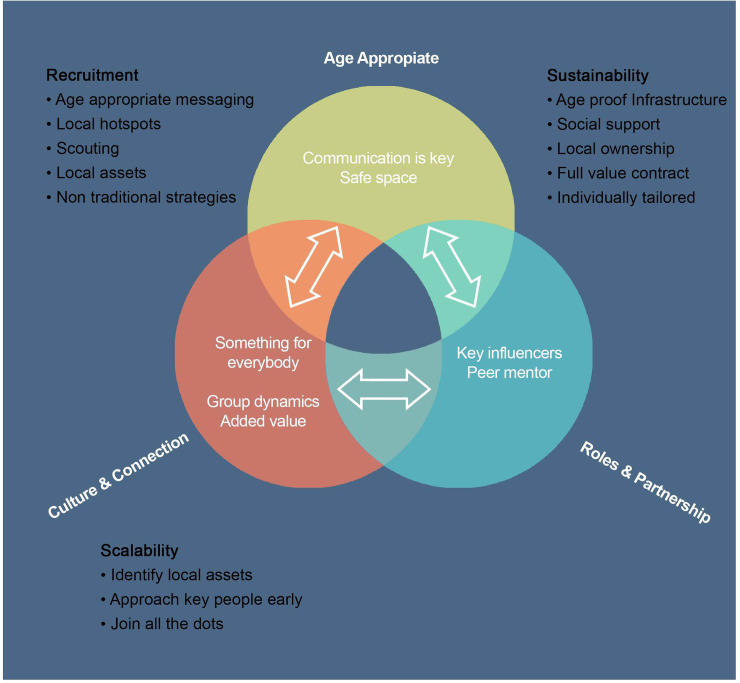
Data analysis produced three overarching themes. "Age appropriate" explains how communication and the environment should be adapted to the needs of adults aged 50 years and older. "Culture and connection" refer to the interplay of individual and social factors that influence participation, including individual fears and insecurities, group cohesion and added value beyond the physical gains in these programmes. "Roles and partnerships" outlines how key collaborations may be identified and managed and how local ownership is key to success and scalability.
Successful recruitment, sustainability and scalability require an understanding that the target population has unique needs that must be catered for when planning interventions, communicating messages and choosing personnel. The findings of this study can inform the development of community-based programmes to increase physical activity in adults aged 50 years and older.
50 岁及以上成年人的身体活动不足是一个全球性的健康问题。本研究的目的是调查参与现有身体活动项目的人员对优化 50 岁及以上成年人身体活动项目的招募、可持续性和可扩展性的看法。
该研究在爱尔兰中西部地区进行,该地区通过由国家资助的地方体育合作伙伴向团体提供基于社区的身体活动项目。招募了项目参与者、身体活动专业人员和社区倡导者。2018 年进行了一对一访谈和焦点小组,由具有丰富定性研究经验的跨学科团队进行录音、转录和分析。通过一系列会议,采用主题方法对转录本进行编码和分析,将数据分类为高级代码、主题和总体主题,目的是理解数据的含义。共有 29 人参加了 4 个焦点小组,18 人参加了一对一访谈。
数据分析产生了三个总体主题。“适合年龄”解释了如何根据 50 岁及以上成年人的需求调整沟通和环境。“文化和联系”是指个人和社会因素相互作用影响参与的方式,包括个人的恐惧和不安全感、群体凝聚力以及这些项目中除身体收益之外的附加值。“角色和伙伴关系”概述了如何确定和管理关键合作关系,以及地方所有权是成功和可扩展性的关键。
成功的招募、可持续性和可扩展性需要认识到目标人群有独特的需求,在规划干预措施、传达信息和选择人员时必须满足这些需求。本研究的结果可以为社区为基础的项目的发展提供信息,以增加 50 岁及以上成年人的身体活动。