
基于甲基化的新型血液检测方法Lung EpiCheck在欧洲和中国高危个体中用于肺癌检测的验证。
Validation of Lung EpiCheck, a novel methylation-based blood assay, for the detection of lung cancer in European and Chinese high-risk individuals.
作者信息
Gaga Mina, Chorostowska-Wynimko Joanna, Horváth Ildikó, Tammemagi Martin C, Shitrit David, Eisenberg Vered H, Liang Hao, Stav David, Levy Faber Dan, Jansen Maarten, Raviv Yael, Panagoulias Vasileios, Rudzinski Piotr, Izbicki Gabriel, Ronen Ohad, Goldhaber Adiv, Moalem Rawia, Arber Nadir, Haas Ilana, Zhou Qinghua
机构信息
7th Respiratory Medicine Dept, Athens Chest Hospital, Athens, Greece.
National Institute of Tuberculosis and Lung Diseases, Warsaw, Poland.
出版信息
Eur Respir J. 2021 Jan 14;57(1). doi: 10.1183/13993003.02682-2020. Print 2021 Jan.
AIM
Lung cancer screening reduces mortality. We aim to validate the performance of Lung EpiCheck, a six-marker panel methylation-based plasma test, in the detection of lung cancer in European and Chinese samples.
METHODS
A case-control European training set (n=102 lung cancer cases, n=265 controls) was used to define the panel and algorithm. Two cut-offs were selected, low cut-off (LCO) for high sensitivity and high cut-off (HCO) for high specificity. The performance was validated in case-control European and Chinese validation sets (cases/controls 179/137 and 30/15, respectively).
RESULTS
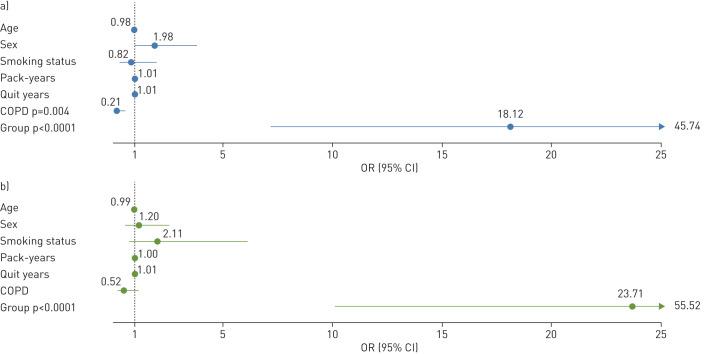
The European and Chinese validation sets achieved AUCs of 0.882 and 0.899, respectively. The sensitivities/specificities with LCO were 87.2%/64.2% and 76.7%/93.3%, and with HCO they were 74.3%/90.5% and 56.7%/100.0%, respectively. Stage I nonsmall cell lung cancer (NSCLC) sensitivity in European and Chinese samples with LCO was 78.4% and 70.0% and with HCO was 62.2% and 30.0%, respectively. Small cell lung cancer (SCLC) was represented only in the European set and sensitivities with LCO and HCO were 100.0% and 93.3%, respectively. In multivariable analyses of the European validation set, the assay's ability to predict lung cancer was independent of established risk factors (age, smoking, COPD), and overall AUC was 0.942.
CONCLUSIONS
Lung EpiCheck demonstrated strong performance in lung cancer prediction in case-control European and Chinese samples, detecting high proportions of early-stage NSCLC and SCLC and significantly improving predictive accuracy when added to established risk factors. Prospective studies are required to confirm these findings. Utilising such a simple and inexpensive blood test has the potential to improve compliance and broaden access to screening for at-risk populations.
目的
肺癌筛查可降低死亡率。我们旨在验证Lung EpiCheck(一种基于六标记物panel的血浆甲基化检测方法)在欧洲和中国样本中检测肺癌的性能。
方法
使用一个欧洲病例对照训练集(n = 102例肺癌病例,n = 265例对照)来定义检测panel和算法。选择了两个临界值,低临界值(LCO)用于高灵敏度,高临界值(HCO)用于高特异性。在欧洲和中国的病例对照验证集(分别为病例/对照179/137和30/15)中验证性能。
结果
欧洲和中国验证集的曲线下面积(AUC)分别为0.882和0.899。LCO时的灵敏度/特异性分别为87.2%/64.2%和76.7%/93.3%,HCO时分别为74.3%/90.5%和56.7%/100.0%。欧洲和中国样本中I期非小细胞肺癌(NSCLC)在LCO时的灵敏度分别为78.4%和70.0%,HCO时分别为62.2%和30.0%。小细胞肺癌(SCLC)仅在欧洲样本中出现,LCO和HCO时的灵敏度分别为100.0%和93.3%。在欧洲验证集的多变量分析中,该检测方法预测肺癌的能力独立于既定风险因素(年龄、吸烟、慢性阻塞性肺疾病),总体AUC为0.942。
结论
Lung EpiCheck在欧洲和中国病例对照样本的肺癌预测中表现出强大性能,能检测出高比例的早期NSCLC和SCLC,并且添加到既定风险因素中时能显著提高预测准确性。需要进行前瞻性研究来证实这些发现。使用这种简单且廉价的血液检测方法有可能提高依从性,并扩大高危人群的筛查范围。


 Zotero 插件