Deffner Felix, Scharr Melanie, Klingenstein Stefanie, Klingenstein Moritz, Milazzo Alfio, Scherer Simon, Wagner Andreas, Hirt Bernhard, Mack Andreas F, Neckel Peter H
Institute of Clinical Anatomy and Cell Analysis, University of Tübingen, Tübingen, Germany.
Institute of Neuroanatomy and Developmental Biology, University of Tübingen, Tübingen, Germany.
Front Neuroanat. 2020 Oct 6;14:596439. doi: 10.3389/fnana.2020.596439. eCollection 2020.
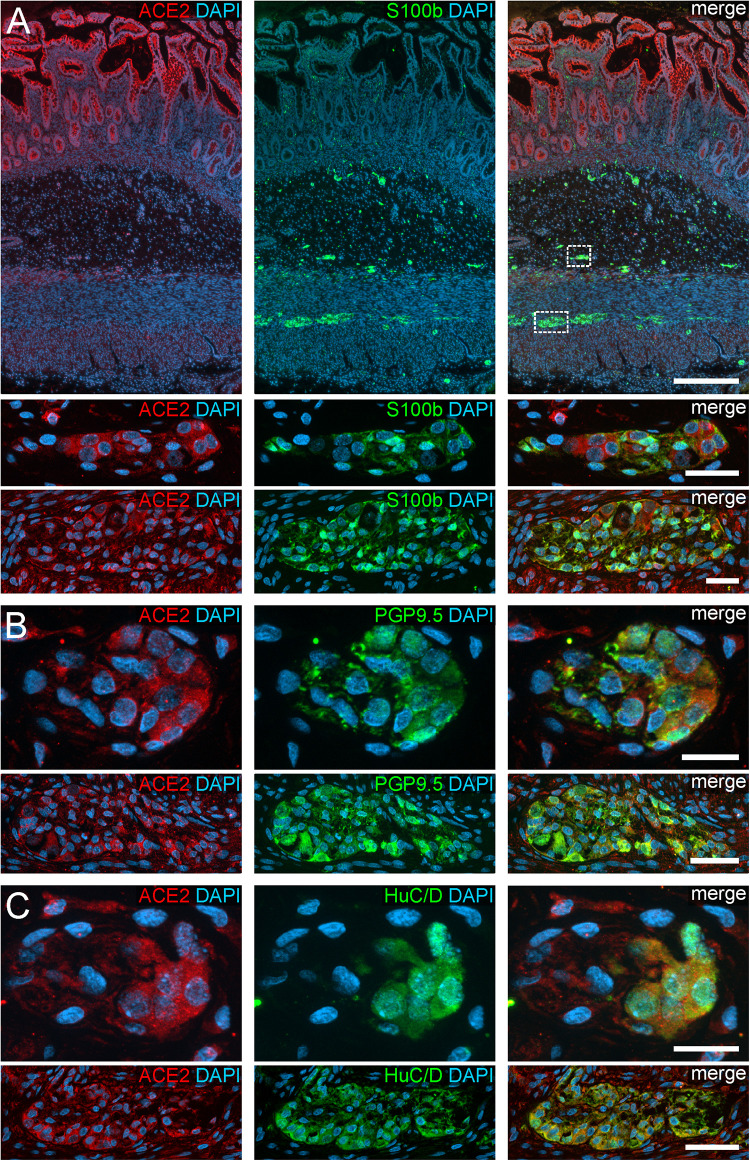
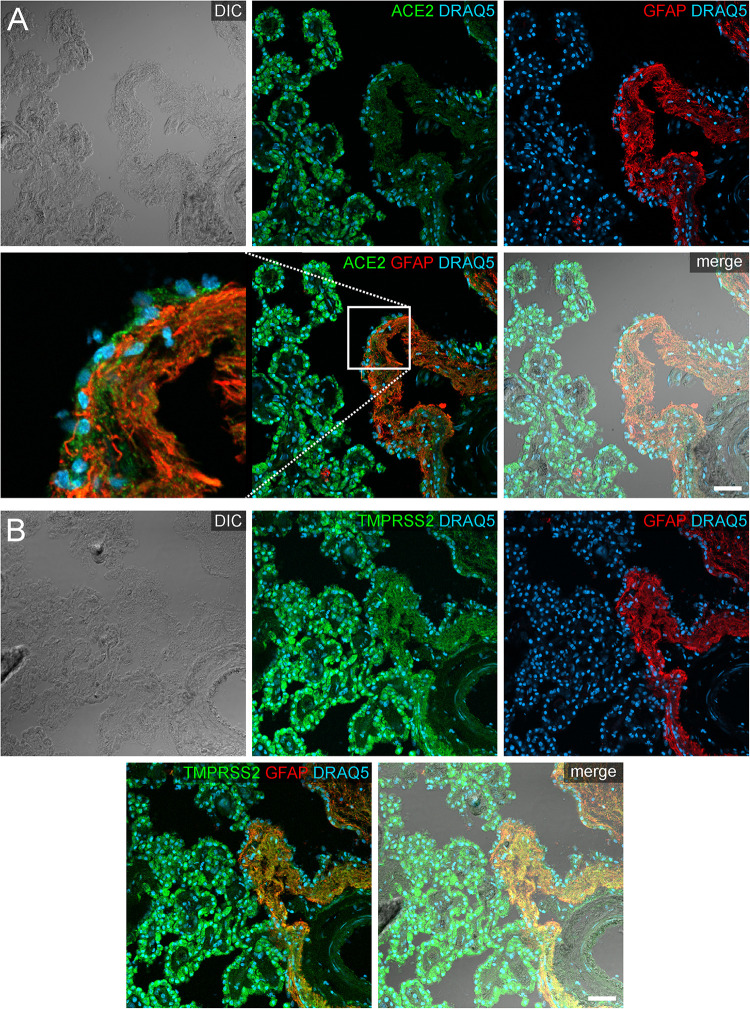
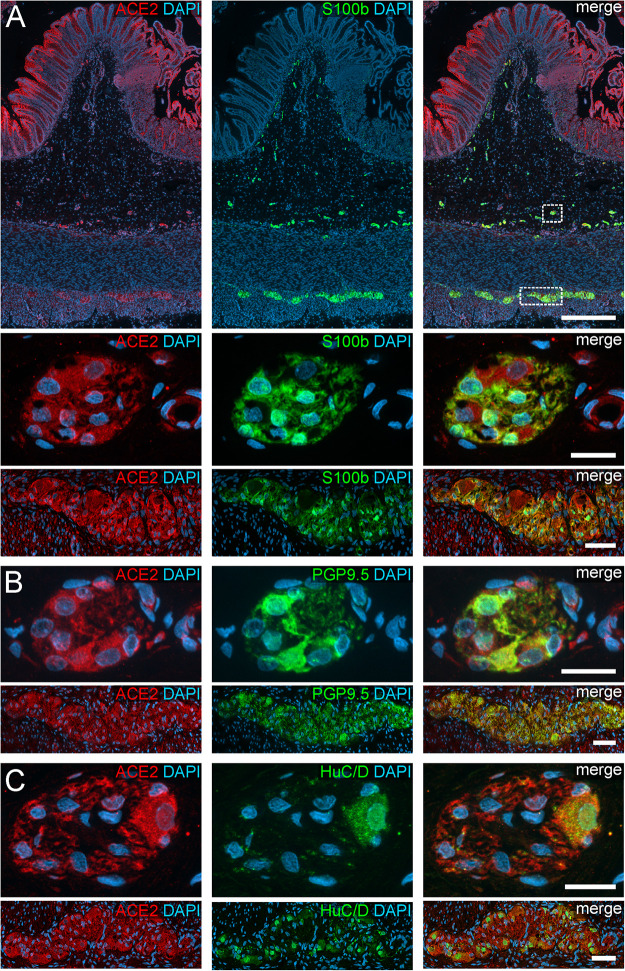
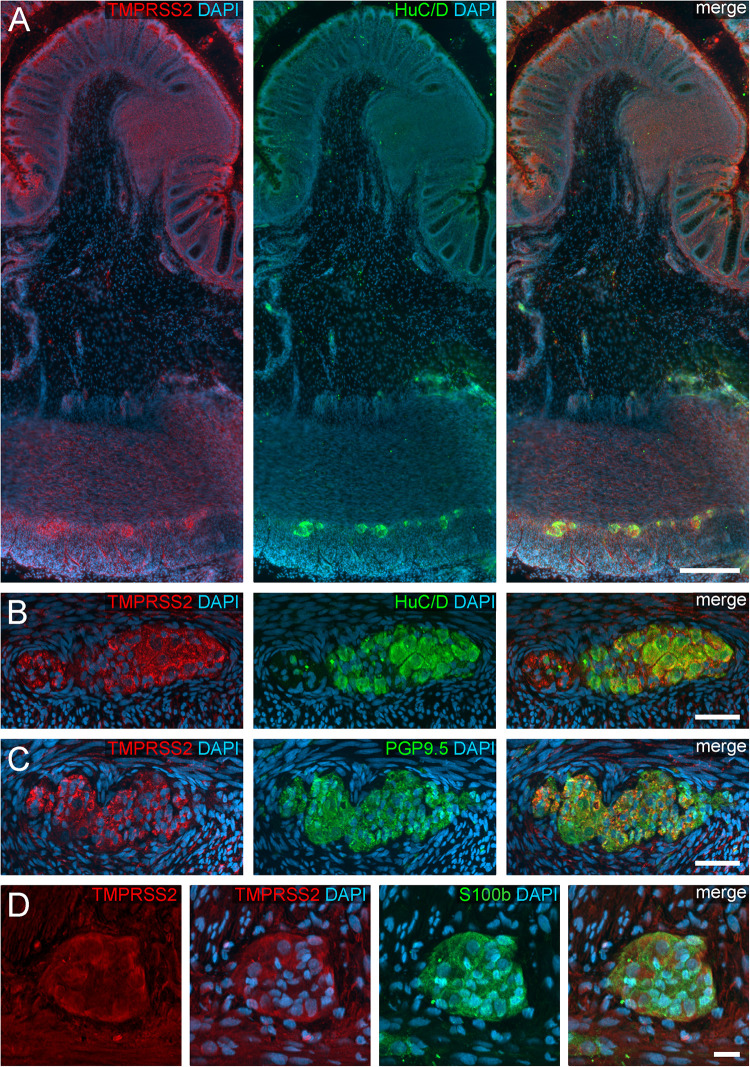
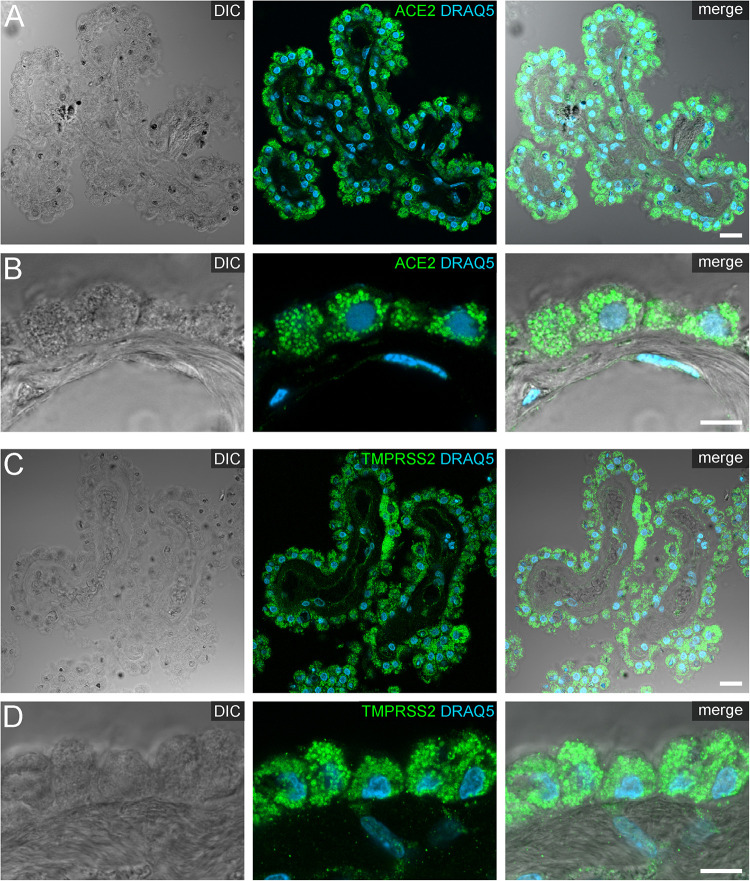
Evidence is mounting that the novel corona virus SARS-CoV2 inflicts neurological symptoms in a subgroup of COVID-19 patients. While plenty of theories on the route of neuroinvasion have been proposed, little histological evidence has been presented supporting any of these hypotheses. Therefore, we carried out immunostainings for ACE2 and TMPRSS2, two proteinases crucial for the entry of SARS-CoV2 into host cells, in the human enteric nervous system (ENS), as well as in the choroid plexus of the lateral ventricles. Both of these sites are important, yet often neglected entry gates to the nervous system. We found that ACE2 and TMPRSS2 are expressed by enteric neurons and glial cells of the small and large intestine, as well as choroid plexus epithelial cells, indicating that these cells meet the molecular requirements for viral entry. Together, our results are fundamental histological evidence substantiating current theories of neuroinvasion by SARS-CoV2.
越来越多的证据表明,新型冠状病毒SARS-CoV-2会在一部分新冠患者中引发神经症状。尽管已经提出了许多关于神经侵袭途径的理论,但几乎没有组织学证据支持这些假设中的任何一个。因此,我们在人类肠神经系统(ENS)以及侧脑室脉络丛中对ACE2和TMPRSS2进行了免疫染色,这两种蛋白酶对SARS-CoV-2进入宿主细胞至关重要。这两个部位都是重要的,但往往被忽视的神经系统入口。我们发现,ACE2和TMPRSS2在小肠和大肠的肠神经元和神经胶质细胞以及脉络丛上皮细胞中表达,表明这些细胞满足病毒进入的分子要求。总之,我们的结果是支持SARS-CoV-2神经侵袭当前理论的基础组织学证据。