Llaguno-Munive Monserrat, León-Zetina Sebastián, Vazquez-Lopez Inés, Ramos-Godinez María Del Pilar, Medina Luis A, Garcia-Lopez Patricia
Laboratorio de Farmacología, Subdirección de Investigación Básica, Instituto Nacional de Cancerología, Mexico City, Mexico.
Posgrado en Ciencias Biomédicas, Universidad Nacional Autónoma de México, Mexico City, Mexico.
Front Oncol. 2020 Oct 5;10:581814. doi: 10.3389/fonc.2020.581814. eCollection 2020.
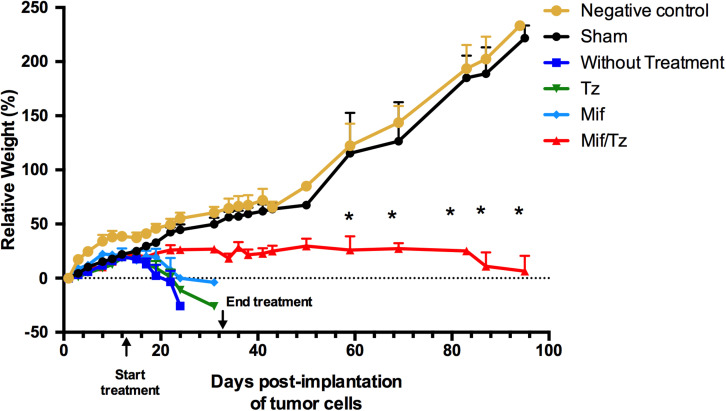
Glioblastoma, the most common primary central nervous system tumor, is characterized by extensive vascular neoformation and an area of necrosis generated by rapid proliferation. The standard treatment for this type of tumor is surgery followed by chemotherapy based on temozolomide and radiotherapy, resulting in poor patient survival. Glioblastoma is known for strong resistance to treatment, frequent recurrence and rapid progression. The aim of this study was to evaluate whether mifepristone, an antihormonal agent, can enhance the effect of temozolomide on C6 glioma cells orthotopically implanted in Wistar rats. The levels of the vascular endothelial growth factor (VEGF), and P-glycoprotein (P-gp) were examined, the former a promoter of angiogenesis that facilitates proliferation, and the latter an efflux pump transporter linked to drug resistance. After a 3-week treatment, the mifepristone/temozolomide regimen had decreased the level of VEGF and P-gp and significantly reduced tumor proliferation (detected by PET/CT images based on 18F-fluorothymidine uptake). Additionally, mifepristone proved to increase the intracerebral concentration of temozolomide. The lower level of O6-methylguanine-DNA-methyltransferase (MGMT) (related to DNA repair in tumors) previously reported for this combined treatment was herein confirmed. After the mifepristone/temozolomide treatment ended, however, the values of VEGF, P-gp, and MGMT increased and reached control levels by 14 weeks post-treatment. There was also tumor recurrence, as occurred when administering temozolomide alone. On the other hand, temozolomide led to 100% mortality within 26 days after beginning the drug treatment, while mifepristone/temozolomide enabled 70% survival 60-70 days and 30% survived over 100 days, suggesting that mifepristone could possibly act as a chemo-sensitizing agent for temozolomide.
胶质母细胞瘤是最常见的原发性中枢神经系统肿瘤,其特征是广泛的血管新生以及由快速增殖产生的坏死区域。这类肿瘤的标准治疗方法是手术,随后进行基于替莫唑胺的化疗和放疗,患者生存率较低。胶质母细胞瘤以对治疗的强烈抗性、频繁复发和快速进展而闻名。本研究的目的是评估抗激素药物米非司酮是否能增强替莫唑胺对原位植入Wistar大鼠的C6胶质瘤细胞的作用。检测了血管内皮生长因子(VEGF)和P-糖蛋白(P-gp)的水平,前者是促进增殖的血管生成促进因子,后者是与耐药性相关的外排泵转运蛋白。经过3周的治疗,米非司酮/替莫唑胺方案降低了VEGF和P-gp的水平,并显著降低了肿瘤增殖(通过基于18F-氟胸腺嘧啶摄取的PET/CT图像检测)。此外,米非司酮被证明可提高替莫唑胺的脑内浓度。此前报道的这种联合治疗中较低水平的O6-甲基鸟嘌呤-DNA甲基转移酶(MGMT)(与肿瘤中的DNA修复有关)在本研究中得到了证实。然而,在米非司酮/替莫唑胺治疗结束后,VEGF、P-gp和MGMT的值升高,并在治疗后14周达到对照水平。也出现了肿瘤复发,就像单独使用替莫唑胺时一样。另一方面,替莫唑胺在开始药物治疗后26天内导致100%的死亡率,而米非司酮/替莫唑胺使70%的大鼠在60 - 70天内存活,30%的大鼠存活超过100天,这表明米非司酮可能作为替莫唑胺的化疗增敏剂。