Ryu Seunghyong, Lee Hyeongrae, Lee Dong-Kyun, Nam Hee Jung, Chung Young-Chul, Kim Sung-Wan
Department of Psychiatry, Chonnam National University Medical School, Gwangju, Korea.
Department of Mental Health Research, National Center for Mental Health, Seoul, Korea.
Clin Psychopharmacol Neurosci. 2020 Nov 30;18(4):571-579. doi: 10.9758/cpn.2020.18.4.571.
: This study used network analyses to examine network structures reflecting interactions between specific domains of social functioning in schizophrenia (SZ) and bipolar disorder (BD).
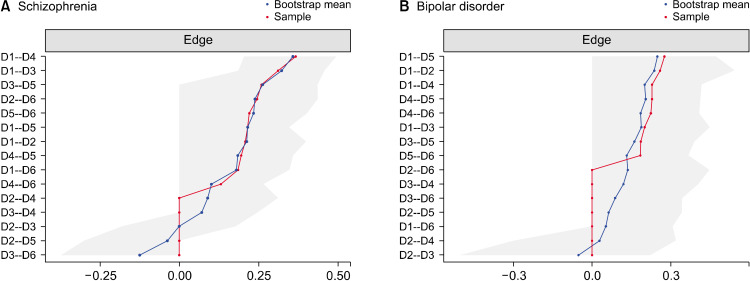
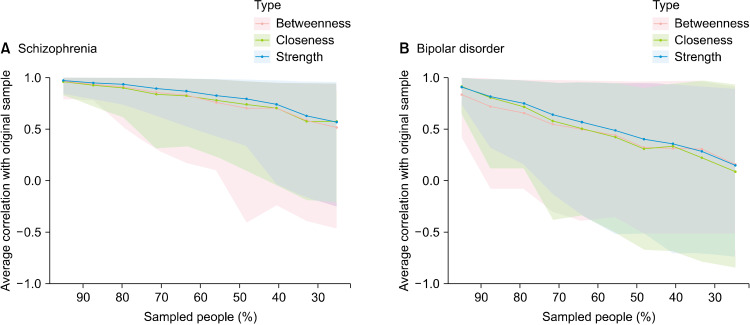
We used the World Health Organization Disability Assessment Schedule 2.0 (WHODAS 2.0) to assess six domains of social functioning ('cognition', 'mobility', 'self-care', 'getting along', 'life activities', and 'participation') in 143 patients with SZ, 81 patients with BD, and 106 healthy subjects. We constructed regularized partial correlation networks, estimated network centrality and edge strength, tested network stability, and compared SZ and BD network structures.
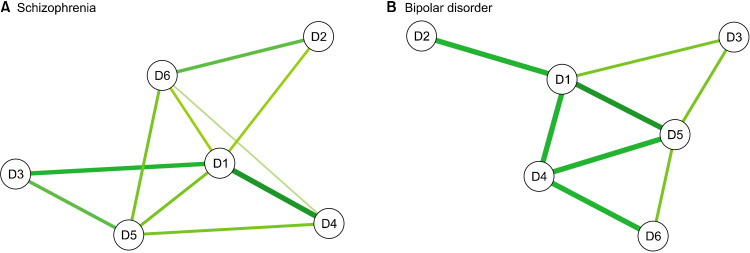
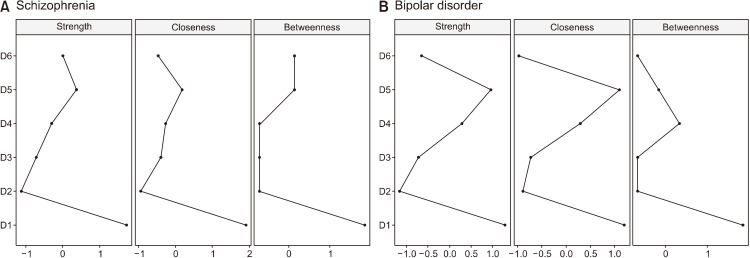
Patients with SZ showed a significantly higher level of functional disability than patients with BD. In the networks we constructed, 'cognition' was the most central domain of social functioning in both SZ and BD. The 'cognition' domain was primarily associated with the 'getting along' domain in the SZ network and the 'life activities' domain in the BD network. We found no significant group-level differences in network structures for SZ vs. BD.
Our results suggest that cognition may play a pivotal role in social functioning in both SZ and BD. In addition, domains of social functioning in SZ and BD have similar network structures despite the higher level of disability in SZ compared to BD.
本研究采用网络分析方法,以检验反映精神分裂症(SZ)和双相情感障碍(BD)社会功能特定领域之间相互作用的网络结构。
我们使用世界卫生组织残疾评定量表2.0(WHODAS 2.0)对143例SZ患者、81例BD患者和106名健康受试者的六个社会功能领域(“认知”、“移动性”、“自我护理”、“相处”、“生活活动”和“参与”)进行评估。我们构建了正则化偏相关网络,估计网络中心性和边强度,测试网络稳定性,并比较SZ和BD的网络结构。
SZ患者的功能残疾水平显著高于BD患者。在我们构建的网络中,“认知”是SZ和BD中社会功能最核心的领域。在SZ网络中,“认知”领域主要与“相处”领域相关;在BD网络中,“认知”领域主要与“生活活动”领域相关。我们发现SZ与BD的网络结构在组水平上无显著差异。
我们的结果表明,认知可能在SZ和BD的社会功能中起关键作用。此外,尽管SZ的残疾水平高于BD,但SZ和BD的社会功能领域具有相似的网络结构。