Center of the Development of Medical Education (CEDEM), School of Medicine, University of Sao Paulo, Sao Paulo, SP, Brazil.
Harvard T.H. Chan School of Public Health, Boston, MA, USA.
BMC Med Educ. 2020 Oct 30;20(1):393. doi: 10.1186/s12909-020-02318-8.
In self-regulated learning, learning is defined as metacognitively guided, intrinsically motivated and strategic. In the context of medical education, the development of self-regulated learning can be associated with better academic and clinical performance. Hence, this report focuses on demonstrating the association between metacognitive awareness and motivation to learn among medical students in the clinical sciences portion of their education (3rd and 4th years of the medical programme) and characterizing medical students' motivational factors.
We performed a cross-sectional study with a qualitative and quantitative approach involving medical students from the University of Sao Paulo (USP) in Brazil. We have selected validated self-report questionnaires for the evaluation of metacognition (the Schraw and Dennison Metacognitive Awareness Inventory - MAI) and motivation to learn (the Baranik, Barron and Finney Achievement Goals for a Work Domain - AGWD). MAI has two domains: knowledge about cognition and regulation of cognition. AGWD divides achievement goals into mastery approach, mastery avoidance, performance approach and performance avoidance goal orientations. We also performed a qualitative analysis based on an open-ended question: "What motivates me the most in medical training?"
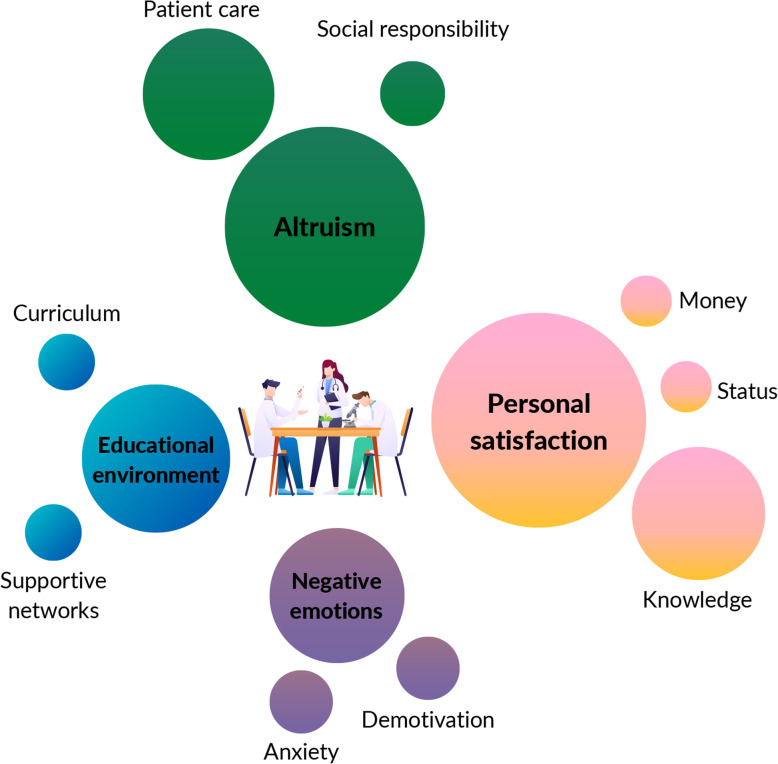
One hundred eighty-five students completed the questionnaires: 103 (55.67%) were men, 110 (59.45%) were in their fourth year of the medical programme, and 152 (82.16%) were up to 24 years old. Only the knowledge about cognition domain of MAI was significantly associated with motivation to learn. We found that higher scores on the knowledge about cognition domain of MAI was associated with the mastery approach goal orientation (p = 0.003, median 0.71, IQR 0.23) and that lower scores on this same domain was associated with a mastery avoidance goal orientation (p = 0.034, median 0.65, IQR 0.14). The open-ended question showed that altruism, personal satisfaction, financial feedback, personal and supportive networks and graduating were motivational factors.
Metacognitive awareness and motivation to learn are closely related. This association may represent a potential target for the educational process, as deans and faculty can adopt strategies focused on promoting self-regulated learning concerning students' motivational factors. This could enhance academic outcomes and promote more enjoyable learning.
在自我调节学习中,学习被定义为元认知指导、内在动机驱动和策略性的。在医学教育背景下,自我调节学习的发展可以与更好的学业和临床表现相关联。因此,本报告重点展示了医学生在临床科学部分(医学课程的第 3 年和第 4 年)的元认知意识和学习动机之间的关联,并描述了医学生的动机因素。
我们在巴西圣保罗大学(USP)进行了一项横断面研究,采用定性和定量相结合的方法,涉及医学生。我们选择了经过验证的元认知评估自评问卷(Schraw 和 Dennison 元认知意识量表 - MAI)和学习动机评估问卷(Baranik、Barron 和 Finney 工作领域成就目标量表 - AGWD)。MAI 有两个领域:认知知识和认知调节。AGWD 将成就目标分为掌握趋近、掌握回避、表现趋近和表现回避目标取向。我们还根据一个开放式问题进行了定性分析:“医学培训中最激励我的是什么?”
共有 185 名学生完成了问卷:103 名(55.67%)为男性,110 名(59.45%)处于医学课程的第 4 年,152 名(82.16%)年龄在 24 岁以下。只有 MAI 的认知知识领域与学习动机显著相关。我们发现,MAI 认知知识领域的得分越高,与掌握趋近目标取向相关(p=0.003,中位数 0.71,IQR 0.23),而该领域的得分越低,与掌握回避目标取向相关(p=0.034,中位数 0.65,IQR 0.14)。开放式问题表明,利他主义、个人满足感、经济反馈、个人和支持性网络以及毕业是激励因素。
元认知意识和学习动机密切相关。这种关联可能是教育过程的一个潜在目标,因为院长和教师可以采取策略,关注学生的动机因素,促进自我调节学习。这可以提高学业成绩,促进更愉快的学习。