Toronto General Hospital, University Health Network, Toronto, Ontario M5G 2C4, Canada.
National Eating Disorder Information Centre (NEDIC), Toronto, Ontario M5G 2C4, Canada.
Gen Hosp Psychiatry. 2020 Nov-Dec;67:136-140. doi: 10.1016/j.genhosppsych.2020.10.006. Epub 2020 Oct 25.
To describe the impact of the COVID-19 pandemic on help-seeking behaviors among individuals with eating disorders and caregivers.
We analyzed service utilization data from the National Eating Disorder Information Centre (NEDIC). We compared the number of contacts and symptom frequency between the pandemic period and previous years.
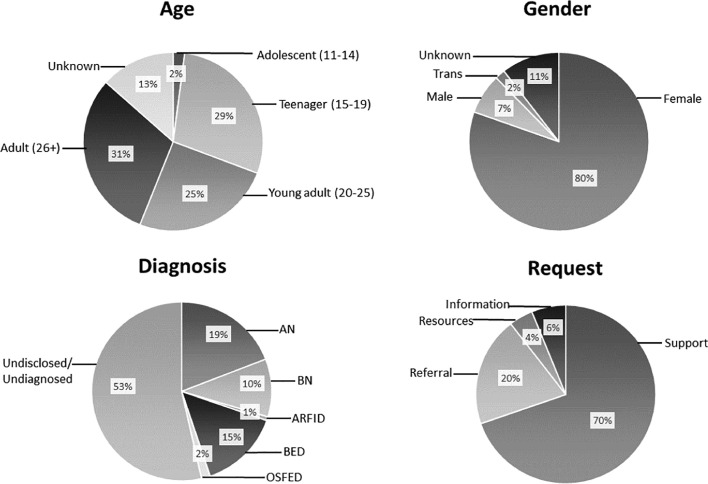
NEDIC was contacted 609 times during March 1-April 30, 2020 (72.1% individuals affected by disordered eating, 20.4% caregivers). The number of total contacts significantly increased from 2018 to 2019 and 2018 to 2020 (X(3) = 50.34, p < .001). Among affected individuals (80.4% women), the number of contacts during the pandemic period was significantly higher (n = 439; X(2) = 92.74, p < .001) compared to 2018 (n = 197) and 2019 (n = 312). There were higher rates of eating disorder symptoms, anxiety, and depression in 2020 compared to previous years. Thematic analysis of instant chats from the pandemic year revealed four emerging themes: 1) lack of access to treatment, 2) worsening of symptoms, 3) feeling out of control, and 4) need for support.
These findings point toward the impact of COVID-19 in individuals affected by disordered eating and hold implications for service delivery during times of crises.
描述 COVID-19 大流行对饮食障碍患者及其照顾者寻求帮助行为的影响。
我们分析了国家饮食失调信息中心(NEDIC)的服务利用数据。我们比较了大流行期间和前几年的联系次数和症状频率。
2020 年 3 月 1 日至 4 月 30 日,NEDIC 共接到 609 个电话(72.1%的个体受饮食障碍影响,20.4%为照顾者)。总联系人数从 2018 年到 2019 年以及 2018 年到 2020 年显著增加(X(3) = 50.34,p < 0.001)。在受影响的个体中(80.4%为女性),大流行期间的联系人数明显高于 2018 年(n = 197)和 2019 年(n = 312;X(2) = 92.74,p < 0.001)。与前几年相比,2020 年饮食障碍症状、焦虑和抑郁的发生率更高。对大流行年份即时聊天的主题分析揭示了四个新出现的主题:1)治疗机会有限,2)症状恶化,3)失控感,4)需要支持。
这些发现表明 COVID-19 对受饮食障碍影响的个体产生了影响,并对危机时期的服务提供产生了影响。