Dawel Amy, Shou Yiyun, Smithson Michael, Cherbuin Nicolas, Banfield Michelle, Calear Alison L, Farrer Louise M, Gray Darren, Gulliver Amelia, Housen Tambri, McCallum Sonia M, Morse Alyssa R, Murray Kristen, Newman Eryn, Rodney Harris Rachael M, Batterham Philip J
Research School of Psychology, The Australian National University, Canberra, ACT, Australia.
Centre for Research on Ageing, Health and Wellbeing, Research School of Population Health, The Australian National University, Canberra, ACT, Australia.
Front Psychiatry. 2020 Oct 6;11:579985. doi: 10.3389/fpsyt.2020.579985. eCollection 2020.
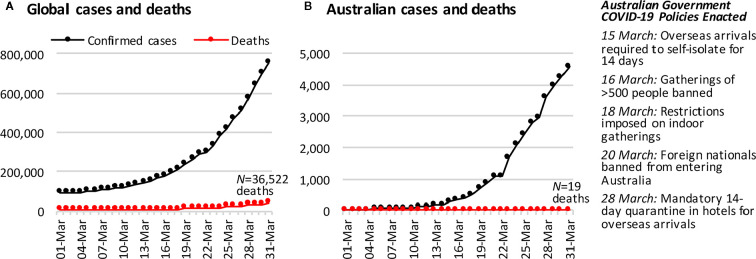
There is minimal knowledge about the impact of large-scale epidemics on community mental health, particularly during the acute phase. This gap in knowledge means we are critically ill-equipped to support communities as they face the unprecedented COVID-19 pandemic. This study aimed to provide data urgently needed to inform government policy and resource allocation now and in other future crises. The study was the first to survey a representative sample from the Australian population at the early acute phase of the COVID-19 pandemic. Depression, anxiety, and psychological wellbeing were measured with well-validated scales (PHQ-9, GAD-7, WHO-5). Using linear regression, we tested for associations between mental health and exposure to COVID-19, impacts of COVID-19 on work and social functioning, and socio-demographic factors. Depression and anxiety symptoms were substantively elevated relative to usual population data, including for individuals with no existing mental health diagnosis. Exposure to COVID-19 had minimal association with mental health outcomes. Recent exposure to the Australian bushfires was also unrelated to depression and anxiety, although bushfire smoke exposure correlated with reduced psychological wellbeing. In contrast, pandemic-induced impairments in work and social functioning were strongly associated with elevated depression and anxiety symptoms, as well as decreased psychological wellbeing. Financial distress due to the pandemic, rather than job loss , was also a key correlate of poorer mental health. These findings suggest that minimizing disruption to work and social functioning, and increasing access to mental health services in the community, are important policy goals to minimize pandemic-related impacts on mental health and wellbeing. Innovative and creative strategies are needed to meet these community needs while continuing to enact vital public health strategies to control the spread of COVID-19.
关于大规模流行病对社区心理健康的影响,尤其是在急性期的影响,人们了解甚少。这种知识空白意味着,在社区面对前所未有的新冠疫情时,我们在提供支持方面准备严重不足。本研究旨在提供迫切需要的数据,为政府当前及未来其他危机中的政策制定和资源分配提供参考。该研究首次在新冠疫情的早期急性期,对澳大利亚有代表性的人群样本进行了调查。使用经过充分验证的量表(PHQ - 9、GAD - 7、WHO - 5)来测量抑郁、焦虑和心理健康状况。我们通过线性回归测试了心理健康与接触新冠病毒、新冠病毒对工作和社会功能的影响以及社会人口学因素之间的关联。与普通人群数据相比,抑郁和焦虑症状显著增加,包括那些没有现有心理健康诊断的个体。接触新冠病毒与心理健康结果的关联极小。近期接触澳大利亚丛林大火也与抑郁和焦虑无关,尽管接触丛林大火烟雾与心理健康状况下降相关。相比之下,疫情导致的工作和社会功能障碍与抑郁和焦虑症状增加以及心理健康状况下降密切相关。疫情导致的经济困境而非失业,也是心理健康状况较差的关键相关因素。这些发现表明,尽量减少对工作和社会功能的干扰,以及增加社区心理健康服务的可及性,是将疫情对心理健康和幸福的影响降至最低的重要政策目标。在继续实施控制新冠病毒传播的重要公共卫生策略的同时,需要创新和创造性的策略来满足这些社区需求。