Tigchelaar Michelle, Battisti David S, Spector June T
Department of Atmospheric Sciences, University of Washington, Seattle, WA.
now at: Center for Ocean Solutions, Stanford University, Palo Alto, CA.
Environ Res Lett. 2020 Sep;15(9). doi: 10.1088/1748-9326/ab86f4. Epub 2020 Aug 25.
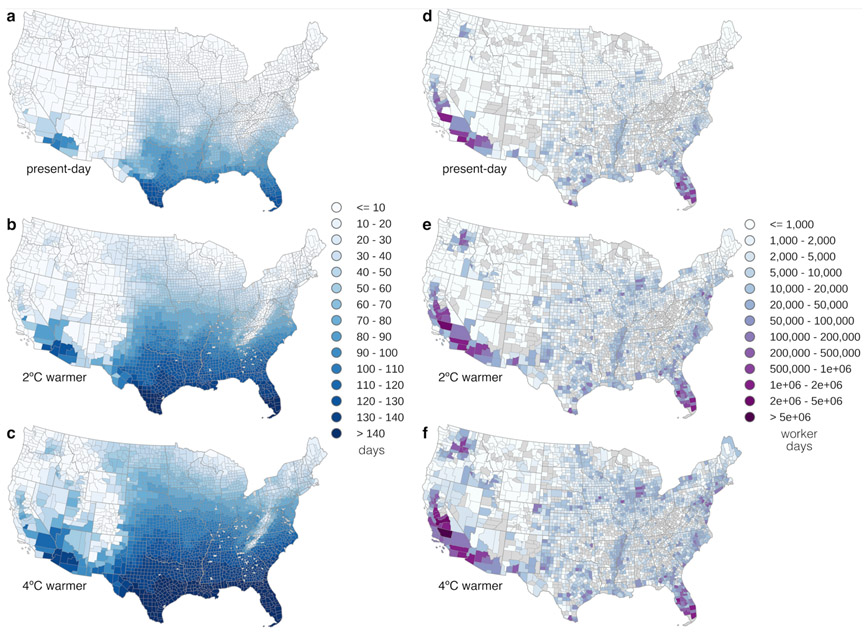
The over one million agricultural workers in the United States (U.S.) are amongst the populations most vulnerable to the health impacts of extreme heat. Climate change will further increase this vulnerability. Here we estimate the magnitude and spatial patterns of the growing heat exposure and health risk faced by U.S. crop workers and assess the effect of workplace adaptations on mitigating that risk. We find that the average number of days spent working in unsafe conditions will double by mid-century, and, without mitigation, triple by the end of it. Increases in rest time and the availability of climate-controlled recovery areas can eliminate this risk but could affect farm productivity, farm worker earnings, and/or labor costs much more than alternative measures. Safeguarding the health and well-being of U.S. crop workers will therefore require systemic change beyond the worker and workplace level.
美国超过100万农业工人是最易受极端高温影响健康的人群之一。气候变化将进一步加剧这种脆弱性。在此,我们估算了美国农作物工人面临的日益增加的高温暴露和健康风险的程度及空间格局,并评估了工作场所适应性措施对降低该风险的效果。我们发现,到本世纪中叶,在不安全条件下工作的平均天数将增加一倍,若不采取缓解措施,到本世纪末将增加两倍。休息时间的增加以及配备气候控制恢复区域可消除这种风险,但相比其他措施,这对农场生产力、农场工人收入和/或劳动力成本的影响要大得多。因此,保障美国农作物工人的健康和福祉需要超越工人和工作场所层面的系统性变革。