Xu Yitong, Rogers Connie J
Intercollege Graduate Degree Program in Integrative and Biomedical Physiology, Huck Institutes of the Life Sciences, The Pennsylvania State University, University Park, PA, United States.
Department of Nutritional Sciences, The Pennsylvania State University, University Park, PA, United States.
Front Nutr. 2020 Oct 8;7:557997. doi: 10.3389/fnut.2020.557997. eCollection 2020.
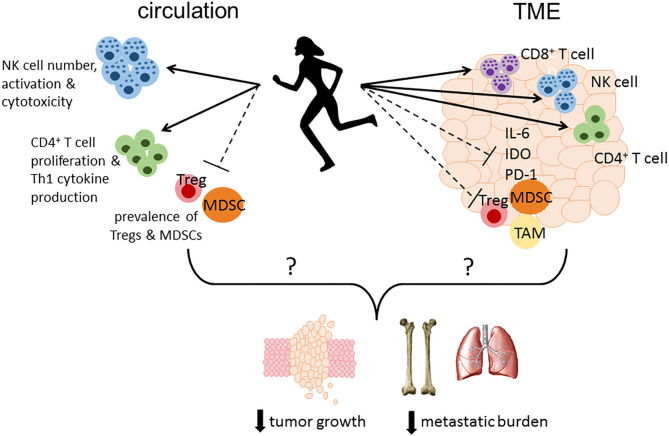
There is strong evidence that physical activity (PA) reduces risk, recurrence, and mortality from breast cancer. Emerging data suggest that PA induces changes in inflammatory and immune mediators that may contribute to beneficial effects on breast cancer outcomes. Thus, the goal of this review was to evaluate the evidence linking the protective benefit of PA to modulation of immune responses in breast cancer. A literature search was conducted to identify studies that evaluated the impact of PA on tumor and immune outcomes in breast cancer patients and in mammary tumor models. Nineteen studies investigated the effect of PA interventions on cancer immune outcomes using preclinical breast cancer models. Tumor growth was reduced in 11 studies, unchanged in three studies, and increased in one study. Spontaneous metastasis was reduced in two studies and survival was improved in four studies. Frequently assessed immune outcomes include splenic cell number and function, circulating inflammatory cytokines, and intratumoral immune cells and inflammatory markers. Circulating inflammatory cytokine responses were heterogeneous in preclinical models. Within the tumor microenvironment (TME), several studies documented a change in the infiltration of immune cells with an increase in effector cells and a reduction in immune suppressive cells. Twenty-three studies investigated the effect of PA interventions on immune outcomes in breast cancer patients. Thirteen studies used aerobic PA interventions and 10 studies used a combination of aerobic and resistance exercise interventions. Cycling and treadmill activities were the most commonly used PA modalities. Circulating immune cells and inflammatory cytokines were the most frequently assessed immune outcomes in the clinical studies. Among the 19 studies that evaluated a PA intervention during the post treatment period, 10 reported a reduction in the levels of at least one inflammatory cytokine. No inflammatory cytokines were quantified in the three studies that evaluated a PA intervention during treatment with chemotherapy. Immune outcomes within the tumor were assessed in only one study performing a PA intervention prior to surgery. Results from preclinical and clinical studies suggest that PA exerts heterogeneous effects on inflammatory cytokines, but may alter the gene expression profile and immune infiltrates in the tumor which may result in a reduction in immunosuppressive factors. However, additional studies are needed to better understand the effect of PA on immune outcomes in the TME.
有充分证据表明,体育活动(PA)可降低乳腺癌的风险、复发率和死亡率。新出现的数据表明,体育活动会引起炎症和免疫介质的变化,这可能有助于对乳腺癌预后产生有益影响。因此,本综述的目的是评估将体育活动的保护益处与乳腺癌免疫反应调节联系起来的证据。进行了文献检索,以确定评估体育活动对乳腺癌患者和乳腺肿瘤模型中肿瘤及免疫结果影响的研究。19项研究使用临床前乳腺癌模型调查了体育活动干预对癌症免疫结果的影响。11项研究中肿瘤生长减少,3项研究中无变化,1项研究中增加。2项研究中自发转移减少,4项研究中生存率提高。经常评估的免疫结果包括脾细胞数量和功能、循环炎症细胞因子以及肿瘤内免疫细胞和炎症标志物。在临床前模型中,循环炎症细胞因子反应存在异质性。在肿瘤微环境(TME)中,多项研究记录了免疫细胞浸润的变化,效应细胞增加,免疫抑制细胞减少。23项研究调查了体育活动干预对乳腺癌患者免疫结果的影响。13项研究使用有氧运动干预,10项研究使用有氧运动和抗阻运动干预相结合的方式。骑自行车和跑步机活动是最常用的体育活动方式。循环免疫细胞和炎症细胞因子是临床研究中最常评估的免疫结果。在评估治疗后阶段体育活动干预的19项研究中,10项报告至少一种炎症细胞因子水平降低。在评估化疗期间体育活动干预的3项研究中,未对炎症细胞因子进行定量。仅在一项术前进行体育活动干预的研究中评估了肿瘤内的免疫结果。临床前和临床研究结果表明,体育活动对炎症细胞因子有不同影响,但可能会改变肿瘤中的基因表达谱和免疫浸润,这可能导致免疫抑制因子减少。然而,需要更多研究来更好地了解体育活动对肿瘤微环境中免疫结果的影响。