• 文献检索
  • 文档翻译
  • 深度研究
  • 学术资讯
  • Suppr Zotero 插件Zotero 插件
  • 邀请有礼
  • 套餐&价格
  • 历史记录
应用&插件
Suppr Zotero 插件Zotero 插件浏览器插件Mac 客户端Windows 客户端微信小程序
定价
高级版会员购买积分包购买API积分包
服务
文献检索文档翻译深度研究API 文档MCP 服务
关于我们
关于 Suppr公司介绍联系我们用户协议隐私条款
关注我们

Suppr 超能文献

核心技术专利:CN118964589B侵权必究
粤ICP备2023148730 号-1Suppr @ 2026

文献检索

告别复杂PubMed语法,用中文像聊天一样搜索,搜遍4000万医学文献。AI智能推荐,让科研检索更轻松。

立即免费搜索

文件翻译

保留排版,准确专业,支持PDF/Word/PPT等文件格式,支持 12+语言互译。

免费翻译文档

深度研究

AI帮你快速写综述,25分钟生成高质量综述,智能提取关键信息,辅助科研写作。

立即免费体验

将机器学习与人类知识相结合。

Integrating Machine Learning with Human Knowledge.

作者信息

Deng Changyu, Ji Xunbi, Rainey Colton, Zhang Jianyu, Lu Wei

机构信息

Department of Mechanical Engineering, University of Michigan, Ann Arbor, MI 48109, USA.

Department of Materials Science & Engineering, University of Michigan, Ann Arbor, MI 48109, USA.

出版信息

iScience. 2020 Oct 9;23(11):101656. doi: 10.1016/j.isci.2020.101656. eCollection 2020 Nov 20.

DOI:10.1016/j.isci.2020.101656
PMID:33134890
原文链接:https://pmc.ncbi.nlm.nih.gov/articles/PMC7588855/
Abstract

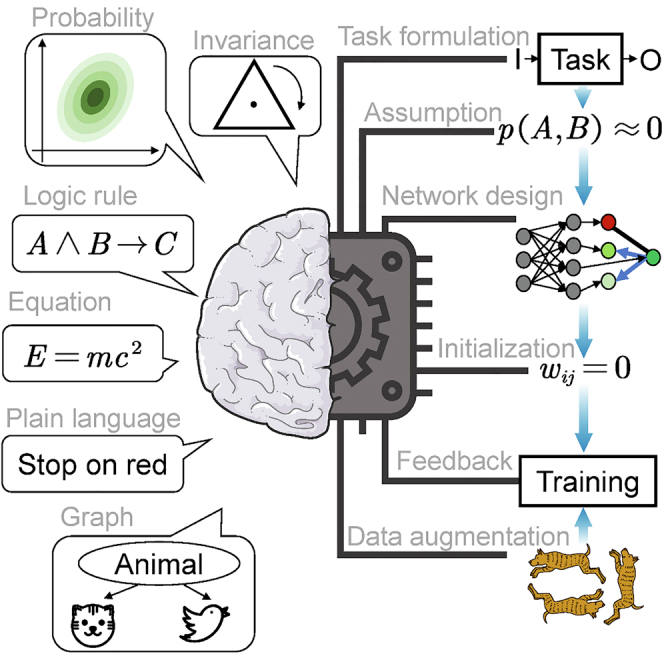
Machine learning has been heavily researched and widely used in many disciplines. However, achieving high accuracy requires a large amount of data that is sometimes difficult, expensive, or impractical to obtain. Integrating human knowledge into machine learning can significantly reduce data requirement, increase reliability and robustness of machine learning, and build explainable machine learning systems. This allows leveraging the vast amount of human knowledge and capability of machine learning to achieve functions and performance not available before and will facilitate the interaction between human beings and machine learning systems, making machine learning decisions understandable to humans. This paper gives an overview of the knowledge and its representations that can be integrated into machine learning and the methodology. We cover the fundamentals, current status, and recent progress of the methods, with a focus on popular and new topics. The perspectives on future directions are also discussed.

摘要

机器学习已经在许多学科中得到了深入研究和广泛应用。然而,要实现高精度需要大量数据,而这些数据有时难以获取、成本高昂或不切实际。将人类知识融入机器学习可以显著减少数据需求,提高机器学习的可靠性和鲁棒性,并构建可解释的机器学习系统。这使得能够利用大量的人类知识和机器学习的能力来实现以前无法实现的功能和性能,并将促进人类与机器学习系统之间的交互,使机器学习决策对人类来说是可理解的。本文概述了可以融入机器学习的知识及其表示形式和方法。我们涵盖了这些方法的基本原理、现状和最新进展,重点关注热门和新出现的主题。还讨论了未来方向的观点。
https://cdn.ncbi.nlm.nih.gov/pmc/blobs/f385/7588855/3fc9809714d7/gr5.jpg
https://cdn.ncbi.nlm.nih.gov/pmc/blobs/f385/7588855/a8fd719631f7/fx1.jpg
https://cdn.ncbi.nlm.nih.gov/pmc/blobs/f385/7588855/8e92f62ba7cc/gr1.jpg
https://cdn.ncbi.nlm.nih.gov/pmc/blobs/f385/7588855/3c5ed889e88c/gr2.jpg
https://cdn.ncbi.nlm.nih.gov/pmc/blobs/f385/7588855/5e937fa8dea6/gr3.jpg
https://cdn.ncbi.nlm.nih.gov/pmc/blobs/f385/7588855/c2019466e8f1/gr4.jpg
https://cdn.ncbi.nlm.nih.gov/pmc/blobs/f385/7588855/3fc9809714d7/gr5.jpg
https://cdn.ncbi.nlm.nih.gov/pmc/blobs/f385/7588855/a8fd719631f7/fx1.jpg
https://cdn.ncbi.nlm.nih.gov/pmc/blobs/f385/7588855/8e92f62ba7cc/gr1.jpg
https://cdn.ncbi.nlm.nih.gov/pmc/blobs/f385/7588855/3c5ed889e88c/gr2.jpg
https://cdn.ncbi.nlm.nih.gov/pmc/blobs/f385/7588855/5e937fa8dea6/gr3.jpg
https://cdn.ncbi.nlm.nih.gov/pmc/blobs/f385/7588855/c2019466e8f1/gr4.jpg
https://cdn.ncbi.nlm.nih.gov/pmc/blobs/f385/7588855/3fc9809714d7/gr5.jpg

相似文献

1
Integrating Machine Learning with Human Knowledge.将机器学习与人类知识相结合。
iScience. 2020 Oct 9;23(11):101656. doi: 10.1016/j.isci.2020.101656. eCollection 2020 Nov 20.
2
Explaining protein-protein interactions with knowledge graph-based semantic similarity.用基于知识图的语义相似度解释蛋白质-蛋白质相互作用。
Comput Biol Med. 2024 Mar;170:108076. doi: 10.1016/j.compbiomed.2024.108076. Epub 2024 Feb 1.
3
Identification of microstructures critically affecting material properties using machine learning framework based on metallurgists' thinking process.使用基于冶金学家思维过程的机器学习框架识别对材料性能有重大影响的微观结构。
Sci Rep. 2022 Aug 20;12(1):14238. doi: 10.1038/s41598-022-17614-0.
4
Explainable Artificial Intelligence for Predictive Modeling in Healthcare.用于医疗保健预测建模的可解释人工智能
J Healthc Inform Res. 2022 Feb 11;6(2):228-239. doi: 10.1007/s41666-022-00114-1. eCollection 2022 Jun.
5
Involvement of Machine Learning Tools in Healthcare Decision Making.机器学习工具在医疗保健决策中的应用。
J Healthc Eng. 2021 Jan 27;2021:6679512. doi: 10.1155/2021/6679512. eCollection 2021.
6
Explainable Artificial Intelligence Recommendation System by Leveraging the Semantics of Adverse Childhood Experiences: Proof-of-Concept Prototype Development.利用童年不良经历的语义构建可解释人工智能推荐系统:概念验证原型开发
JMIR Med Inform. 2020 Nov 4;8(11):e18752. doi: 10.2196/18752.
7
Artificial Intelligence and Machine Learning in Prostate Cancer Patient Management-Current Trends and Future Perspectives.人工智能与机器学习在前列腺癌患者管理中的应用——当前趋势与未来展望
Diagnostics (Basel). 2021 Feb 20;11(2):354. doi: 10.3390/diagnostics11020354.
8
Application of Machine Learning Based on Structured Medical Data in Gastroenterology.基于结构化医学数据的机器学习在胃肠病学中的应用
Biomimetics (Basel). 2023 Oct 28;8(7):512. doi: 10.3390/biomimetics8070512.
9
[A primer on machine learning].[机器学习入门]
Radiologe. 2020 Jan;60(1):24-31. doi: 10.1007/s00117-019-00616-x.
10
Integrated Evolutionary Learning: An Artificial Intelligence Approach to Joint Learning of Features and Hyperparameters for Optimized, Explainable Machine Learning.集成进化学习:一种用于特征和超参数联合学习以实现优化、可解释机器学习的人工智能方法。
Front Artif Intell. 2022 Apr 5;5:832530. doi: 10.3389/frai.2022.832530. eCollection 2022.

引用本文的文献

1
Machine Learning-Enhanced Nanoparticle Design for Precision Cancer Drug Delivery.用于精准癌症药物递送的机器学习增强型纳米颗粒设计
Adv Sci (Weinh). 2025 Aug;12(30):e03138. doi: 10.1002/advs.202503138. Epub 2025 Jun 19.
2
Assessment of the Diagnostic Accuracy of Artificial Intelligence Software in Identifying Common Periodontal and Restorative Dental Conditions (Marginal Bone Loss, Periapical Lesion, Crown, Restoration, Dental Caries) in Intraoral Periapical Radiographs.评估人工智能软件在识别口腔根尖片上常见牙周和修复性牙科病症(边缘骨丧失、根尖周病变、牙冠、修复体、龋齿)方面的诊断准确性。
Diagnostics (Basel). 2025 Jun 4;15(11):1432. doi: 10.3390/diagnostics15111432.
3

本文引用的文献

1
Self-directed online machine learning for topology optimization.自主在线机器学习拓扑优化。
Nat Commun. 2022 Jan 19;13(1):388. doi: 10.1038/s41467-021-27713-7.
2
Text Data Augmentation for Deep Learning.用于深度学习的文本数据增强
J Big Data. 2021;8(1):101. doi: 10.1186/s40537-021-00492-0. Epub 2021 Jul 19.
3
Transfer Learning from Adult to Children for Speech Recognition: Evaluation, Analysis and Recommendations.从成人到儿童的语音识别迁移学习:评估、分析与建议
Precision Rehabilitation After Youth Anterior Cruciate Ligament Reconstruction: Individualized Reinjury Risk Stratification and Modifiable Risk Factor Identification to Guide Late-Phase Rehabilitation.
青少年前交叉韧带重建术后的精准康复:个体化再损伤风险分层及可改变风险因素识别以指导后期康复
Orthop J Sports Med. 2025 Apr 11;13(4):23259671251329355. doi: 10.1177/23259671251329355. eCollection 2025 Apr.
4
Revolutionizing ESCC prognosis: the efficiency of tumor-infiltrating immune cells (TIIC) signature score.革新食管鳞癌预后:肿瘤浸润免疫细胞(TIIC)特征评分的效能
Discov Oncol. 2025 Jan 20;16(1):65. doi: 10.1007/s12672-024-01709-3.
5
Thick Data Analytics (TDA): An Iterative and Inductive Framework for Algorithmic Improvement.厚数据分析(TDA):一种用于算法改进的迭代归纳框架。
Am Stat. 2024;78(4):456-464. doi: 10.1080/00031305.2024.2327535. Epub 2024 Apr 15.
6
Deep learning application in prediction of cancer molecular alterations based on pathological images: a bibliographic analysis via CiteSpace.深度学习在基于病理图像的癌症分子改变预测中的应用:基于 CiteSpace 的文献分析。
J Cancer Res Clin Oncol. 2024 Oct 18;150(10):467. doi: 10.1007/s00432-024-05992-z.
7
Global Research on Pandemics or Epidemics and Mental Health: A Natural Language Processing Study.全球大流行病或传染病与心理健康研究:自然语言处理视角。
J Epidemiol Glob Health. 2024 Sep;14(3):1268-1280. doi: 10.1007/s44197-024-00284-8. Epub 2024 Aug 8.
8
Brain Disorder Detection and Diagnosis using Machine Learning and Deep Learning - A Bibliometric Analysis.基于机器学习和深度学习的脑疾病检测与诊断 - 文献计量分析。
Curr Neuropharmacol. 2024;22(13):2191-2216. doi: 10.2174/1570159X22999240531160344.
9
DIGIPREDICT: physiological, behavioural and environmental predictors of asthma attacks-a prospective observational study using digital markers and artificial intelligence-study protocol.DIGIPREDICT:哮喘发作的生理、行为和环境预测因子——使用数字标志物和人工智能的前瞻性观察研究——研究方案。
BMJ Open Respir Res. 2024 May 22;11(1):e002275. doi: 10.1136/bmjresp-2023-002275.
10
Towards proactive palliative care in oncology: developing an explainable EHR-based machine learning model for mortality risk prediction.迈向肿瘤学积极的姑息治疗:开发基于可解释电子健康记录的机器学习模型进行死亡率风险预测。
BMC Palliat Care. 2024 May 20;23(1):124. doi: 10.1186/s12904-024-01457-9.
Comput Speech Lang. 2020 Sep;63. doi: 10.1016/j.csl.2020.101077. Epub 2020 Feb 18.
4
A Comprehensive Survey on Graph Neural Networks.图神经网络综述。
IEEE Trans Neural Netw Learn Syst. 2021 Jan;32(1):4-24. doi: 10.1109/TNNLS.2020.2978386. Epub 2021 Jan 4.
5
Improved protein structure prediction using potentials from deep learning.利用深度学习势进行蛋白质结构预测的改进。
Nature. 2020 Jan;577(7792):706-710. doi: 10.1038/s41586-019-1923-7. Epub 2020 Jan 15.
6
In-Silico Molecular Binding Prediction for Human Drug Targets Using Deep Neural Multi-Task Learning.基于深度神经网络多任务学习的人源药物靶点的计算机分子结合预测。
Genes (Basel). 2019 Nov 7;10(11):906. doi: 10.3390/genes10110906.
7
Mapping the knowledge structure and trends of epilepsy genetics over the past decade: A co-word analysis based on medical subject headings terms.绘制过去十年癫痫遗传学的知识结构与趋势:基于医学主题词的共词分析
Medicine (Baltimore). 2019 Aug;98(32):e16782. doi: 10.1097/MD.0000000000016782.
8
DQNViz: A Visual Analytics Approach to Understand Deep Q-Networks.DQNViz:一种理解深度Q网络的可视化分析方法。
IEEE Trans Vis Comput Graph. 2018 Sep 5. doi: 10.1109/TVCG.2018.2864504.
9
Visual Analytics in Deep Learning: An Interrogative Survey for the Next Frontiers.深度学习中的可视化分析:对新前沿领域的探索性调查
IEEE Trans Vis Comput Graph. 2018 Jun 4. doi: 10.1109/TVCG.2018.2843369.
10
Transfer Learning From Simulations on a Reference Anatomy for ECGI in Personalized Cardiac Resynchronization Therapy.从参考解剖模型上的 ECGI 模拟数据中进行迁移学习,以实现个体化心脏再同步治疗。
IEEE Trans Biomed Eng. 2019 Feb;66(2):343-353. doi: 10.1109/TBME.2018.2839713. Epub 2018 May 23.