Université de Nantes, CNRS, CEISAM UMR 6230, F-44000 Nantes, France.
SpectroMaitrise, CAPACITES SAS, F-44000 Nantes, France.
Anal Chem. 2020 Nov 17;92(22):14867-14871. doi: 10.1021/acs.analchem.0c03510. Epub 2020 Nov 2.
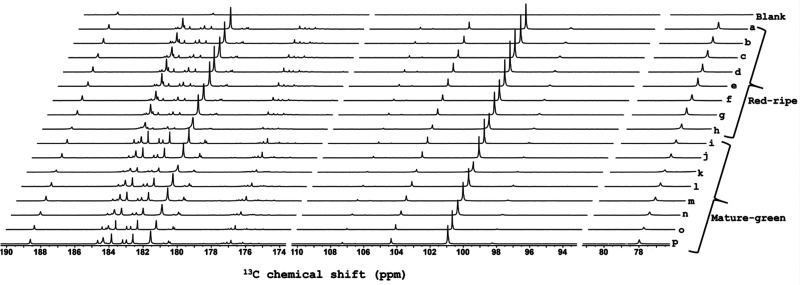
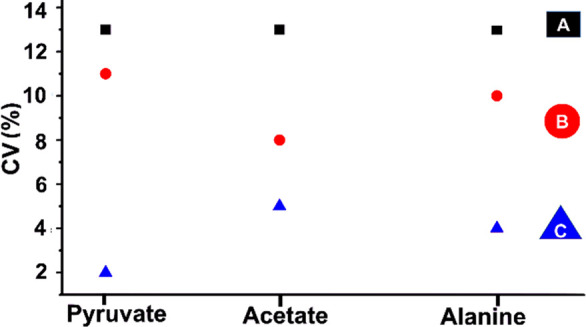
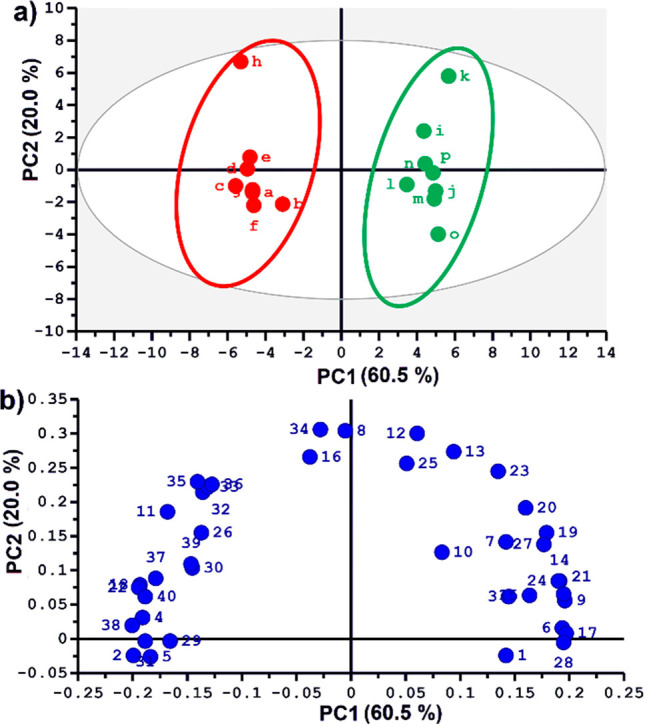
Metabolomics plays a pivotal role in systems biology, and NMR is a central tool with high precision and exceptional resolution of chemical information. Most NMR metabolomic studies are based on H 1D spectroscopy, severely limited by peak overlap. C NMR benefits from a larger signal dispersion but is barely used in metabolomics due to ca. 6000-fold lower sensitivity. We introduce a new approach, based on hyperpolarized C NMR at natural abundance, that circumvents this limitation. A new untargeted NMR-based metabolomic workflow based on dissolution dynamic nuclear polarization (d-DNP) for the first time enabled hyperpolarized natural abundance C metabolomics. Statistical analysis of resulting hyperpolarized C data distinguishes two groups of plant (tomato) extracts and highlights biomarkers, in full agreement with previous results on the same biological model. We also optimize parameters of the semiautomated d-DNP system suitable for high-throughput studies.
代谢组学在系统生物学中起着关键作用,NMR 是一种具有高精度和出色化学信息分辨率的核心工具。大多数 NMR 代谢组学研究基于 H 1D 光谱学,但由于峰重叠严重受限。13C NMR 得益于更大的信号分散度,但由于灵敏度约低 6000 倍,几乎未用于代谢组学。我们引入了一种新方法,基于自然丰度的超极化 13C NMR,该方法规避了这一限制。一种新的基于未靶向 NMR 的代谢组学工作流程,基于溶解动态核极化(d-DNP),首次实现了超极化自然丰度 13C 代谢组学。对产生的超极化 13C 数据进行的统计分析将两组植物(番茄)提取物区分开来,并突出了生物标志物,与同一生物模型的先前结果完全一致。我们还优化了适用于高通量研究的半自动化 d-DNP 系统的参数。