• 文献检索
  • 文档翻译
  • 深度研究
  • 学术资讯
  • Suppr Zotero 插件Zotero 插件
  • 邀请有礼
  • 套餐&价格
  • 历史记录
应用&插件
Suppr Zotero 插件Zotero 插件浏览器插件Mac 客户端Windows 客户端微信小程序
定价
高级版会员购买积分包购买API积分包
服务
文献检索文档翻译深度研究API 文档MCP 服务
关于我们
关于 Suppr公司介绍联系我们用户协议隐私条款
关注我们

Suppr 超能文献

核心技术专利:CN118964589B侵权必究
粤ICP备2023148730 号-1Suppr @ 2026

文献检索

告别复杂PubMed语法,用中文像聊天一样搜索,搜遍4000万医学文献。AI智能推荐,让科研检索更轻松。

立即免费搜索

文件翻译

保留排版,准确专业,支持PDF/Word/PPT等文件格式,支持 12+语言互译。

免费翻译文档

深度研究

AI帮你快速写综述,25分钟生成高质量综述,智能提取关键信息,辅助科研写作。

立即免费体验

新冠疫情期间的担忧、回避和应对:综合网络分析。

Worry, avoidance, and coping during the COVID-19 pandemic: A comprehensive network analysis.

机构信息

Department of Psychiatry, University of British Columbia, Vancouver, BC, Canada.

Department of Psychology, University of Regina, Regina, SK, Canada.

出版信息

J Anxiety Disord. 2020 Dec;76:102327. doi: 10.1016/j.janxdis.2020.102327. Epub 2020 Oct 24.

DOI:10.1016/j.janxdis.2020.102327
PMID:33137601
原文链接:https://pmc.ncbi.nlm.nih.gov/articles/PMC7585364/
Abstract

BACKGROUND

Many psychological factors play a role in the COVID-19 pandemic, including various forms of worry, avoidance, and coping. Adding to the complexity, some people believe the threat of COVID-19 is exaggerated. We used network analysis to investigate how these diverse elements are interrelated.

METHODS

A population-representative sample of 3075 American and Canadian adults completed an online survey, including measures of COVID-19-related worry, avoidance, self-protective behaviors, and other variables.

RESULTS

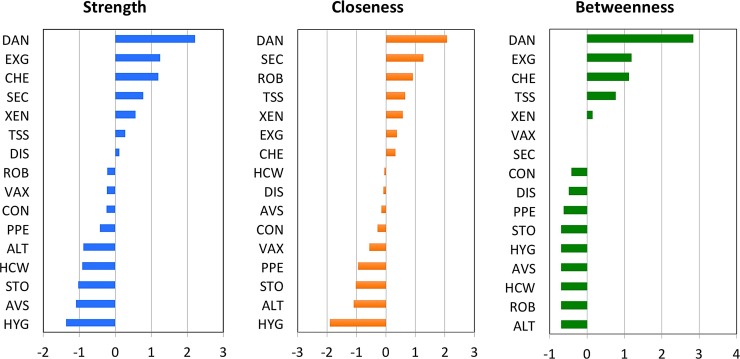
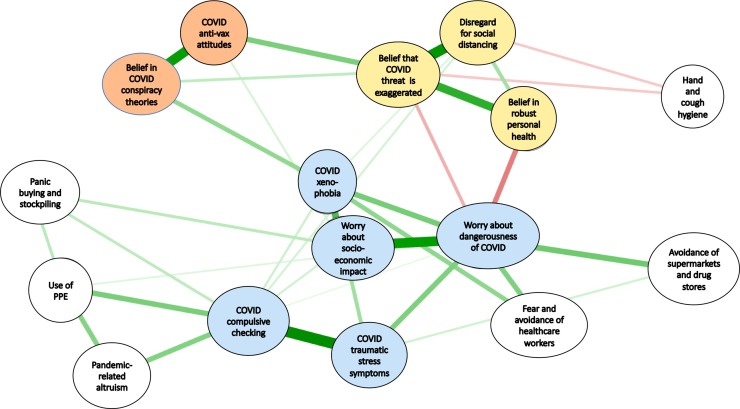
The network contained three major hubs, replicated across gender and age groups. The most important hub centered around worries about the dangerousness of COVID-19, and formed the core of the previously identified COVID Stress Syndrome. The second most important hub, which was negatively correlated with the first hub, centered around the belief that the COVID-19 threat is exaggerated, and was associated with disregard for social distancing, poor hand hygiene, and anti-vaccination attitudes. The third most important hub, which was linked to the first hub, centered around COVID-19-related compulsive checking and reassurance-seeking, including self-protective behaviors such as panic buying and use of personal protective equipment.

CONCLUSION

Network analysis showed how various forms of worry, avoidance, coping, and other variables are interrelated. Implications for managing disease and distress are discussed.

摘要

背景

许多心理因素在 COVID-19 大流行中发挥作用,包括各种形式的担忧、回避和应对。更复杂的是,有些人认为 COVID-19 的威胁被夸大了。我们使用网络分析来研究这些不同元素是如何相互关联的。

方法

一项针对美国和加拿大 3075 名成年人的代表性人群调查,完成了一项在线调查,包括与 COVID-19 相关的担忧、回避、自我保护行为和其他变量的测量。

结果

网络包含三个主要中心,在性别和年龄组中均得到复制。最重要的中心围绕着对 COVID-19 危险性的担忧,构成了之前确定的 COVID 应激综合征的核心。第二大重要中心,与第一个中心呈负相关,围绕着 COVID-19 威胁被夸大的信念,与不遵守社交距离、手部卫生差和反疫苗接种态度有关。第三个最重要的中心,与第一个中心相连,围绕着与 COVID-19 相关的强迫性检查和寻求安慰,包括自我保护行为,如恐慌性购买和使用个人防护设备。

结论

网络分析显示了各种形式的担忧、回避、应对和其他变量是如何相互关联的。讨论了管理疾病和痛苦的影响。
https://cdn.ncbi.nlm.nih.gov/pmc/blobs/ff98/7585364/b31d6b451877/gr2_lrg.jpg
https://cdn.ncbi.nlm.nih.gov/pmc/blobs/ff98/7585364/adda2222c6b1/gr1_lrg.jpg
https://cdn.ncbi.nlm.nih.gov/pmc/blobs/ff98/7585364/b31d6b451877/gr2_lrg.jpg
https://cdn.ncbi.nlm.nih.gov/pmc/blobs/ff98/7585364/adda2222c6b1/gr1_lrg.jpg
https://cdn.ncbi.nlm.nih.gov/pmc/blobs/ff98/7585364/b31d6b451877/gr2_lrg.jpg

相似文献

1
Worry, avoidance, and coping during the COVID-19 pandemic: A comprehensive network analysis.新冠疫情期间的担忧、回避和应对:综合网络分析。
J Anxiety Disord. 2020 Dec;76:102327. doi: 10.1016/j.janxdis.2020.102327. Epub 2020 Oct 24.
2
COVID stress syndrome: Concept, structure, and correlates.COVID 应激综合征:概念、结构和相关性。
Depress Anxiety. 2020 Aug;37(8):706-714. doi: 10.1002/da.23071. Epub 2020 Jul 5.
3
Substance use and abuse, COVID-19-related distress, and disregard for social distancing: A network analysis.物质使用和滥用、与 COVID-19 相关的困扰以及不顾社交距离:网络分析。
Addict Behav. 2021 Mar;114:106754. doi: 10.1016/j.addbeh.2020.106754. Epub 2020 Dec 3.
4
Reactions to COVID-19: Differential predictors of distress, avoidance, and disregard for social distancing.对 COVID-19 的反应:痛苦、回避和不遵守社交距离的差异预测因素。
J Affect Disord. 2020 Dec 1;277:94-98. doi: 10.1016/j.jad.2020.08.002. Epub 2020 Aug 7.
5
The psychological impact of COVID-19 pandemic on the general population of Saudi Arabia.COVID-19 大流行对沙特阿拉伯普通民众的心理影响。
Compr Psychiatry. 2020 Oct;102:152192. doi: 10.1016/j.comppsych.2020.152192. Epub 2020 Jul 12.
6
A national cross-sectional survey of public perceptions of the COVID-19 pandemic: Self-reported beliefs, knowledge, and behaviors.一项关于公众对 COVID-19 大流行看法的全国性横断面调查:自我报告的信念、知识和行为。
PLoS One. 2020 Oct 23;15(10):e0241259. doi: 10.1371/journal.pone.0241259. eCollection 2020.
7
Public perceptions, anxiety and the perceived efficacy of health-protective behaviours to mitigate the spread of the SARS-Cov-2/ COVID-19 pandemic.公众认知、焦虑与健康保护行为在减轻 SARS-CoV-2/COVID-19 大流行传播方面的感知效果。
Public Health. 2020 Oct;187:67-73. doi: 10.1016/j.puhe.2020.08.002. Epub 2020 Aug 8.
8
Do pre-existing anxiety-related and mood disorders differentially impact COVID-19 stress responses and coping?既往存在的焦虑相关和心境障碍是否会对 COVID-19 应激反应和应对方式产生不同影响?
J Anxiety Disord. 2020 Aug;74:102271. doi: 10.1016/j.janxdis.2020.102271. Epub 2020 Jul 7.
9
Knowledge, Concerns, and Behaviors of Individuals During the First Week of the Coronavirus Disease 2019 Pandemic in Italy.意大利人在 2019 冠状病毒病大流行的第一周的知识、担忧和行为。
JAMA Netw Open. 2020 Jul 1;3(7):e2015821. doi: 10.1001/jamanetworkopen.2020.15821.
10
COVID-19 and traumatic stress: The role of perceived vulnerability, COVID-19-related worries, and social isolation.COVID-19 与创伤后应激:易感性认知、与 COVID-19 相关的担忧和社会隔离的作用。
J Anxiety Disord. 2020 Dec;76:102307. doi: 10.1016/j.janxdis.2020.102307. Epub 2020 Sep 8.

引用本文的文献

1
A one-arm pilot trial of a telehealth CBT-based group intervention targeting transdiagnostic risk for emotional distress.一项针对情绪困扰跨诊断风险的基于远程医疗认知行为疗法的团体干预单臂试点试验。
PLoS One. 2025 Jun 18;20(6):e0303131. doi: 10.1371/journal.pone.0303131. eCollection 2025.
2
Exploring the role of information networks in promoting sustainable rural production in Iran.探索信息网络在促进伊朗农村可持续生产中的作用。
Sci Rep. 2025 Jun 5;15(1):19822. doi: 10.1038/s41598-025-03899-4.
3
Loss of resources and gambling during the COVID-19 pandemic: a three-wave longitudinal study.

本文引用的文献

1
Fear and avoidance of healthcare workers: An important, under-recognized form of stigmatization during the COVID-19 pandemic.对医护工作者的恐惧和回避:COVID-19 大流行期间一种重要但未被充分认识的污名形式。
J Anxiety Disord. 2020 Oct;75:102289. doi: 10.1016/j.janxdis.2020.102289. Epub 2020 Aug 19.
2
Facing new fears during the COVID-19 pandemic: The State of America's mental health.在 COVID-19 大流行期间面临新的恐惧:美国的精神健康状况。
J Anxiety Disord. 2020 Oct;75:102291. doi: 10.1016/j.janxdis.2020.102291. Epub 2020 Aug 13.
3
Reactions to COVID-19: Differential predictors of distress, avoidance, and disregard for social distancing.
新冠肺炎大流行期间资源损失和赌博行为:一项三波纵向研究。
Sci Rep. 2024 Nov 8;14(1):27297. doi: 10.1038/s41598-024-78866-6.
4
Co-rumination and intrapersonal cognitive processes predict distress: Longitudinal evidence from the COVID-19 pandemic.共同反刍和人际内认知过程可预测痛苦:来自新冠疫情的纵向证据。
Stress Health. 2024 Dec;40(6):e3490. doi: 10.1002/smi.3490. Epub 2024 Oct 8.
5
The Motivation for COVID-19 Vaccination and Preventive Behavior.**动机**:**COVID-19 疫苗接种和预防行为**。
J Prev (2022). 2024 Oct;45(5):765-783. doi: 10.1007/s10935-024-00787-x. Epub 2024 Jun 5.
6
A One-Arm Pilot Trial of a Telehealth CBT-Based Group Intervention Targeting Transdiagnostic Risk for Emotional Distress.一项针对情绪困扰跨诊断风险的基于远程医疗认知行为疗法的团体干预单臂试点试验。
medRxiv. 2024 Apr 23:2024.04.23.24306218. doi: 10.1101/2024.04.23.24306218.
7
Trait and situation-specific intolerance of uncertainty predict affective symptoms during the COVID-19 pandemic.特质性和情境特异性的不确定性不耐受可预测新冠疫情期间的情感症状。
J Affect Disord. 2024 May 1;352:115-124. doi: 10.1016/j.jad.2024.02.010. Epub 2024 Feb 12.
8
Predictors of depression: lifestyle choices during the pandemic.抑郁症的预测因素:疫情期间的生活方式选择。
Front Psychol. 2023 Oct 5;14:1194270. doi: 10.3389/fpsyg.2023.1194270. eCollection 2023.
9
Longitudinal Course of Obsessive-Compulsive Symptoms During the Covid-19 Pandemic: A Systematic Review of Three Years of Prospective Cohort Studies.新冠疫情期间强迫症状的纵向病程:对三年前瞻性队列研究的系统评价
Clin Neuropsychiatry. 2023 Aug;20(4):293-308. doi: 10.36131/cnfioritieditore20230409.
10
The Symptom Network Structure of Teachers' Burnout and Its Connection to Psychological Capital.教师职业倦怠的症状网络结构及其与心理资本的联系。
Psychol Res Behav Manag. 2023 Aug 31;16:3503-3518. doi: 10.2147/PRBM.S421932. eCollection 2023.
对 COVID-19 的反应:痛苦、回避和不遵守社交距离的差异预测因素。
J Affect Disord. 2020 Dec 1;277:94-98. doi: 10.1016/j.jad.2020.08.002. Epub 2020 Aug 7.
4
COVID-19 stress and substance use: Current issues and future preparations.新冠疫情压力与物质使用:当前问题与未来准备
J Anxiety Disord. 2020 Aug;74:102274. doi: 10.1016/j.janxdis.2020.102274. Epub 2020 Jul 21.
5
COVID stress syndrome: Concept, structure, and correlates.COVID 应激综合征:概念、结构和相关性。
Depress Anxiety. 2020 Aug;37(8):706-714. doi: 10.1002/da.23071. Epub 2020 Jul 5.
6
Substance use and abuse associated with the behavioral immune system during COVID-19: The special case of healthcare workers and essential workers.COVID-19 期间与行为免疫系统相关的物质使用与滥用:医护人员和关键岗位工作者的特殊情况
Addict Behav. 2020 Nov;110:106522. doi: 10.1016/j.addbeh.2020.106522. Epub 2020 Jun 27.
7
Fear of the coronavirus (COVID-19): Predictors in an online study conducted in March 2020.对冠状病毒(COVID-19)的恐惧:2020 年 3 月进行的在线研究中的预测因素。
J Anxiety Disord. 2020 Aug;74:102258. doi: 10.1016/j.janxdis.2020.102258. Epub 2020 Jun 10.
8
Development and initial validation of the COVID Stress Scales.《COVID 应激量表的编制与初步验证》
J Anxiety Disord. 2020 May;72:102232. doi: 10.1016/j.janxdis.2020.102232. Epub 2020 May 4.
9
The Fear of COVID-19 Scale: Development and Initial Validation.《COVID-19恐惧量表:编制与初步验证》
Int J Ment Health Addict. 2022;20(3):1537-1545. doi: 10.1007/s11469-020-00270-8. Epub 2020 Mar 27.
10
A tutorial on regularized partial correlation networks.正则化偏相关网络教程。
Psychol Methods. 2018 Dec;23(4):617-634. doi: 10.1037/met0000167. Epub 2018 Mar 29.