Lewandowska Małgorzata, Więckowska Barbara, Sztorc Lidia, Sajdak Stefan
Medical Faculty, Lazarski University, 02-662 Warsaw, Poland.
Division of Gynecological Surgery, University Hospital, 33 Polna Str., 60-535 Poznan, Poland.
J Clin Med. 2020 Oct 29;9(11):3504. doi: 10.3390/jcm9113504.
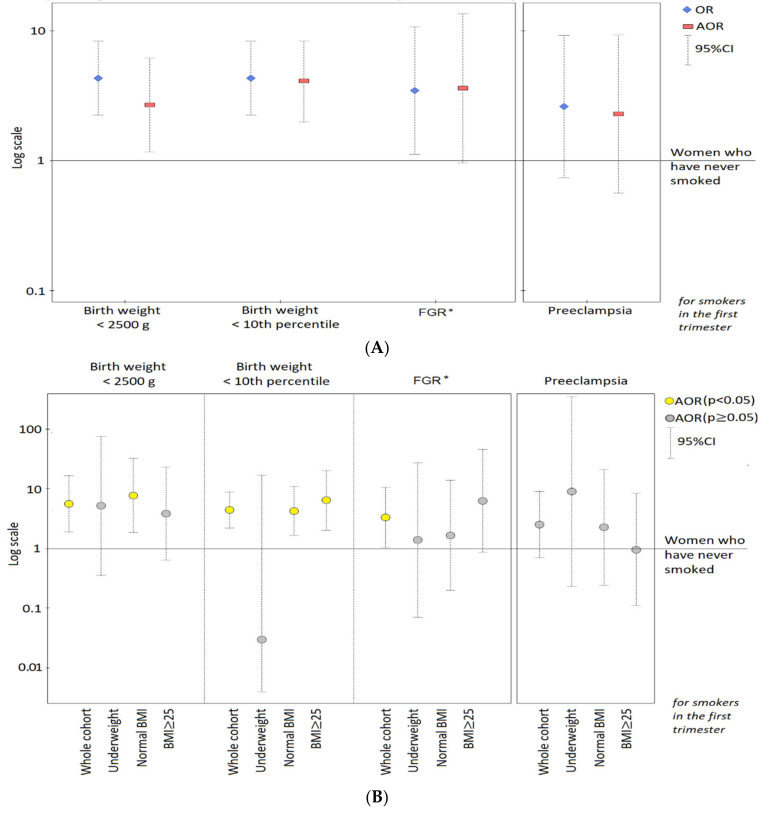
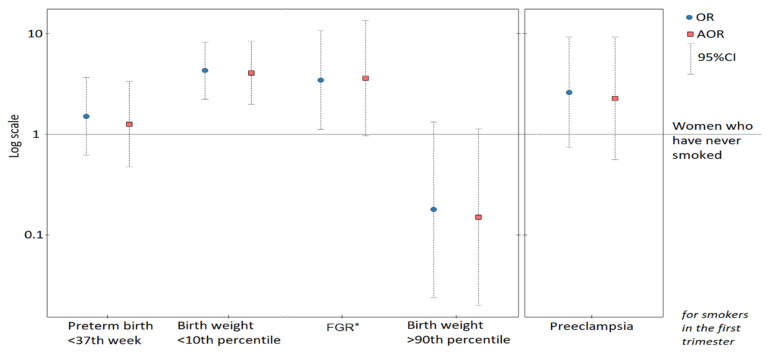
Many studies have shown that neonates of smoking mothers have a lower birth weight, but several issues remain poorly studied, e.g., the effects of giving up smoking or the combined effects of smoking and maternal obesity. Therefore, we evaluated a prospective cohort of 912 mothers in a single pregnancy, recruited in Poland, in 2015-2016. In the cohort, we recorded 72 (7.9%) newborns with birth weight <10th percentile, 21 (2.3%) fetal growth restriction (FGR) cases, and 60 (6.6%) low birth weight (LBW, <2500 g) newborns. In the cohort, 168 (18.4%) women smoked before pregnancy; the mean number of cigarettes/day was 10.8 (1-30), and the mean number of years of cigarette smoking was 8.5 (1-25). Among smokers, 57 (6.3%) women smoked in the first trimester. Adjusted odds ratio (AOR) of newborn outcomes (with 95% confidence intervals, CI) was calculated in multi-dimensional logistic regressions. Compared to participants who had never smoked, smoking before pregnancy was associated with a higher odds ratio of birth weight <10th percentile (AOR = 1.93, CI: 1.08-3.44, = 0.027), but the result for LBW (AOR = 2.76, CI: 1.05-7.26, = 0.039) and FGR (AOR = 1.13, CI: 0.38-3.36, = 0.822) had the wider confidence interval or was insignificant. Effects of smoking cessation before pregnancy were statistically insignificant for the studied outcomes. Smoking in the first trimester was associated with a higher risk of birth weight <10th percentile (AOR = 4.68, CI: 2.28-9.62, < 0.001), LBW (AOR = 6.42, CI: 1.84-22.36, = 0.004), and FGR (AOR = 3.60, CI: 0.96-13.49, = 0.057). Smoking cessation in the second/third trimester was associated with a higher odds ratio of birth weight <10th percentile (AOR = 4.54, CI: 1.58-13.02, = 0.005), FGR (AOR = 3.36, CI: 0.6-18.74, = 0.167), and LBW (AOR = 2.14, CI: 0.62-7.36), = 0.229), to a similar degree to smoking in the first trimester. The odds ratios were higher in the subgroup of pre-pregnancy body mass index ≥25 kg/m for the risk of birth weight <10th percentile (AOR = 6.39, CI: 2.01-20.34, = 0.002) and FGR (AOR = 6.25, CI: 0.86-45.59, = 0.071). The length of cigarette smoking time was also the risk factor for studied outcomes. Conclusions: Smoking in the first trimester increased the studied risks, and the coexistence of excessive maternal weight increased the effects. Smoking cessation during the second/third trimester did not have a protective effect.
许多研究表明,吸烟母亲的新生儿出生体重较低,但仍有几个问题研究较少,例如戒烟的影响或吸烟与母亲肥胖的综合影响。因此,我们评估了2015 - 2016年在波兰招募的912名单胎妊娠母亲的前瞻性队列。在该队列中,我们记录了72名(7.9%)出生体重低于第10百分位数的新生儿、21例(2.3%)胎儿生长受限(FGR)病例和60名(6.6%)低出生体重(LBW,<2500 g)新生儿。在该队列中,168名(18.4%)女性在怀孕前吸烟;平均每日吸烟量为10.8支(1 - 30支),平均吸烟年限为8.5年(1 - 25年)。在吸烟者中,57名(6.3%)女性在孕早期吸烟。在多维度逻辑回归中计算了新生儿结局的调整优势比(AOR)及95%置信区间(CI)。与从未吸烟的参与者相比,怀孕前吸烟与出生体重低于第10百分位数的较高优势比相关(AOR = 1.93,CI:1.08 - 3.44,P = 0.027),但低出生体重(AOR = 2.76,CI:1.05 - 7.26,P = 0.039)和胎儿生长受限(AOR = 1.13,CI:0.38 - 3.36,P = 0.822)的结果置信区间较宽或无统计学意义。怀孕前戒烟对所研究结局的影响无统计学意义。孕早期吸烟与出生体重低于第10百分位数(AOR = 4.68,CI:2.28 - 9.62,P < 0.001)、低出生体重(AOR = 6.42,CI:1.84 - 22.36,P = 0.004)和胎儿生长受限(AOR = 3.60,CI:0.96 - 13.49,P = 0.057)的较高风险相关。孕中/晚期戒烟与出生体重低于第10百分位数(AOR = 4.54,CI:1.58 - 13.02,P = 0.005)、胎儿生长受限(AOR = 3.36,CI:0.6 - 18.74,P = 0.167)和低出生体重(AOR = 2.14,CI:0.62 - 7.36,P = 0.229)的较高优势比相关,与孕早期吸烟程度相似。对于出生体重低于第10百分位数(AOR =
6.39,CI:2.01 - 20.34,P =
0.002)和胎儿生长受限(AOR = 6.25,CI:0.86 - 45.59,P = 0.071)的风险,怀孕前体重指数≥25 kg/m²亚组中的优势比更高。吸烟时间长短也是所研究结局的危险因素。结论:孕早期吸烟增加了所研究的风险,母亲超重会加剧这种影响。孕中/晚期戒烟没有保护作用。