Instituto Nacional de Ciencias Médicas y Nutrición Salvador Zubirán, Mexico City 14000, Mexico; Instituto Nacional de Cancerología (INCan), Mexico City, Mexico.
Instituto Nacional de Ciencias Médicas y Nutrición Salvador Zubirán, Mexico City 14000, Mexico.
Heart Lung. 2021 Jan-Feb;50(1):28-32. doi: 10.1016/j.hrtlng.2020.10.013. Epub 2020 Oct 21.
As of June 15, 2020, a cumulative total of 7,823,289 confirmed cases of COVID-19 have been reported across 216 countries and territories worldwide. However, there is little information on the clinical characteristics and outcomes of critically ill patients with severe COVID-19 who were admitted to intensive care units (ICUs) in Latin America. The present study evaluated the clinical characteristics and outcomes of critically ill patients with severe COVID-19 who were admitted to ICUs in Mexico.
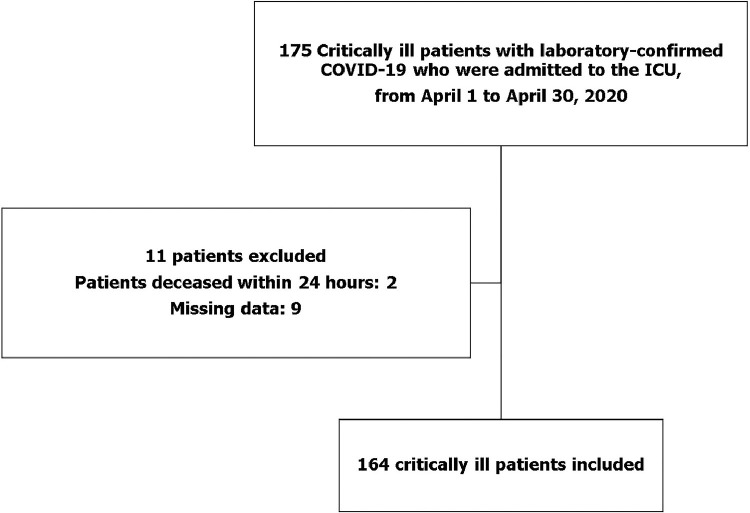
This was a multicenter observational study that included 164 critically ill patients with laboratory-confirmed COVID-19 who were admitted to 10 ICUs in Mexico, from April 1 to April 30, 2020. Demographic data, comorbid conditions, clinical presentation, treatment, and outcomes were collected and analyzed. The date of final follow-up was June 4, 2020.
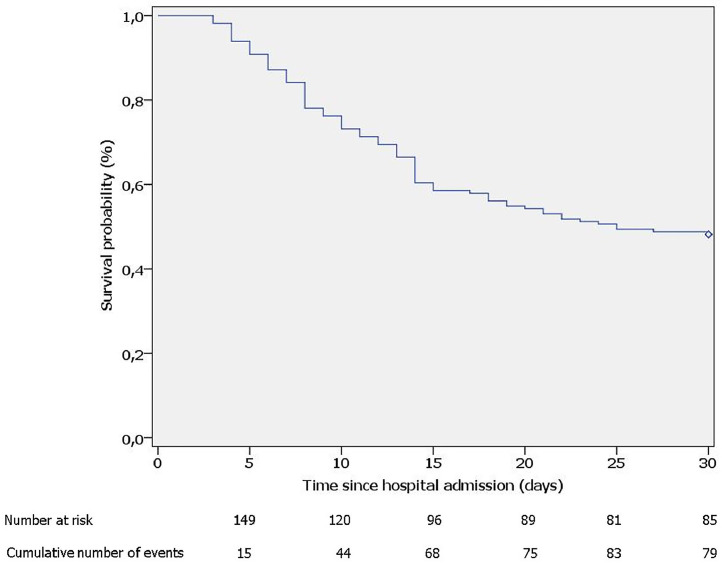
A total of 164 patients with severe COVID-19 were included in this study. The mean age of patients was 57.3 years (SD 13.7), 114 (69.5%) were men, and 6.0% were healthcare workers. Comorbid conditions were common in patients with critical COVID-19: 38.4% of patients had hypertension and 32.3% had diabetes. Compared to survivors, nonsurvivors were older and more likely to have diabetes, hypertension or other conditions. Patients presented to the hospital a median of 7 days (IQR 4.5-9) after symptom onset. The most common presenting symptoms were shortness of breath, fever, dry cough, and myalgias. One hundred percent of patients received invasive mechanical ventilation for a median time of 11 days (IQR 6-14). A total of 139 of 164 patients (89.4%) received vasopressors, and 24 patients (14.6%) received renal replacement therapy during hospitalization. Eighty-five (51.8%) patients died at or before 30 days, with a median survival of 25 days. Age (OR, 1.05; 95% CI, 1.02-1.08; p<0.001) and C-reactive protein levels upon ICU admission (1.008; 95% CI, 1.003-1.012; p<0.001) were associated with a higher risk of in-hospital death. ICU length of stay was associated with reduced in-hospital mortality risk (OR, 0.89; 95% CI, 0.84-0.94; p<0.001).
This observational study of critically ill patients with laboratory-confirmed COVID-19 who were admitted to the ICU in Mexico demonstrated that age and C-reactive protein level upon ICU admission were associated with in-hospital mortality, and the overall hospital mortality rate was high.
ClinicalTrials.gov, NCT04336345.
截至 2020 年 6 月 15 日,全球 216 个国家和地区累计报告了 7823289 例新冠肺炎确诊病例。然而,关于在拉丁美洲的重症监护病房(ICU)中收治的重症 COVID-19 患者的临床特征和结局的信息很少。本研究评估了在墨西哥 ICU 收治的重症 COVID-19 患者的临床特征和结局。
这是一项多中心观察性研究,纳入了 2020 年 4 月 1 日至 4 月 30 日在墨西哥 10 家 ICU 住院的 164 例经实验室确诊的 COVID-19 重症患者。收集并分析了人口统计学数据、合并症、临床表现、治疗和结局。最终随访日期为 2020 年 6 月 4 日。
本研究共纳入 164 例重症 COVID-19 患者。患者平均年龄为 57.3 岁(标准差 13.7),114 例(69.5%)为男性,6.0%为医护人员。患有严重 COVID-19 的患者常见合并症:38.4%的患者有高血压,32.3%的患者有糖尿病。与幸存者相比,非幸存者年龄更大,更有可能患有糖尿病、高血压或其他疾病。患者自症状出现后中位数 7 天(四分位距 4.5-9)到达医院。最常见的首发症状是呼吸急促、发热、干咳和肌痛。100%的患者接受了中位数为 11 天(四分位距 6-14)的有创机械通气。164 例患者中有 139 例(89.4%)接受了血管加压素,24 例(14.6%)在住院期间接受了肾脏替代治疗。85 例(51.8%)患者在 30 天内死亡,中位生存时间为 25 天。年龄(比值比,1.05;95%置信区间,1.02-1.08;p<0.001)和入住 ICU 时的 C 反应蛋白水平(1.008;95%置信区间,1.003-1.012;p<0.001)与住院死亡风险较高相关。入住 ICU 的时间与降低住院死亡率相关(比值比,0.89;95%置信区间,0.84-0.94;p<0.001)。
本研究对在墨西哥 ICU 住院的经实验室确诊的 COVID-19 重症患者进行了观察性研究,结果表明年龄和入住 ICU 时的 C 反应蛋白水平与住院死亡率相关,总体住院死亡率较高。
ClinicalTrials.gov,NCT04336345。