Department of Psychology, Kroc Institute for International Peace Studies, Notre Dame, IN, USA.
Trauma Violence Abuse. 2022 Apr;23(2):660-675. doi: 10.1177/1524838020967329. Epub 2020 Nov 4.
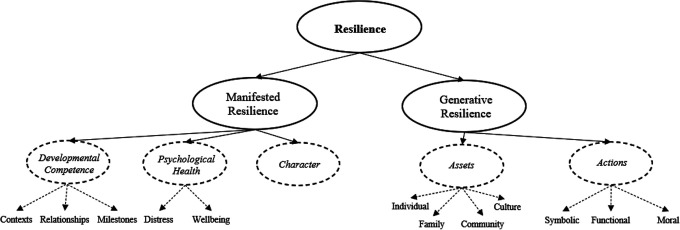
Theoretical work in resilience has continuously evolved to inform and respond to advances in empirical work. In order to further scientific inquiry, it must continue to do so. This narrative overview of the field of resilience science focuses on contemporary challenges confronted by theoretical models of individual resilience and proposes a taxonomic structure for resilience-the multidimensional taxonomy of individual resilience (MTIR). The goal of the MTIR is to articulate a systematic framework within which extant theoretical and empirical work can be nested. Consistent with existing work, the MTIR organizes resilience into two primary branches-manifested resilience and generative resilience. These two components are then organized into subdomains that demonstrate evidence of conceptual distinctiveness. The specification of the subdomains in the MTIR draws support from a diverse body of work on resilience across disciplines and in multiple global contexts. The MTIR makes several critical advances, including expanding and refining the definitions and components of resilience in psychology, providing a clearer framework for conceptualizing mixed profiles of resilience, and tempering assumptions regarding the relational dependencies across domains of resilience. Finally, the utility of the MTIR in organizing research in resilience and advancing theory-testing and development is discussed.
韧性理论工作不断发展,为实证工作的进展提供信息并做出回应。为了进一步推动科学研究,它必须继续这样做。本综述聚焦于个体韧性理论模型所面临的当代挑战,并提出了一个韧性的分类结构——个体韧性的多维分类法(MTIR)。MTIR 的目标是阐明一个系统框架,使现有理论和实证工作能够嵌套其中。与现有工作一致,MTIR 将韧性分为两个主要分支——表现韧性和生成韧性。然后,这两个组成部分被组织成具有概念独特性证据的子领域。MTIR 对子领域的规范来自于不同学科和多个全球背景下关于韧性的大量工作。MTIR 取得了几项重大进展,包括扩展和细化心理学中韧性的定义和组成部分,为概念化韧性的混合特征提供了更清晰的框架,并调整了对韧性各领域之间关系依赖的假设。最后,讨论了 MTIR 在组织韧性研究、推进理论检验和发展方面的效用。