Barcelona Institute for Global Health (ISGlobal), Hospital Clínic, University of Barcelona, Barcelona, Spain.
Unidad Móvil de Reducción del Daño SMASD, Madrid, Spain.
Harm Reduct J. 2020 Nov 4;17(1):87. doi: 10.1186/s12954-020-00432-w.
Containment policies and other restrictions introduced by the Spanish government in response to the COVID-19 pandemic present challenges for marginalised populations, such as people who use drugs. Harm reduction centres are often linked to social services, mental health services, and infectious disease testing, in addition to tools and services that help to reduce the harms associated with injecting drugs. This study aimed to explore the impact of the pandemic on these services in four autonomous communities in Spain.
This is a cross-sectional study that employed a seven-section structured survey administered electronically to 20 centres in July 2020. Data from the most heavily affected months (March-June) in 2020 were compared to data from the same period in 2019. Averages were calculated with their ranges, rates, and absolute numbers.
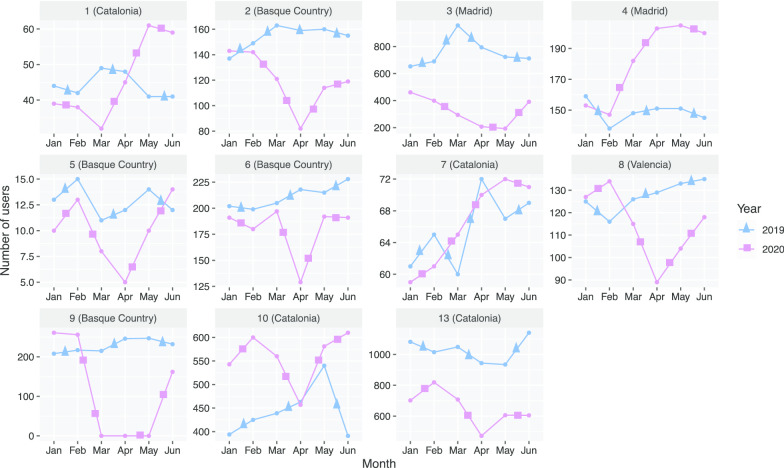
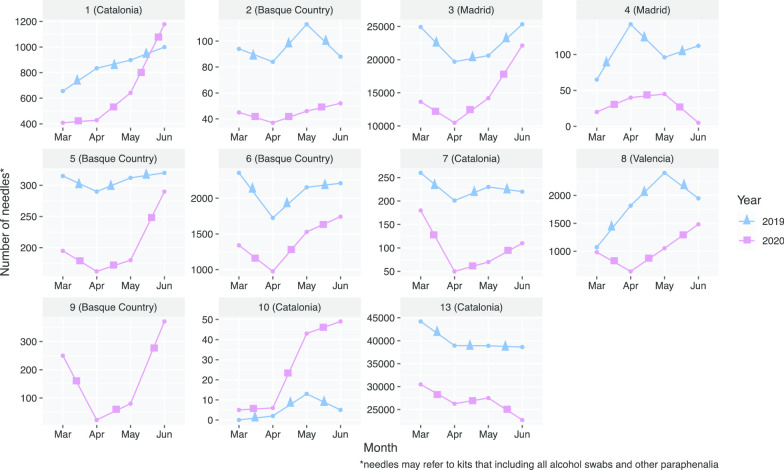
All 11 responding centres reported having had to adapt or modify their services during the Spanish state of alarm (14 March-21 June 2020). One centre reported complete closure for 2 months and four reported increases in their operating hours. The average number of service users across all centres decreased by 22% in comparison to the same period in the previous year and the average needle distribution decreased by 40% in comparison to 2019. Most centres reported a decrease in infectious disease testing rates (hepatitis B and C viruses, human immunodeficiency virus, and tuberculosis) for March, April, and May in 2020 compared to the previous year. Reported deaths as a result of overdose did not increase during the state of alarm, but 2/11 (18%) centres reported an increase in overdose deaths immediately after finalisation of the state of alarm.
Overall, Spanish harm reduction centres were able to continue operating and offering services by adjusting operating hours. The number of overall service users and needles distributed fell during the Spanish state of alarm lockdown period, suggesting that fewer clients accessed harm reduction services during this time, putting them at greater risk of reusing or sharing injecting equipment, overdosing, acquiring infectious diseases with decreased access to testing or discontinuing ongoing treatment such as methadone maintenance therapy, hepatitis C treatment, or antiretroviral therapy.
西班牙政府为应对 COVID-19 大流行而实施的遏制政策和其他限制措施,给边缘化人群带来了挑战,例如吸毒者。减少伤害中心通常与社会服务、心理健康服务和传染病检测相关联,此外还提供有助于减少与注射毒品相关危害的工具和服务。本研究旨在探讨大流行对西班牙四个自治区的这些服务的影响。
这是一项横断面研究,于 2020 年 7 月采用七部分结构问卷调查了 20 个中心。将 2020 年 3 月至 6 月受影响最严重的月份(三月至六月)的数据与 2019 年同期的数据进行了比较。用平均值及其范围、比率和绝对值来计算数据。
所有 11 个回复中心都报告说,在西班牙国家警报(2020 年 3 月 14 日至 6 月 21 日)期间,他们不得不调整或修改服务。一个中心报告说,该中心已经关闭了 2 个月,有 4 个中心报告说,其运营时间增加了。与前一年同期相比,所有中心的服务使用者平均数量减少了 22%,而平均针具分发量减少了 40%。大多数中心报告说,与前一年相比,2020 年 3 月、4 月和 5 月传染病检测率(乙型肝炎和丙型肝炎病毒、人类免疫缺陷病毒和结核病)有所下降。在国家警报期间,没有报告因过量用药而死亡的人数增加,但有 2/11(18%)中心报告说,在国家警报结束后,过量用药死亡人数增加。
总的来说,西班牙减少伤害中心能够通过调整运营时间继续运营并提供服务。在西班牙国家警报封锁期间,总的服务使用者和分发的针具数量下降,这表明在此期间,较少的客户获得了减少伤害服务,使他们面临更大的风险,例如重新使用或共享注射设备、过量用药、由于检测机会减少而感染传染病,或停止正在进行的治疗,如美沙酮维持治疗、丙型肝炎治疗或抗逆转录病毒治疗。