Department of Health Sciences, University of Leicester, Leicester, UK.
Department of Medical Epidemiology and Biostatistics, Karolinska Institutet, Stockholm, Sweden.
Br J Cancer. 2021 Feb;124(3):671-677. doi: 10.1038/s41416-020-01144-5. Epub 2020 Nov 4.
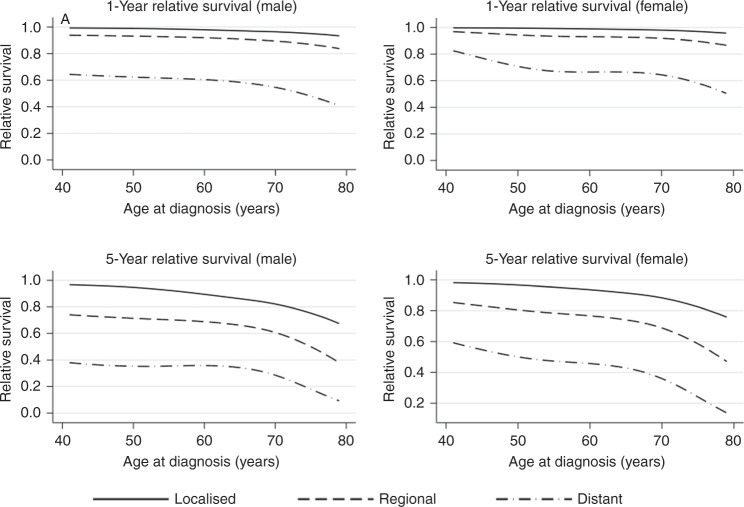
This paper investigates the difference in survival of melanoma patients across stage and sex by utilising net survival measures. Metrics are presented at both the individual and population level.
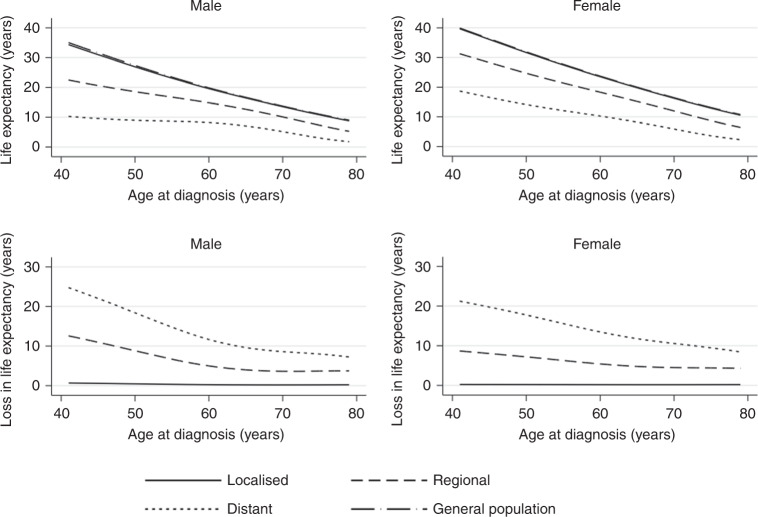
Flexible parametric models were fitted to estimate life-expectancy metrics to be applied to a group of 104,938 subjects with a melanoma skin cancer diagnosis from 2000 to 2017. Period analysis was used for better predictions for newly diagnosed patients, and missing-stage information was imputed for 9918 patients. Female relative survival was assigned to male subjects to demonstrate the survival discrepancies experienced between sexes.
At the age of 60, males diagnosed at the regional stage lose an average of 4.99 years of life compared to the general population, and females lose 4.79 years, demonstrating the sex variation in expected mortality. In 2017, males contributed 3545 more life years lost than females, and a potential 1931 life years could be preserved if sex differences in survival were eliminated.
This study demonstrates the survival differences across population subgroups as a result of a melanoma cancer diagnosis. Females experience better prognosis across age and stage at diagnosis; however, further investigation is necessary to better understand the mechanisms behind this difference.
本研究利用净生存测量方法,考察了不同性别和分期的黑色素瘤患者的生存差异。在个体和人群水平上都呈现了相关指标。
采用灵活的参数模型来估计预期寿命指标,应用于 2000 年至 2017 年间诊断为黑色素瘤皮肤癌的 104938 名患者群体。使用时期分析来更好地预测新诊断的患者,并对 9918 名患者缺失的分期信息进行了推断。为了展示性别之间的生存差异,将女性的相对生存率分配给男性患者。
在 60 岁时,被诊断为区域性的男性患者平均比普通人群少活 4.99 年,女性则少活 4.79 年,表明了预期死亡率的性别差异。2017 年,男性比女性多失去了 3545 个生命年,而如果消除了生存方面的性别差异,可能会多保留 1931 个生命年。
本研究表明,由于黑色素瘤的诊断,人群亚组之间存在生存差异。女性在诊断时的年龄和分期上都有更好的预后;然而,需要进一步的研究来更好地理解这种差异背后的机制。