Ameyaroy Divyasree Kochilat, Ramabhadran Biniraj Kannanganatt, Emmatty Rishi, Paul Tony Pallipurathukaran, Jose Priya
Department of Clinical Periodontology and Oral Implantology, Royal Dental College, Palakkad, Kerala, India.
J Indian Soc Periodontol. 2020 Sep-Oct;24(5):447-453. doi: 10.4103/jisp.jisp_381_19. Epub 2020 Jun 2.
A split-mouth longitudinal study was conducted to compare and evaluate the effect of ozonated water and photodynamic therapy (PDT) in nonsurgical management of chronic periodontitis, along with mechanical debridement procedure.
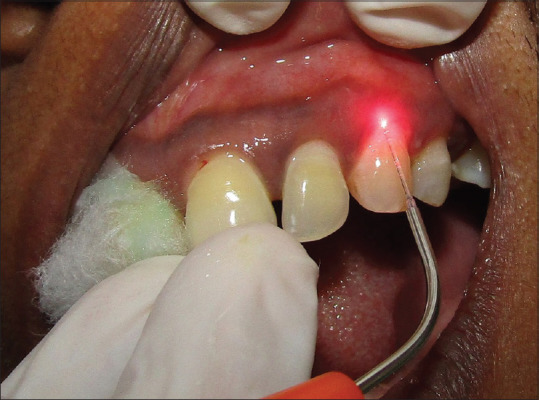
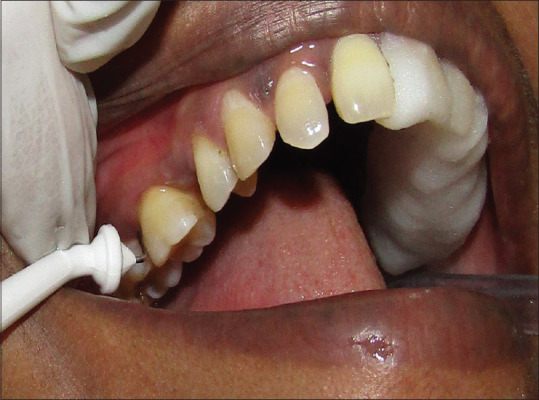
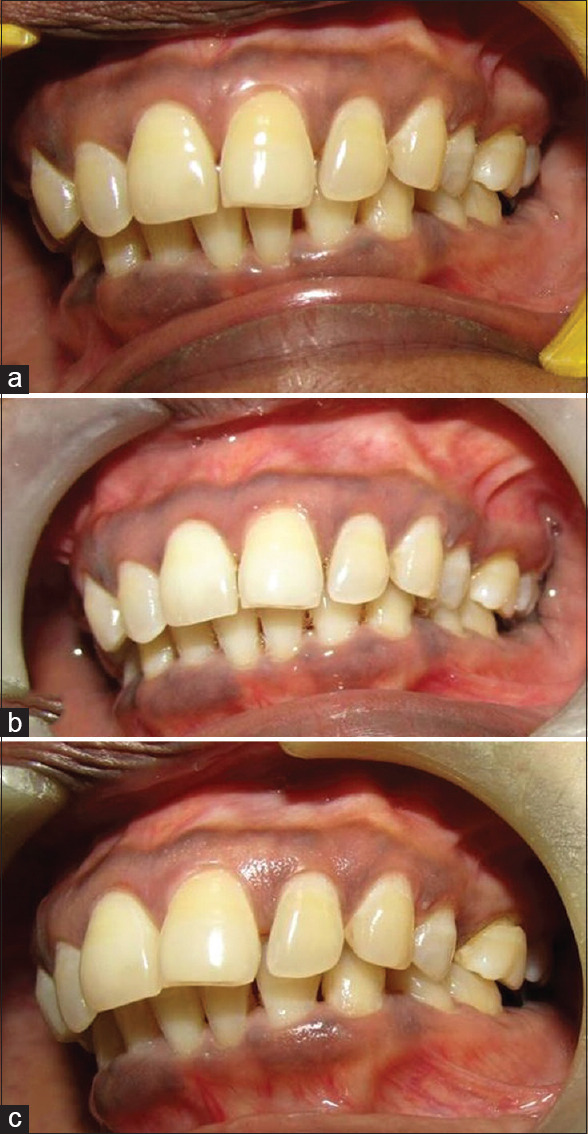
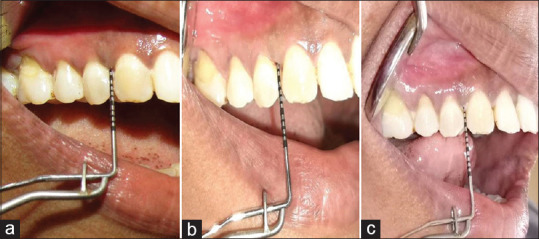
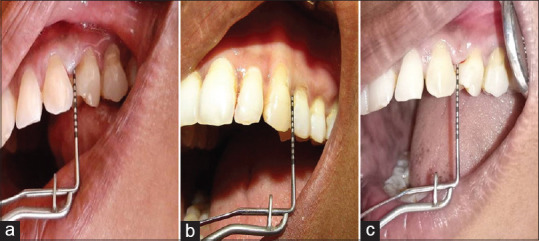
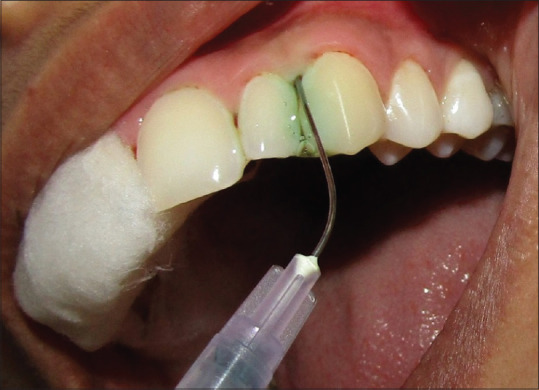
Twenty-two patients diagnosed with chronic generalized periodontitis were subjected to the study. Following the assessment of gingival index, periodontal pocket depth, and clinical attachment loss, all patients underwent full-mouth scaling and root planing. Upper right and left quadrants of each patient were considered as sample sites in the study. Among these split-mouth sites, upper right quadrant of each patient was subjected to ozonated water irrigation with a 22-gauge needle and left upper quadrant was treated with PDT, which involved sulcus irrigation with indocyanine green dye (0.05 mg/ml) followed by low-level diode laser light application at 0.5 W and 810 nm (AMD Picasso) through a fiber-optic tip of 10 mm length, default angle of 60°, and fiber core diameter of 400 μm in noncontact continuous wave mode. Patients were recalled at the 2 and 4 months regularly, and the therapy was repeated at the same sites in the same manner. Clinical parameters recorded before the study were assessed again at the end of the 2- and 6-month period.
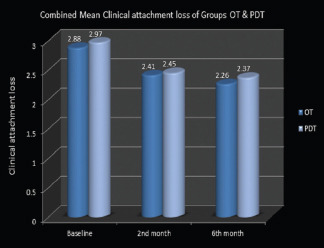
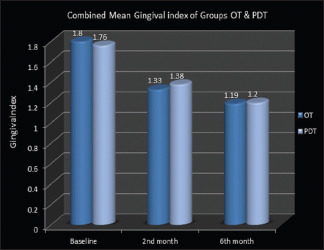
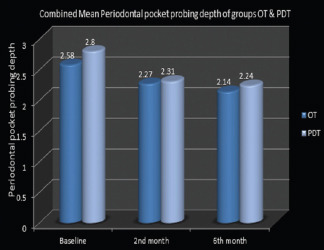
A statistically significant reduction ( < 0.05) was observed in gingival index scores within both the study groups at all intervals of the study. In Ozone therapy (OT) group, a statistically significant difference was noted for total periodontal pocket depth values between baseline and 2 month ( = 0.000), baseline and 6 month ( = 0.000), and between 2 month and 6 month ( = 0.029). In the PDT group, on contrary, a statistically significant difference was noticed in total periodontal pocket probing depth values between baseline and 2 month ( = 0.000) and baseline to 6 month ( = 0.000), but a similar significant difference was not noticed between 2-month and 6-month periods ( = 0.269). In group OT, a statistically significant difference was noted for total clinical attachment loss between baseline and 2 month ( = 0.000), baseline and 6 months ( = 0.000), and 2 month and 6 month ( = 0.019). In group PDT, a statistically significant difference in terms of its improvement was noted at intervals between baseline and 2 months ( = 0.000) and from baseline to 6 months ( = 0.000) but not between 2 month and 6 month ( = 0.129).
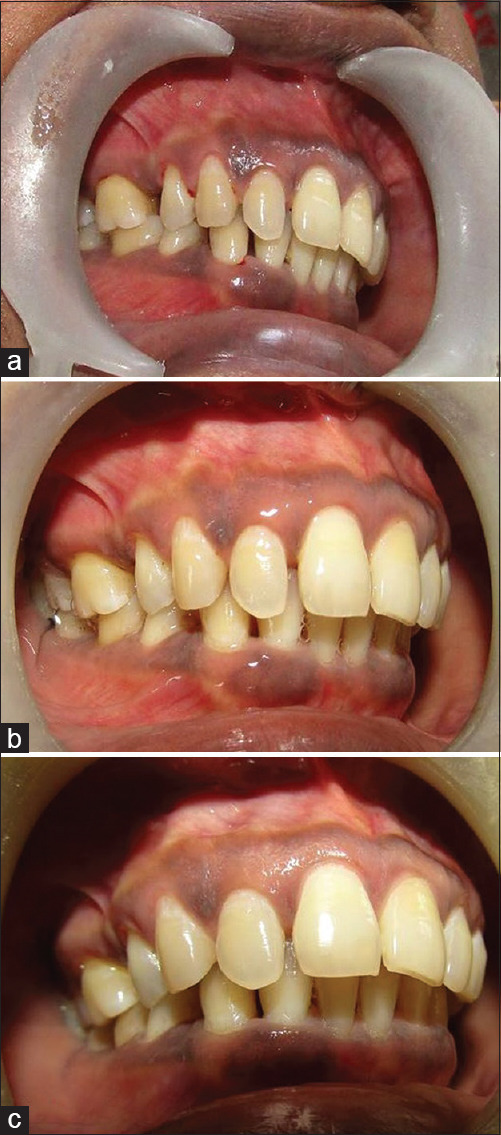
Results of the study showed that sub-gingival OT and PDT equally improved the clinical outcomes of treatment drastically following mechanical debridement at the end of first 2 months. Thereafter, it was shown to improve steadily throughout the study period, with slightly better results with OT compared with PDT.
进行了一项半口纵向研究,以比较和评估臭氧水和光动力疗法(PDT)在慢性牙周炎非手术治疗中的效果,并结合机械清创术。
22例被诊断为慢性广泛性牙周炎的患者纳入本研究。在评估牙龈指数、牙周袋深度和临床附着丧失后,所有患者均接受全口洁治和根面平整。每位患者的右上和左上象限被视为研究中的样本部位。在这些半口部位中,每位患者的右上象限用22号针头进行臭氧水冲洗,左上象限接受PDT治疗,包括用吲哚菁绿染料(0.05mg/ml)进行龈沟冲洗,然后通过长度为10mm、默认角度为60°、光纤芯直径为400μm的光纤尖端,以0.5W和810nm(AMD Picasso)的低水平二极管激光在非接触连续波模式下照射。患者在第2个月和第4个月定期复诊,并在相同部位以相同方式重复治疗。在研究结束时,再次评估研究前记录的临床参数。
在研究的所有时间间隔内,两个研究组的牙龈指数评分均有统计学意义的降低(<0.05)。在臭氧治疗(OT)组中,基线与2个月(=0.000)、基线与6个月(=0.000)以及2个月与6个月之间(=0.029)的总牙周袋深度值存在统计学意义的差异。相反,在PDT组中,基线与2个月(=0.000)以及基线至6个月(=0.000)之间的总牙周袋探诊深度值存在统计学意义的差异,但在2个月和6个月之间未观察到类似的显著差异(=0.269)。在OT组中,基线与2个月(=0.000)、基线与6个月(=0.000)以及2个月与6个月之间(=0.019)的总临床附着丧失存在统计学意义的差异。在PDT组中,在基线与2个月之间(=0.000)以及从基线到6个月之间(=0.000)的改善方面存在统计学意义的差异,但在2个月和6个月之间未观察到(=0.129)。
研究结果表明,龈下OT和PDT在最初2个月结束时机械清创后均能显著改善治疗的临床效果。此后,在整个研究期间均显示出稳步改善,OT的效果略优于PDT。