Department of Dermatology, University of Massachussetts Medical School, Worcester, MA, 01605, USA.
F1000Res. 2020 Oct 5;9:1197. doi: 10.12688/f1000research.26728.1. eCollection 2020.
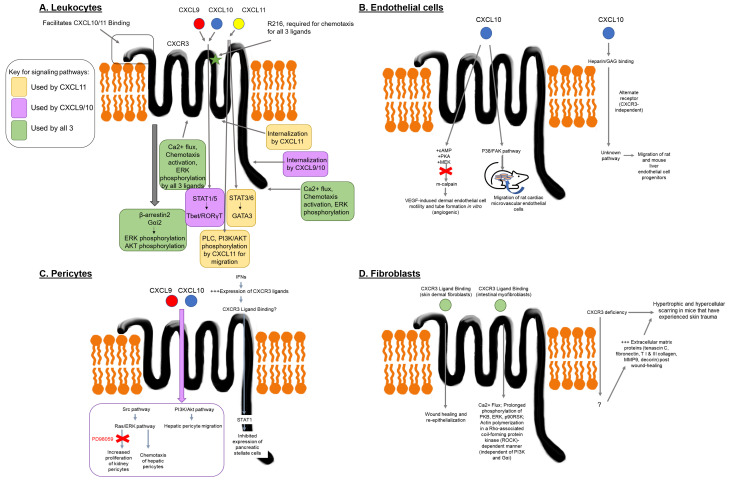
Chemokines play important roles in homeostasis and inflammatory processes. While their roles in leukocyte recruitment are well-appreciated, chemokines play additional roles in the body, including mediating or regulating angiogenesis, tumor metastasis and wound healing. In this opinion article, we focus on the role of CXCR3 and its ligands in fibrotic processes. We emphasize differences of the effects of each ligand, CXCL9, CXCL10 and CXCL11, on fibroblasts in different tissues of the body. We include discussions of differences in signaling pathways that may account for protective or pro-fibrotic effects of each ligand in different experimental models and analysis of human tissues. Our goal is to highlight potential reasons why there are disparate findings in different models, and to suggest ways in which this chemokine axis could be manipulated for the treatment of fibrosis.
趋化因子在维持体内平衡和炎症过程中发挥着重要作用。虽然它们在白细胞募集中的作用已得到充分认识,但趋化因子在体内还发挥着其他作用,包括介导或调节血管生成、肿瘤转移和伤口愈合。在这篇观点文章中,我们重点关注 CXCR3 及其配体在纤维化过程中的作用。我们强调了每种配体(CXCL9、CXCL10 和 CXCL11)对体内不同组织的成纤维细胞的影响的差异。我们还讨论了可能导致每种配体在不同实验模型中产生保护或促纤维化作用的信号通路的差异,并对人类组织进行了分析。我们的目标是强调为什么在不同模型中会出现不一致的发现的潜在原因,并提出操纵该趋化因子轴以治疗纤维化的方法。