Laboratório da Visão, Instituto de Psicologia, Universidade de São Paulo, São Paulo, SP, Brasil.
Divisão de Geriatria, Faculdade de Medicina, Universidade de São Paulo, São Paulo, SP, Brasil.
Braz J Med Biol Res. 2020 Oct 30;53(12):e10347. doi: 10.1590/1414-431X202010347. eCollection 2020.
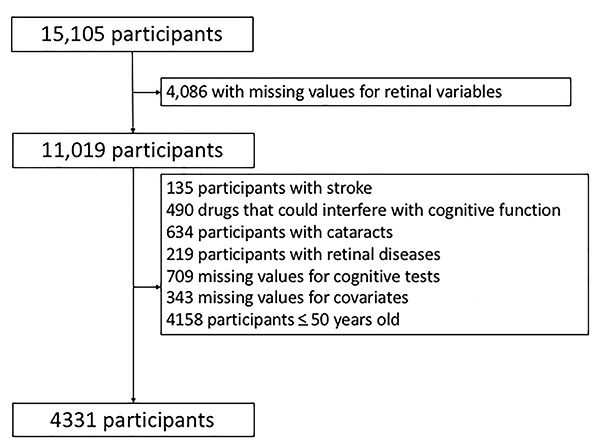
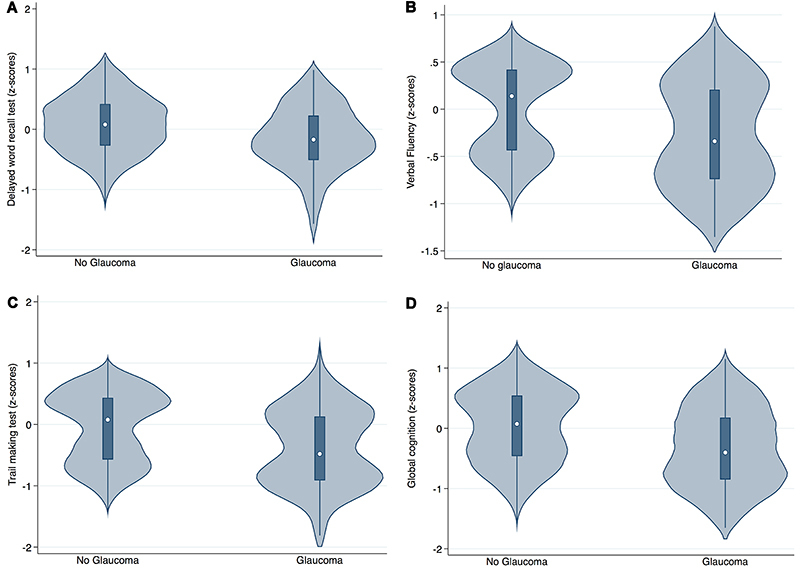
Recent evidence suggests that glaucoma and Alzheimer's disease are neurodegenerative diseases sharing common pathophysiological and etiological features, although findings are inconclusive. We sought to investigate whether self-reported glaucoma patients without dementia present poorer cognitive performance, an issue that has been less investigated. We employed cross-sectional data from the Brazilian Longitudinal Study of Adult Health (ELSA-Brasil) and included participants ≥50 years of age without a known diagnosis of dementia and a self-reported glaucoma diagnosis. We excluded those with previous stroke, other eye conditions, and using drugs that could impair cognition. We evaluated cognition using delayed word recall, phonemic verbal fluency, and trail making (version B) tests. We used multinomial linear regression models to investigate associations between self-reported glaucoma with cognition, adjusted by several sociodemographic and clinical variables. Out of 4,331 participants, 139 reported glaucoma. Fully-adjusted models showed that self-reported glaucoma patients presented poorer performance in the verbal fluency test (β=-0.39, 95%CI=-0.64 to -0.14, P=0.002), but not in the other cognitive assessments. Thus, our results support the hypothesis that self-reported glaucoma is associated with poor cognitive performance; however, longitudinal data are necessary to corroborate our findings.
最近的证据表明,青光眼和阿尔茨海默病是具有共同病理生理和病因特征的神经退行性疾病,尽管研究结果尚无定论。我们试图研究是否没有痴呆症的自我报告青光眼患者表现出较差的认知表现,这是一个研究较少的问题。我们采用了巴西成人健康纵向研究(ELSA-Brasil)的横断面数据,并纳入了≥50 岁、没有已知痴呆症诊断和自我报告青光眼诊断的参与者。我们排除了有既往卒中、其他眼部疾病和使用可能损害认知功能的药物的患者。我们使用延迟单词回忆、语音流畅性和追踪测试(B 版)评估认知功能。我们使用多项线性回归模型,在调整了几个社会人口统计学和临床变量后,研究自我报告的青光眼与认知之间的关联。在 4331 名参与者中,有 139 人报告患有青光眼。完全调整后的模型显示,自我报告的青光眼患者在语音流畅性测试中的表现较差(β=-0.39,95%CI=-0.64 至 -0.14,P=0.002),但在其他认知评估中没有。因此,我们的结果支持自我报告的青光眼与认知表现较差相关的假设;然而,需要进行纵向研究来证实我们的发现。