US Department of Energy Joint Genome Institute, Berkeley, California, United States of America.
Environmental Genomics and Systems Biology Division, Lawrence Berkeley National Laboratory, Berkeley, California, United States of America.
PLoS One. 2020 Nov 4;15(11):e0241867. doi: 10.1371/journal.pone.0241867. eCollection 2020.
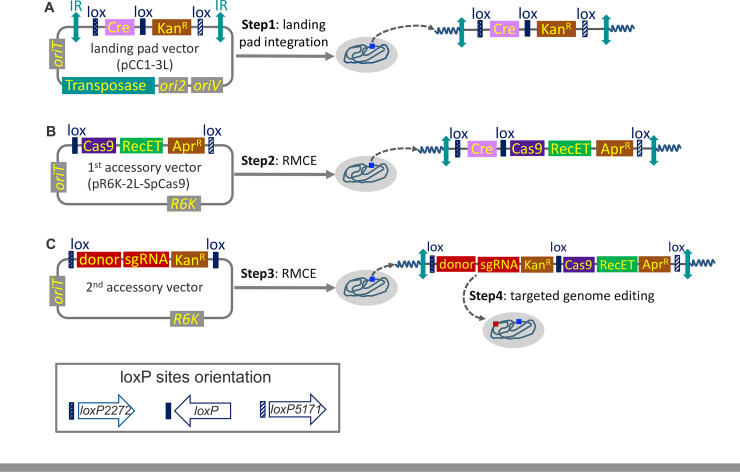
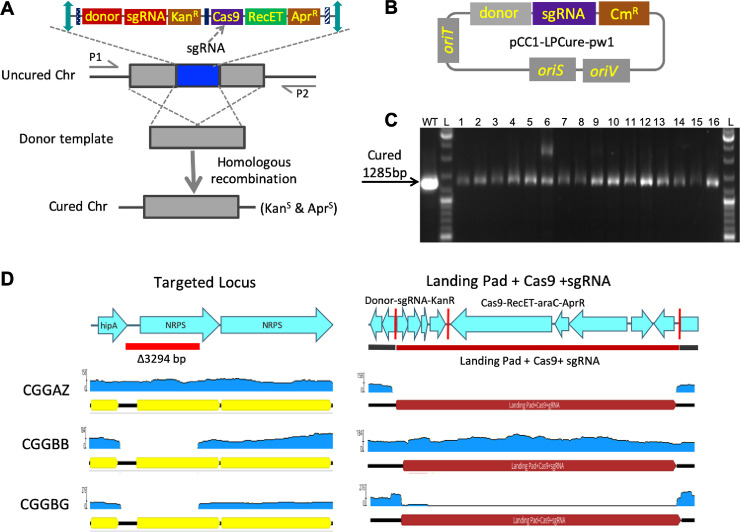
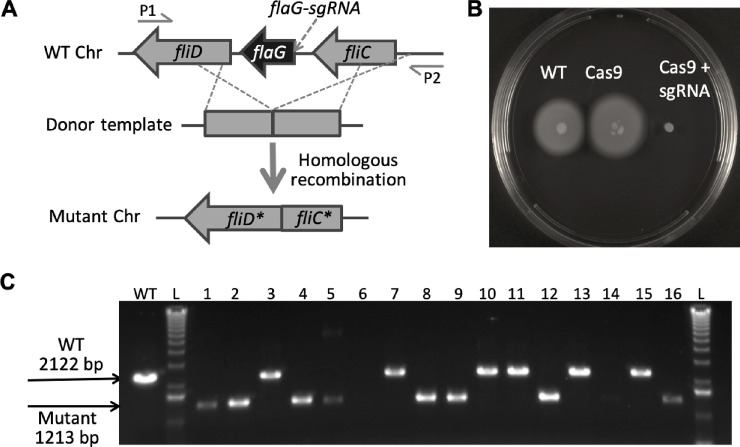
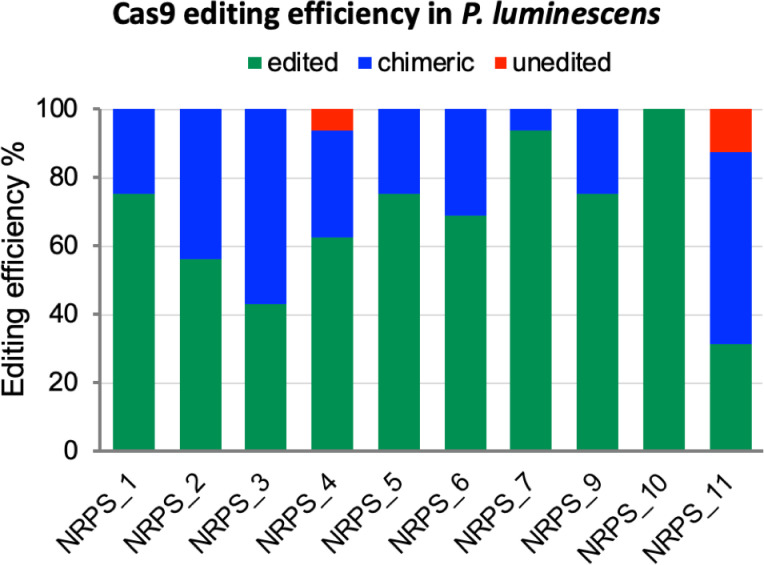
The past decade has been a golden age for microbiology, marked by the discovery of an unprecedented increase in the number of novel bacterial species. Yet gaining biological knowledge of those organisms has not kept pace with sequencing efforts. To unlock this genetic potential there is an urgent need for generic (i.e. non-species specific) genetic toolboxes. Recently, we developed a method, termed chassis-independent recombinase-assisted genome engineering (CRAGE), enabling the integration and expression of large complex gene clusters directly into the chromosomes of diverse bacteria. Here we expand upon this technology by incorporating CRISPR-Cas9 allowing precise genome editing across multiple bacterial species. To do that we have developed a landing pad that carries one wild-type and two mutant lox sites to allow integration of foreign DNA at two locations through Cre-lox recombinase-mediated cassette exchange (RMCE). The first RMCE event is to integrate the Cas9 and the DNA repair protein genes RecET, and the second RMCE event enables the integration of customized sgRNA and a repair template. Following this workflow, we achieved precise genome editing in four different gammaproteobacterial species. We also show that the inserted landing pad and the entire editing machinery can be removed scarlessly after editing. We report here the construction of a single landing pad transposon and demonstrate its functionality across multiple species. The modular design of the landing pad and accessory vectors allows design and assembly of genome editing platforms for other organisms in a similar way. We believe this approach will greatly expand the list of bacteria amenable to genetic manipulation and provides the means to advance our understanding of the microbial world.
过去的十年是微生物学的黄金时代,标志着新发现的细菌物种数量空前增加。然而,获得这些生物体的生物学知识并没有跟上测序工作的步伐。为了挖掘这种遗传潜力,迫切需要通用(即非物种特异性)遗传工具包。最近,我们开发了一种方法,称为底盘独立重组酶辅助基因组工程(CRAGE),能够直接将大型复杂基因簇整合并表达到多种细菌的染色体中。在这里,我们通过整合 CRISPR-Cas9 技术对该技术进行了扩展,从而能够在多个细菌物种中进行精确的基因组编辑。为此,我们开发了一个着陆垫,该着陆垫携带一个野生型和两个突变型 lox 位点,允许通过 Cre-lox 重组酶介导的盒式交换(RMCE)在两个位置整合外源 DNA。第一个 RMCE 事件是整合 Cas9 和 DNA 修复蛋白基因 RecET,第二个 RMCE 事件使定制 sgRNA 和修复模板的整合成为可能。按照这个工作流程,我们在四种不同的γ变形菌中实现了精确的基因组编辑。我们还表明,编辑后可以无痕去除插入的着陆垫和整个编辑机制。我们在这里报告了单个着陆垫转座子的构建,并证明了其在多个物种中的功能。着陆垫和辅助载体的模块化设计允许以类似的方式为其他生物体设计和组装基因组编辑平台。我们相信,这种方法将极大地扩展可进行遗传操作的细菌列表,并为我们深入了解微生物世界提供了手段。