CAS Key Laboratory of Pathogenic Microbiology and Immunology, Institute of Microbiology, Chinese Academy of Sciences, Beijing, 100101, China.
University of Chinese Academy of Sciences, Beijing, 100049, China.
Microb Cell Fact. 2018 Apr 23;17(1):63. doi: 10.1186/s12934-018-0910-2.
Extensive modification of genome is an efficient manner to regulate the metabolic network for producing target metabolites or non-native products using Corynebacterium glutamicum as a cell factory. Genome editing approaches by means of homologous recombination and counter-selection markers are laborious and time consuming due to multiple round manipulations and low editing efficiencies. The current two-plasmid-based CRISPR-Cas9 editing methods generate false positives due to the potential instability of Cas9 on the plasmid, and require a high transformation efficiency for co-occurrence of two plasmids transformation.
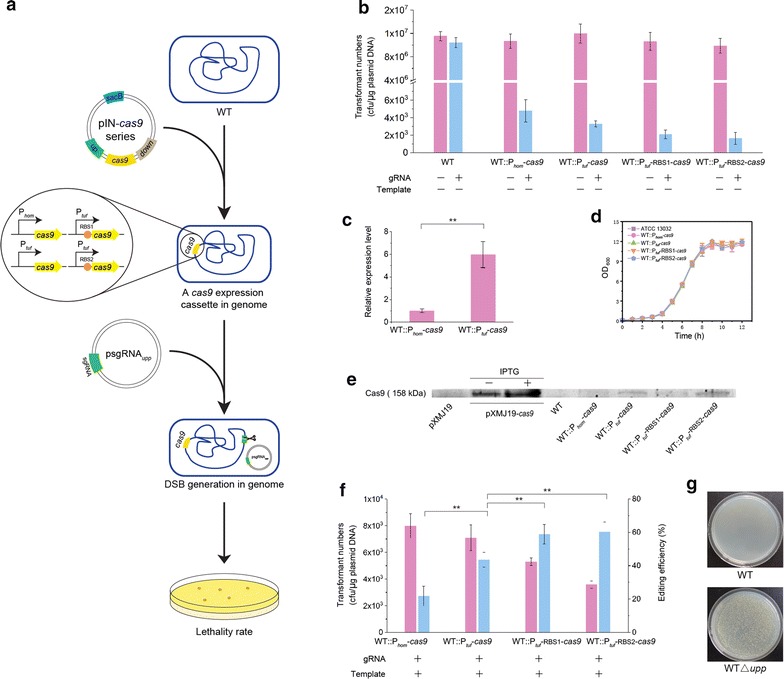
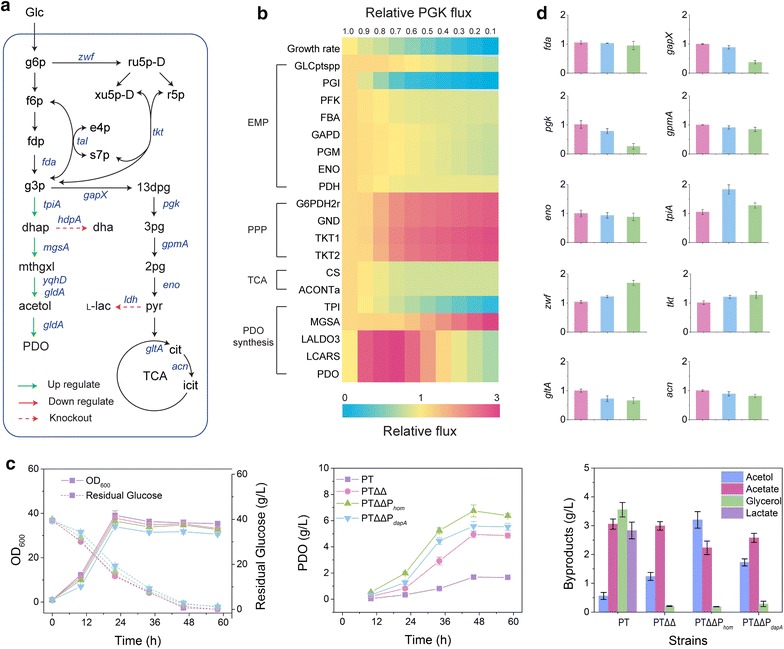
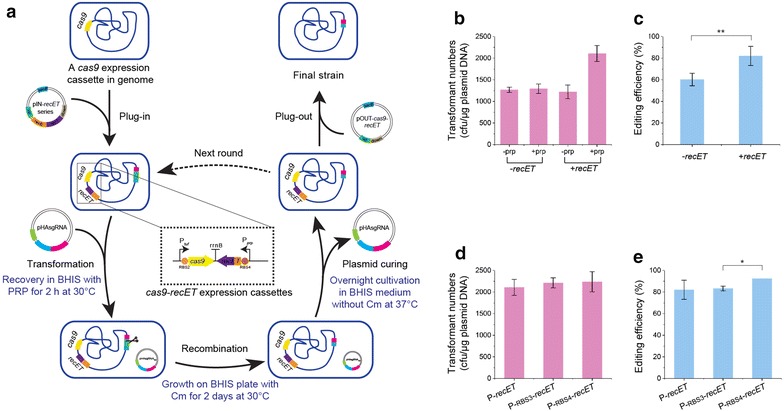
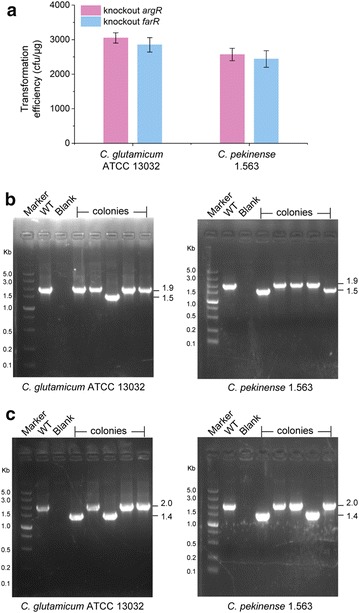
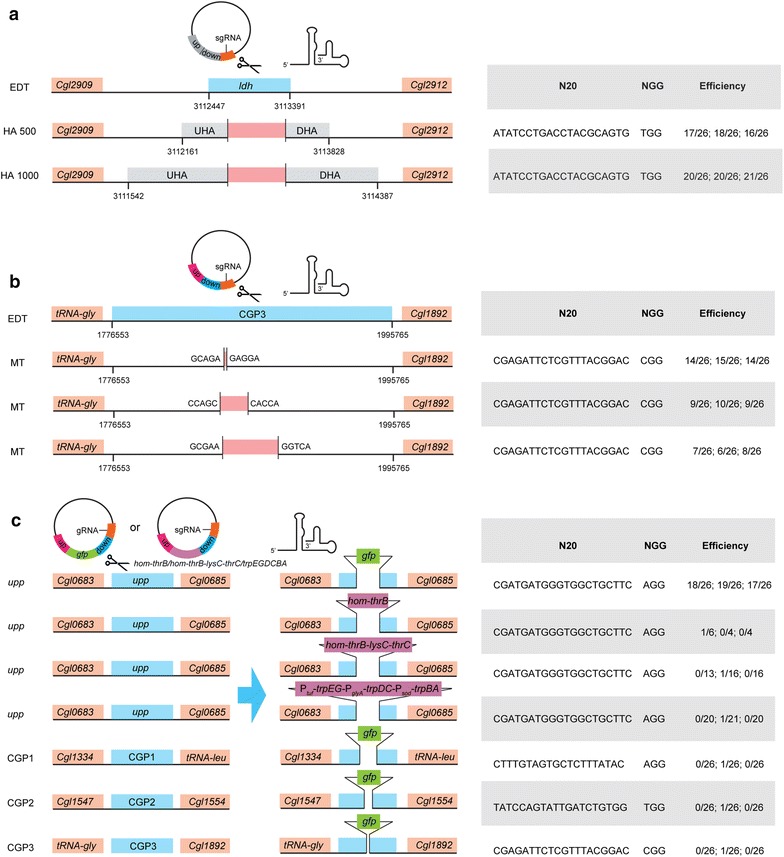
Here, we developed a RecET-assisted CRISPR-Cas9 genome editing method using a chromosome-borne Cas9-RecET and a single plasmid harboring sgRNA and repair templates. The inducible expression of chromosomal RecET promoted the frequencies of homologous recombination, and increased the efficiency for gene deletion. Due to the high transformation efficiency of a single plasmid, this method enabled 10- and 20-kb region deletion, 2.5-, 5.7- and 7.5-kb expression cassette insertion and precise site-specific mutation, suggesting a versatility of this method. Deletion of argR and farR regulators as well as site-directed mutation of argB and pgi genes generated the mutant capable of accumulating L-arginine, indicating the stability of chromosome-borne Cas9 for iterative genome editing. Using this method, the model-predicted target genes were modified to redirect metabolic flux towards 1,2-propanediol biosynthetic pathway. The final engineered strain produced 6.75 ± 0.46 g/L of 1,2-propanediol that is the highest titer reported in C. glutamicum. Furthermore, this method is available for Corynebacterium pekinense 1.563, suggesting its universal applicability in other Corynebacterium species.
The RecET-assisted CRISPR-Cas9 genome editing method will facilitate engineering of metabolic networks for the synthesis of interested bio-based products from renewable biomass using Corynebacterium species as cell factories.
利用谷氨酸棒杆菌作为细胞工厂,通过同源重组和反向选择标记进行基因组编辑是一种有效的调节代谢网络以产生目标代谢物或非天然产物的方法。由于需要多次操作和低编辑效率,基于同源重组和反向选择标记的基因组编辑方法既繁琐又耗时。目前基于双质粒的 CRISPR-Cas9 编辑方法由于 Cas9 在质粒上的潜在不稳定性而产生假阳性,并且需要两个质粒共转化的高转化效率。
在这里,我们开发了一种使用染色体携带的 Cas9-RecET 和一个携带 sgRNA 和修复模板的单质粒的 RecET 辅助的 CRISPR-Cas9 基因组编辑方法。染色体 RecET 的诱导表达促进了同源重组的频率,并提高了基因缺失的效率。由于单质粒的高转化效率,该方法能够实现 10-和 20-kb 区域缺失、2.5-、5.7-和 7.5-kb 表达盒插入和精确的定点突变,表明该方法具有通用性。缺失 argR 和 farR 调节剂以及定点突变 argB 和 pgi 基因产生了能够积累 L-精氨酸的突变体,表明染色体携带的 Cas9 用于迭代基因组编辑的稳定性。使用该方法对模型预测的靶基因进行修饰,以重新定向代谢通量到 1,2-丙二醇生物合成途径。最终工程菌株生产 6.75±0.46 g/L 的 1,2-丙二醇,这是在谷氨酸棒杆菌中报道的最高产量。此外,该方法适用于北京棒杆菌 1.563,表明其在其他棒杆菌属物种中的普遍适用性。
RecET 辅助的 CRISPR-Cas9 基因组编辑方法将有助于工程化代谢网络,以利用可再生生物质作为细胞工厂从可再生生物质中合成感兴趣的生物基产品。